The Federal Government has taken a significant step toward advancing critical infrastructure by inaugurating a high-level technical committee to evaluate and fast-track a proposed integrated gas, power, and high-speed rail project.
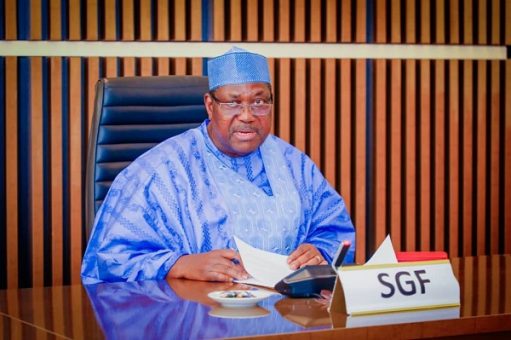
The inauguration ceremony, held at the Office of the Secretary to the Government of the Federation (SGF) in Abuja, was led by SGF George Akume, who underscored the project’s transformative potential for Nigeria’s economy.
Promoted by De-Sadel Nigeria Limited, the ambitious initiative is being hailed as one of the most comprehensive private-sector-led infrastructure projects in Nigeria and the wider West African region. It integrates gas monetisation, power generation, high-speed rail transport, digital systems, and real estate development under a 40-year renewable concession framework.
Speaking at the event, Akume described the project as a key driver of industrialisation, job creation, and energy security. He reaffirmed the Federal Government’s commitment to supporting viable investments that can unlock value across strategic sectors.
“This initiative aligns with our national priorities of economic growth, energy sufficiency, and modern transport systems,” Akume stated, adding that the committee was carefully selected to ensure a thorough and objective review process.
He also tasked the committee with delivering its report within six weeks, stressing the administration’s focus on timely and efficient decision-making.
In a detailed presentation, the President and CEO of De-Sadel Nigeria Limited, Samuel Uko, outlined the project’s funding structure and expected economic impact. He noted that the initiative would generate large-scale employment, improve infrastructure connectivity, and accelerate industrial development.
According to Uko, the project’s integrated design is expected to cut logistics costs, boost power supply to industrial hubs, and open new trade corridors—positioning Nigeria as a stronger regional economic powerhouse.
He added that the project is backed by proof of funds and structured to leverage private capital, ensuring sustainable delivery without placing undue financial strain on government resources.
The technical committee is chaired by a director from the Office of the Permanent Secretary (Political and Economic Affairs) and includes representatives from key government institutions such as the Central Bank of Nigeria, Nigerian National Petroleum Company Limited, Federal Ministry of Transport, Infrastructure and Concession Regulatory Commission, Debt Management Office, Nigerian Electricity Regulatory Commission, and Nigerian Communications Commission.
Other stakeholders represented include the Nigeria Governors’ Forum, Nigerian Financial Intelligence Unit, Office of the Surveyor-General of the Federation, and nominees of the project promoters.
The committee’s findings are expected to shape the next phase of what could become a landmark infrastructure development for Nigeria.