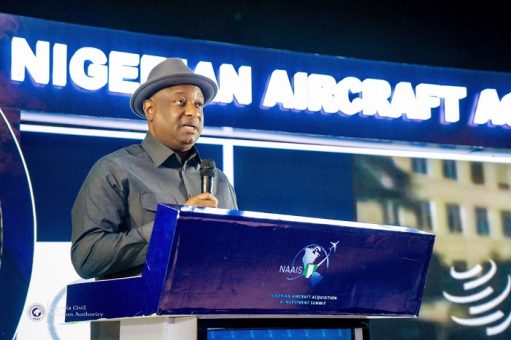
Nigeria’s Minister of Aviation and Aerospace Development, Festus Keyamo, has outlined sweeping reforms by the administration of Bola Ahmed Tinubu aimed at de-risking the country’s aviation sector and attracting global investors.
Speaking at the maiden Nigeria Aircraft Acquisition and Investment Summit (NAAIS) in Lagos, Keyamo said the government has embarked on institutional reforms, infrastructure upgrades, and strengthened regulatory frameworks to boost investor confidence across the aviation value chain.
He noted that these measures are positioning Nigeria as a viable destination for aircraft manufacturers, lessors, development finance institutions, and other key industry players.
A major highlight of the reforms, according to the minister, is Nigeria’s improved compliance with the Cape Town Convention and Aircraft Protocol, including the issuance of the Federal High Court Practice Direction in 2024 and the implementation of the Irrevocable De-Registration and Export Request Authorisation (IDERA).
“These reforms are critical because capital does not chase opportunity alone; it chases certainty,” Keyamo said, adding that Nigeria has also cleared about 98 per cent of previously trapped airline funds, a move that has restored confidence among international investors.
Also speaking at the summit, Director-General of the World Trade Organization, Ngozi Okonjo-Iweala, urged Nigeria to take the lead in advancing the Single African Air Transport Market (SAATM), a flagship African Union initiative aimed at liberalising air travel across the continent.
Okonjo-Iweala emphasised that aviation should be treated as a strategic economic enabler rather than merely a source of government revenue, noting that improved air connectivity is essential for boosting intra-African trade, tourism, and economic growth.
She highlighted the sector’s potential, revealing that aviation supports over 216,700 jobs in Nigeria but contributes less than $3 billion to GDP—figures she described as significantly below the country’s potential.
“A country of Nigeria’s size should be earning far more and creating more jobs from aviation,” she said, stressing the need for investment in air cargo infrastructure, airport modernisation, and maintenance capabilities.
The WTO chief further pointed out that inefficient air connectivity in Africa often forces passengers to transit through Europe, increasing costs and limiting trade, which currently stands at just 16 per cent within the continent.
Director-General of the Nigeria Civil Aviation Authority, Chris Najomo, said the summit was designed to unlock capital, confidence, and capacity in the aviation sector.
He noted that reforms such as enhanced regulatory transparency, streamlined certification processes, and strict adherence to international standards are already improving Nigeria’s attractiveness to global financiers.
Industry stakeholders also applauded the reforms, with Allen Onyema describing the developments as a “new dawn” for Nigeria’s aviation industry.
Similarly, aviation expert Obiora Okonkwo said the policy direction has boosted confidence among local and international partners, including Nigerian banks.
With renewed focus on public-private partnerships, fleet expansion, and infrastructure development, the Federal Government says Nigeria is positioning itself as a major aviation hub and a gateway for trade across West Africa and beyond.