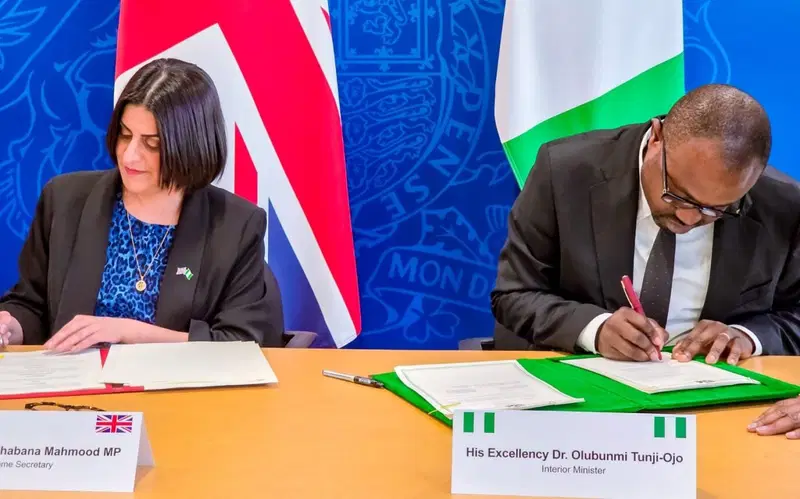
Nigeria has entered into a new agreement with the United Kingdom that will allow British authorities to repatriate thousands of failed asylum seekers and convicted offenders to the West African nation.
The deal was formalised during the recent state visit of Bola Ahmed Tinubu, with Nigeria’s Interior Minister, Olubunmi Tunji-Ojo, and UK Home Secretary, Shabana Mahmood, signing on behalf of both countries, according to a statement from the UK Home Office.
Under the new arrangement, the UK will be able to return individuals who have overstayed their visas, alongside failed asylum seekers and convicted criminals. The framework also introduces a significant policy shift, as Nigeria will now accept UK-issued letters as valid identification for deportees without passports.
The move replaces the previous reliance on emergency travel certificates and is expected to eliminate longstanding bureaucratic delays that have hindered deportation processes.
While the timeline and duration of the agreement remain undisclosed, reports indicate that about 961 Nigerian failed asylum seekers in the UK have exhausted all legal appeals, alongside 1,110 Nigerian nationals awaiting deportation following criminal convictions.
Speaking on the development, Tunji-Ojo said Nigeria’s commitment to the deal reflects its responsibility in upholding international obligations.
“We are totally committed to being a responsible country in fulfilling our core obligations,” he said, adding that transparency and fairness are key to sustaining bilateral relations.
UK Minister for Border Security and Asylum, Alex Norris, described Nigeria as a critical partner in tackling irregular migration, noting its position as the UK’s largest visa market in Africa.
“Anyone who abuses our systems, breaks our laws or tries to cheat their way into Britain will be stopped and removed,” Norris said.
Beyond deportation, both countries agreed to strengthen collaboration through joint enforcement operations and intelligence sharing to dismantle criminal networks exploiting immigration systems.
The agreement follows a rise in cases involving fraudulent job sponsorships, sham marriages, and falsified documentation. Nigeria is also expected to review its immigration laws to impose stricter penalties on offenders.
Additionally, a new joint initiative targeting online fraud—including romance scams, investment fraud, and cryptocurrency-related crimes—will be launched using a “fusion cell” model. The approach will bring together government agencies, financial institutions, technology firms, and telecom operators to improve intelligence sharing and response to emerging threats.
The deal marks a significant step in deepening cooperation between Nigeria and the UK on migration management, security, and crime prevention.