


“I’m Not Really Nigerian”: UK Minister Kemi Badenoch Opens Up on Identity, Citizenship and Roots
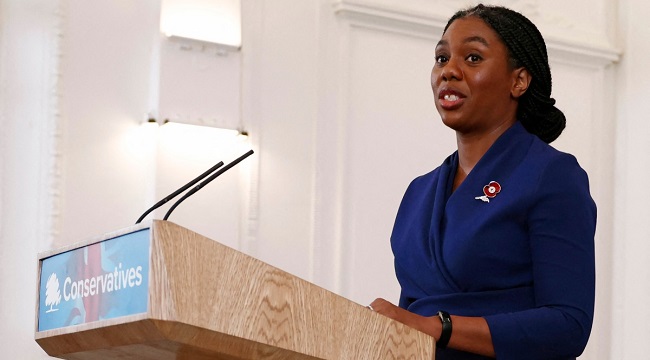
British Conservative Party leader and Secretary of State for Business and Trade, Kemi Badenoch, has sparked debate over national identity following candid remarks in which she distanced herself from her Nigerian roots, stating that she no longer identifies as Nigerian and has not held a Nigerian passport in over two decades.
Speaking on the Rosebud podcast hosted by Gyles Brandreth, Badenoch reflected on her complex relationship with her heritage, explaining that although her parents are Nigerian and she spent part of her upbringing in the country, her sense of identity lies firmly in the United Kingdom.
“I’m Nigerian through ancestry, by birth, despite not being born there because of my parents, but by identity, I’m not really,” she stated.
Born in Wimbledon, London, in 1980, Badenoch is among the last group of people to receive British birthright citizenship before the law changed in 1981 under Prime Minister Margaret Thatcher’s government. She revealed that discovering her automatic British citizenship came as a surprise to many of her peers.
“Finding out that I did have that British citizenship was a marvel to so many of my contemporaries, so many of my peers,” she said.
Though Badenoch acknowledged her familiarity with Nigeria, she underscored a long-standing emotional and cultural disconnect from the country.
“I know the country [Nigeria] very well, I have a lot of family there, and I’m very interested in what happens there,” she said, adding, “Never quite feeling that I belonged there.”
Despite her ancestral and formative ties to Nigeria and the United States, Badenoch said her true sense of home is rooted in the UK, with her current family and political life.
“But home is where my now family is, and my now family is my children, it’s my husband and my brother and his children, in-laws. The Conservative Party is very much part of my family—my extended family, I call it.”
Badenoch also opened up about personal struggles in her early adulthood, noting the challenges she faced after returning to the UK as a teenager.
“The toughest thing I had to do was to fend for myself at 18,” she recalled.
Her remarks have drawn mixed reactions across social and political circles, with some praising her honesty and others questioning the implications of such a public disavowal of Nigerian identity by someone of African descent in a leadership role.