







Senate President Godswill Akpabio has unveiled Nigeria’s new 2025–2030 Counter-Terrorism Strategic Plan, a national framework designed to modernise security institutions, tackle rising terrorism, and strengthen resilience amid escalating kidnappings and attacks nationwide
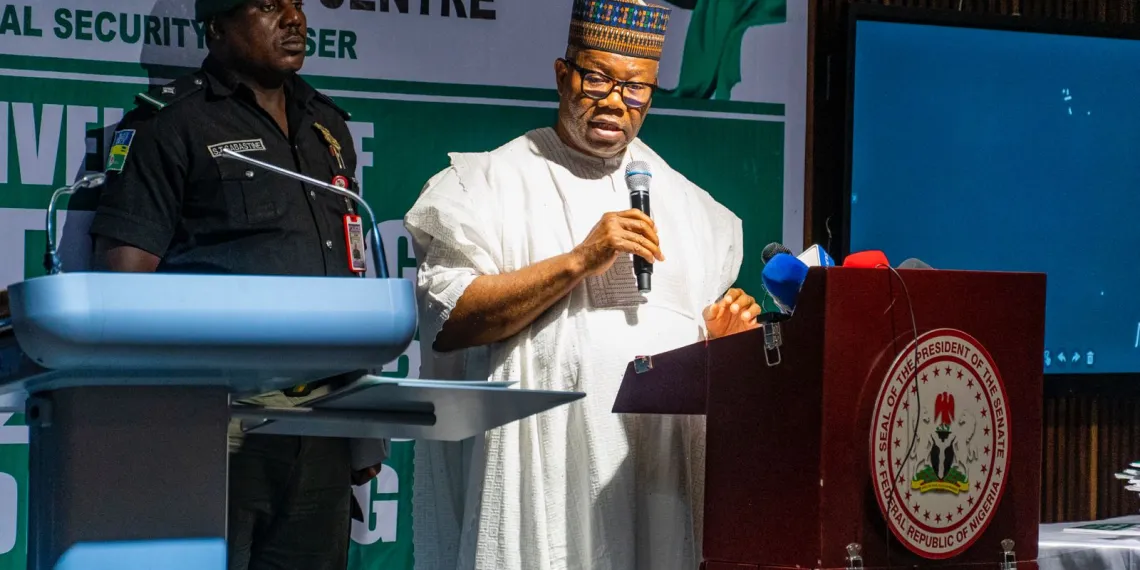
Nigeria Unveils 2025–2030 Counter-Terrorism Strategic Plan to Strengthen National Security
Nigeria’s Senate President, Godswill Akpabio, on Monday unveiled the nation’s new five-year strategy for combating terrorism — a comprehensive security blueprint that will run from 2025 to 2030.
The framework, known as the Nigeria Counter-Terrorism Strategic Plan, was developed by the National Counter-Terrorism Centre under the Office of the National Security Adviser (ONSA).
Speaking during the unveiling in Abuja, Akpabio said the plan reflects the country’s renewed commitment to ensuring that citizens can live free from fear while building a future anchored on peace and stability.
“It is a moment when Nigeria again reaffirms that our people deserve to live without fear, that our children deserve a future of peace, and that our nation must be secured to prosper,” he said.
Akpabio noted that the plan sets out a clear roadmap for transforming Nigeria’s security architecture, modernising key institutions, and strengthening national resilience across all sectors.
“The Strategic Plan 2025–2030 answers how we secure our nation, safeguard our people, and set Nigeria irreversibly on the path of peace, growth, and stability,” he said. “It offers a framework for transforming our institutions, strengthening national resilience, and expanding partnerships across government, industry, civil society, and the international community.”
For more than a decade, Nigeria has faced severe insecurity marked by kidnappings, terrorist attacks, banditry, and violent incursions targeting communities, schools, churches, and public institutions.
Recent incidents include, the abduction of 25 schoolgirls from Government Girls Comprehensive Secondary School, Maga, Kebbi State, where terrorists also killed the vice principal. The attack on Christ Apostolic Church, Oke Igan, Eruku, in Kwara State on 19 November, where three worshippers were killed and 38 abducted — all later freed, and the mass abduction of 303 pupils, students, and staff of St. Mary’s Catholic Primary and Secondary Schools in Papiri, Niger State. Fifty abductees have since escaped, according to CAN.
These escalating attacks have stretched security agencies thin and deepened nationwide concerns over safety.
Akpabio said he has witnessed firsthand the damaging impact of insecurity on Nigeria’s economy, noting that investors are pulling out, farmers are abandoning farmlands, schools are shutting down, and young people are losing hope.
“As President of the Senate, I have seen how insecurity weakens the foundations of development. That is why a pragmatic, implementation-driven plan such as this is timely and necessary,” he said.
The Senate President added that the 10th National Assembly has passed significant legislation on defence, policing, counter-terrorism, cybersecurity, and intelligence coordination, while strengthening inter-agency collaboration and improving the welfare of security personnel.
“While security is a constitutional responsibility shared by all arms of government, the legislature has a unique obligation — to provide the legal, oversight and budgetary backbone upon which security institutions stand and thrive,” he said. Read More