




President Bola Ahmed Tinubu has taken a major step toward addressing Nigeria’s persistent electricity challenges by presenting a proposal to overhaul the country’s struggling power transmission system.
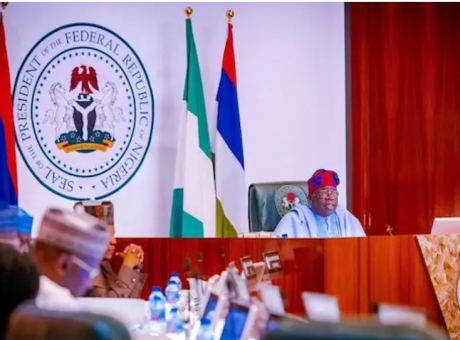
The proposal was presented personally by the president during the Federal Executive Council (FEC) meeting held on Wednesday at the Council Chambers of Aso Villa, where ministers deliberated on solutions to the country’s fragile national grid.
Nigeria’s national grid—widely considered the weakest link in the power sector—has repeatedly collapsed in recent years, resulting in unstable electricity supply across the country.
Following the presentation, the council approved the formation of an eight-member inter-ministerial committee tasked with developing the operational framework for the initiative.
Members of the committee include:
Minister of Power, Adebayo Adelabu
Minister of Finance and Coordinating Minister of the Economy, Wale Edun
Minister of State for Petroleum Resources (Gas), Ekperikpe Ekpo
Minister of Works, Dave Umahi
Minister of Science and Technology, Kingsley Udeh
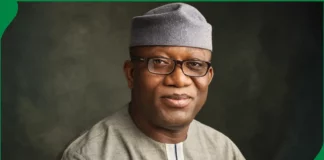
Minister of Justice and Attorney-General of the Federation, Lateef Fagbemi
Chairman of the Nigerian Revenue Service, Zacch Adedeji
The Minister of Information and National Orientation, Mohammed Idris, disclosed this while briefing journalists after the FEC meeting.
According to Idris, the initiative focuses on strengthening the transmission segment of the electricity value chain, which the government believes is the biggest obstacle to achieving reliable power supply.
He noted that since the deregulation of the power sector, the industry has been divided into generation, transmission and distribution, with transmission remaining the most problematic.
Central to the president’s proposal is the establishment of a Grid Asset Management Company (GAMCO) that will oversee and strengthen the national electricity grid.
Idris explained that the committee would examine all regulatory, legal and investment considerations surrounding the proposed company, including the interests of existing investors and operators in the sector.
He added that the committee’s recommendations would eventually be submitted to the National Assembly for legislative backing.
The minister emphasised that the reform aligns with the administration’s broader economic agenda, noting that stable electricity is critical for industrialisation, economic growth and productivity.
“The President believes that for Nigeria to truly industrialise, the power sector must be fixed,” Idris said.
Meanwhile, residents of 11 communities in Osogbo, Osun State, staged a protest against persistent electricity outages, giving the Ibadan Electricity Distribution Company (IBEDC) a seven-day ultimatum to improve supply.
The affected communities include Akede, Owo Eba, Oke-Baale, Army Depot, Uniosun, Air Force Base, Odu, Coker, Ilesa-Garage, Boredun, Tara, Omu and OSBC.
The protesters gathered at the Oke-Baale area of Osogbo before marching to the IBEDC headquarters on Station Road, carrying placards and chanting slogans against the distribution company.
Some of the placards read: “Return us to Band A,” “Our business is dying,” and “IBEDC you are wicked.”
Speaking on behalf of the protesters, Badmus Akeem said the electricity crisis worsened after the communities were moved from Band A to Band C, which significantly reduced their daily electricity supply.
According to him, residents now receive less than four hours of electricity per day, causing severe economic hardship.
“Small-scale businesses are on the verge of collapse, and corporate institutions are also affected,” Akeem said.
The protesters demanded that their communities be restored to Band A or Band B within seven days, warning that failure to meet their demand could lead to further collective action, including restricting operational access for IBEDC staff in their communities.
Responding to the protest, IBEDC Regional Manager Ifeanyi Ikeji said the company was willing to return the affected areas to Band A, but noted that power generation constraints remain a major challenge.
He also cited the high number of unmetered customers as another obstacle.
“We are ready to return you to Band A, but your communities must meet the requirement of at least 90 percent metered customers,” Ikeji said.
He urged residents to encourage customers without meters to obtain them to meet the eligibility requirements for Band A electricity supply.