


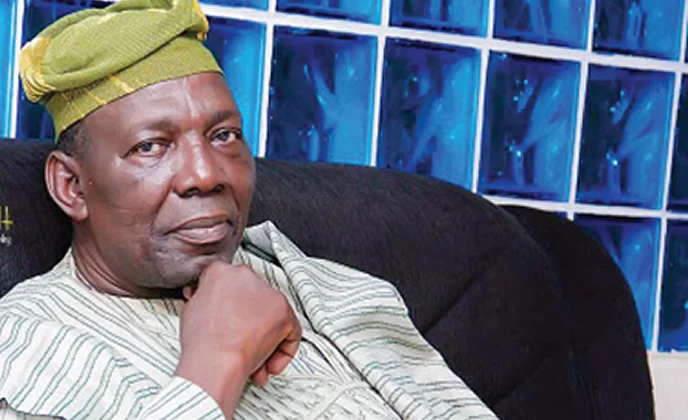




The last child of late Nigerian national team coach Festus Onigbinde, Mr Oyekunle Onigbinde, has revealed that although his father battled illness before his passing, he fought bravely to remain alive.
Oyekunle made this known on Tuesday in Ibadan during an interview with the News Agency of Nigeria (NAN), describing his father’s death on Monday as a huge shock to the family.
According to him, the former coach’s health had been failing due to old age, but he remained determined throughout the struggle.
“He fought well to stay alive. He was sick, but because of old age, his body could not fight the recovery,” he said.
Oyekunle described his father as a generous and accommodating man who always sought to bring people together regardless of their backgrounds.
“My father was very accommodating; he pulled everyone together. He didn’t care who you were — he just wanted everyone happy and united. He was the string that knitted many together,” he added.
Meanwhile, renowned sports analyst Tayo Balogun has also paid tribute to the late football tactician, recalling a memorable 40-minute phone conversation he had with Onigbinde in 2025.
Balogun said the discussion, which reflected on the coach’s remarkable career and contributions to Nigerian football, would forever remain in his memory.
“We went down memory lane, and I thanked him for being who he was: painstaking, foresighted, forthright, forthcoming, and incredibly hardworking,” Balogun said.
“I told him that his contributions to Nigerian football will always be footnoted in history.”
He noted that during the call, he observed that the coach’s voice had weakened slightly, which Onigbinde attributed to old age, while insisting he remained in good health.
Balogun also recalled how the former national team coach fondly asked about members of his television crew, including Feyi Ogunduyile and Modele Sarafa-Yusuf.
Reflecting on Onigbinde’s legacy with Shooting Stars Sports Club (3SC), Balogun praised his impact on the club’s development, including renaming the team from IICC Shooting Stars.
He also recounted a strategic moment involving penalty practice ahead of a continental clash with Tonnere Kalara Club of Yaounde after Shooting Stars had already secured a convincing 4-0 victory in Ibadan.
“Onigbinde explained that if they could beat the opponents 4-0 in Ibadan, the Cameroonian side might try to return the favour in Yaounde,” Balogun said.
Balogun further commended the late coach for his bold decisions while handling the Super Eagles squad during the 2002 FIFA World Cup.
“I told him I understood why he included Mutiu Adepoju in the squad, but I didn’t understand why he didn’t play him in any of the matches,” he said.
“Onigbinde admitted that was the only mistake he made. He explained that if Adepoju had played and the team lost, the blame would have fallen on him.”
Balogun described Onigbinde as the most thorough Nigerian coach he had encountered, noting that the tactician consistently prepared detailed yearly plans for his teams despite limited resources.
“With Shooting Stars, he got only about 20 per cent of what he requested, and with the Super Eagles, he didn’t even get 10 per cent — yet he still achieved remarkable results,” he said.
He also recalled how Onigbinde once led a group of relatively inexperienced players, including Chibuzor Ehilegbu, Paul Okoku and Femi Olukanmi, to Ghana where they defeated the formidable Black Stars on their home turf.
Balogun concluded that Onigbinde’s legacy would remain unforgettable in Nigerian football.
“His memory will remain indelible. He was a gentleman, humble, and highly intelligent. I am glad I got to know you, sir,” he said.