
Data Consumption Surges 44%, Drives N1trn Network Investment
Nigeria’s data consumption rose by about 43.6 per cent between January and July 2026 compared with the corresponding period in 2025, putting greater pressure on telecommunications infrastructure and the investment required to expand network capacity.
Data consumption reached 1.66 million terabytes (TB) in July 2026, the highest monthly volume in the Nigerian Communications Commission’s (NCC) published series.
The July figure followed 1.53 million TB in June and 1.50 million TB in May.
Between January and July 2026, Nigerians consumed approximately 10.18 million TB of data, compared with about 7.09 million TB during the same period in 2025.
The increase in data usage is driving requirements for additional network capacity, fibre, equipment, coverage and maintenance.
MTN Nigeria’s network investment provides an indication of the scale of spending involved.
The operator invested N1 trillion in network capacity in 2025, more than twice the N443.5 billion invested in 2024.
The investment is also extending into fixed broadband and data-centre infrastructure, with MTN expanding its fibre-to-the-home (FTTH) and fixed wireless access businesses.
The company has also disclosed a commitment of more than $240 million to a data-centre project in Lagos, with the first phase expected to cost about $120 million.
The NCC recorded 319,735 total FTTH subscriptions in the second quarter of 2026, with MTN accounting for 176,468.
However, expanding infrastructure is only part of the challenge, as existing networks also face damage and maintenance pressures.
The NCC said more than 5,000 fibre-optic cable cuts occurred in the first half of 2026, largely linked to road construction, excavation and other civil works.
NCC Executive Vice Chairman Aminu Maida warned that damage to fibre infrastructure could result in failed calls, blocked payments, interrupted services and lost economic opportunities.
The growing dependence on telecommunications infrastructure is also reflected in Nigeria’s expanding digital payments activity.
The Nigeria Inter-Bank Settlement System (NIBSS) reported that PoS transactions reached N18.78 trillion in the first quarter of 2026, up 79.03 per cent from N10.49 trillion in Q1 2025.
The increase highlights the growing role of connectivity in supporting everyday commercial transactions involving merchants and consumers.
Nigeria’s digital infrastructure now extends beyond mobile network sites to fibre transmission networks, spectrum and radio equipment, data centres, broadband infrastructure, power systems and digital platforms.
MTN’s FY2025 results showed stronger growth in data, enterprise connectivity and home broadband, with FTTH identified as a core investment priority as demand for high-quality home connectivity grows.
As data consumption continues to rise, the infrastructure supporting that demand requires continuous investment, expansion, maintenance and protection.
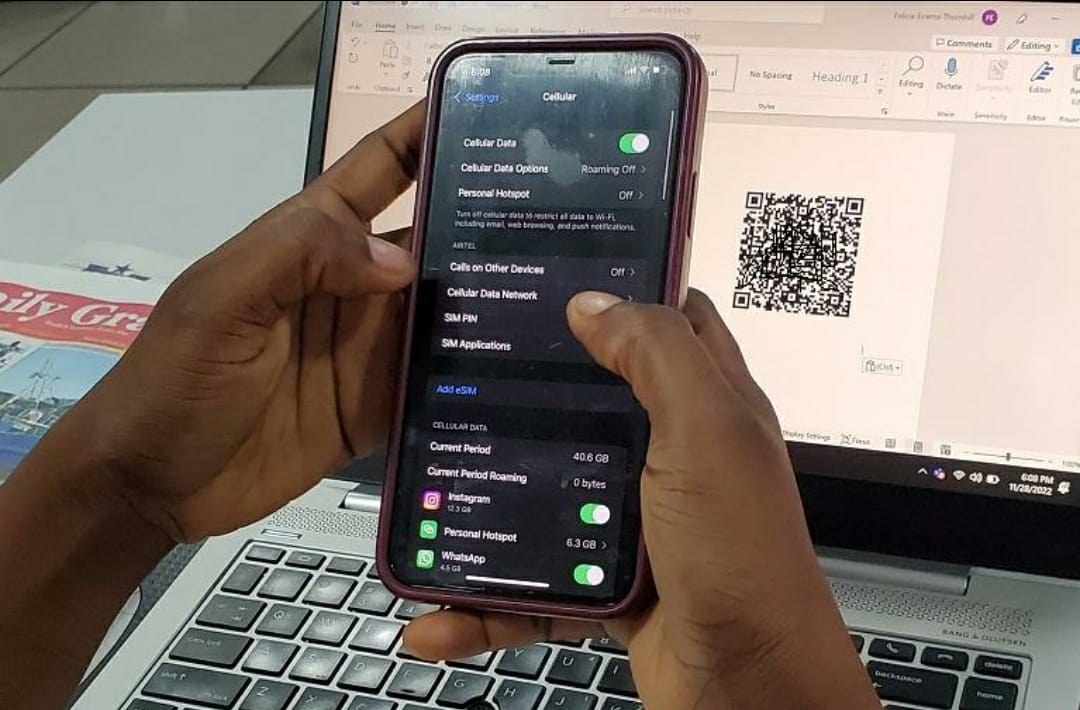
For consumers, the growth is visible in the increasing amount of data used on mobile devices. Behind that usage is an expanding infrastructure network that supports connectivity and an increasingly digital economy.