





Lagos State has sharpened its global push for partnerships, innovative financing and knowledge-sharing to tackle climate change, coastal erosion and flooding, declaring itself ready to “collaborate, innovate and lead” in building a safer, more resilient coastal megacity.
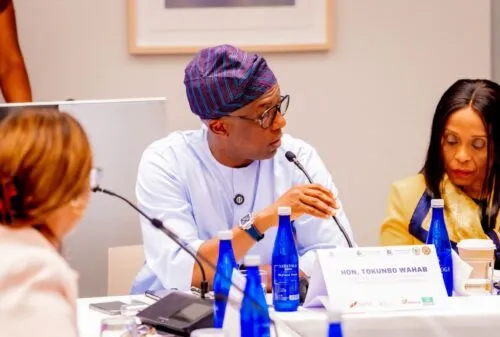
The message was delivered by Lagos State Commissioner for Environment and Water Resources Tokunbo Wahab at the Governor’s Roundtable on “Insuring Our Coastlines,” held in New York on the sidelines of the 81st United Nations General Assembly.
Wahab used the high-level gathering to place Lagos firmly in the global climate-risk conversation. He stressed the need for stronger international partnerships, access to innovative finance and lessons from other cities facing similar threats.
“For me, the conversation went beyond policy discussions. It was about positioning Lagos to build stronger partnerships, access innovative financing, and learn from global experiences as we work towards a safer, more resilient and sustainable coastal city,” Wahab said.
The commissioner noted that Lagos’ coastal location is both an economic asset and a major vulnerability. As one of Africa’s largest urban centres, the state confronts interconnected risks — flooding, coastal erosion and rising sea levels — that threaten communities, infrastructure, businesses and long-term growth.
Organised by the Lagos State Government in partnership with the United Nations Global Compact Networks Nigeria and Caribbean, the roundtable brought together government officials, international investors, development finance institutions, private-sector players and partners from Africa and the Caribbean.
Wahab emphasised that no government can confront the scale of coastal challenges alone. Collective action, knowledge-sharing and innovative solutions are essential to protect communities, infrastructure and future generations.
Governor Babajide Sanwo-Olu reinforced the urgency, pointing to the immediate economic and social toll of climate impacts in Lagos.
“Lagos is a coastal city, so climate change is not a distant concern for us. We see its effects in the flooding that affects our communities and the pressure it puts on our roads, homes and businesses,” the Governor said.
He called for deeper private-sector involvement, stressing that government cannot deliver the required scale of intervention alone. Strong partnerships and practical solutions are needed to safeguard the state’s economic future.
The New York engagement signals Lagos’ shift from reactive emergency responses toward structured anticipation, risk financing, infrastructure protection and long-term resilience. For a city whose commercial life is tightly linked to its coastline and waterways, protecting critical assets is now framed as essential to investment confidence and economic continuity.
With global investors and development partners at the table, the Lagos delegation used the UNGA platform to push for deeper collaboration on financing and implementing climate-resilience projects. Wahab summed up the state’s ambition clearly: Lagos is ready not only to manage its vulnerabilities but to help shape the solutions.