





According to data documented by the GSMA and industry reports, MTN Nigeria, expended N11.1 billion within a two-year period merely to repair and relocate 2,502 kilometers of damaged fibre-optic lines.“Area Boys Keep On Removing Fibre Optics Wires, What Measures Are Govt Taking” – Ogun Resident Raises Alarm
By Lukman OMIKUNLE
Rising incidents of street-level infrastructure sabotage continue to spark fresh concern across the telecommunications sector, as an Ogun State resident raised the alarm over area boys (agberos) systematically digging up and carting away subterranean fibre-optic cables in transit and boundary corridors.
The issue took center stage during Radio One’s (103.5 FM) flagship morning public discourse on Monday September 28, which examined digital literacy and the fragile backbone of Nigeria’s connectivity.
A caller on the live broadcast, identified as Gbenga Adeola from Ogun State, expressed frustration over the impunity with which area boys rip out critical broadband cables laid along public roads and residential quarters.
”Please, the agbero (Area) boys, the optic wire, cables that government fixed on the road, channeled down to the road and all those in our environment, these agbero lArea boys) guys keep on removing it,” Adeola lamented live on air, adding “Right? Are these people doing their self-benefit or the government? And what measures are government taking to help?”
Adeola’s distress call shines a spotlight on a silent crisis: the brazen destruction of public and private digital assets, which undermines billions of naira in telecom investments and triggers widespread service blackouts across the Lagos – Ogun commercial artery.
Billions Down the Drain: The Telecoms’ Staggering Cost
Adeola’s alarm reflects an escalating menace that cost telecommunications operators tens of billions of naira in avoidable capital drain.
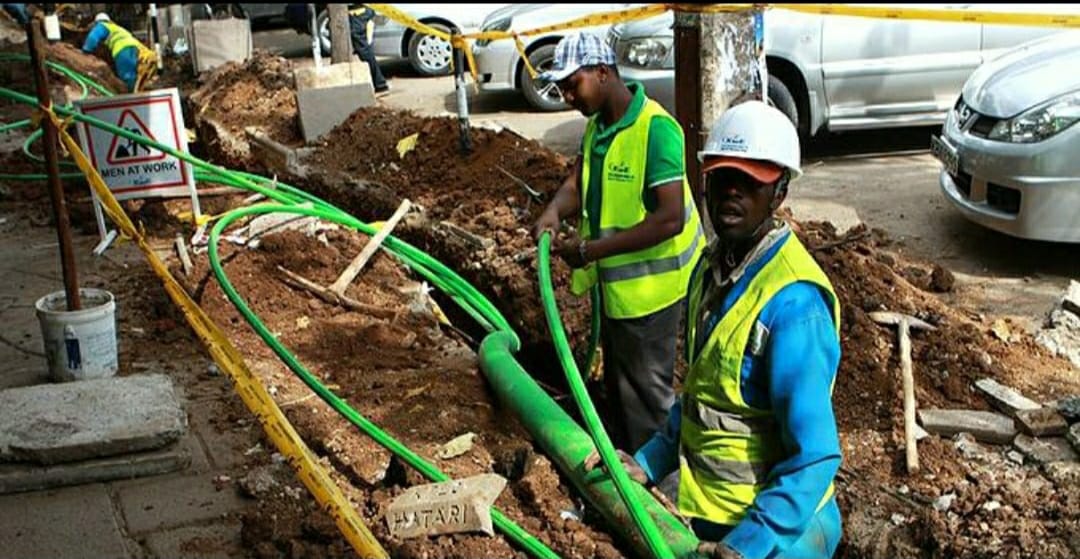
According to data documented by the GSMA and industry reports, Nigeria’s largest telecommunications provider, MTN Nigeria, expended N11.1 billion within a two-year period merely to repair and relocate 2,502 kilometers of damaged fibre-optic lines. The operator spent N4.4 billion in 2022 to rehabilitate 1,069 kilometers of severed cables and an additional N6.7 billion in 2023 to fix 1,433 kilometers.
Analysts noted that had those capital expenditures not been diverted into emergency maintenance, the operator could have deployed over 870 kilometers of brand-new fibre lines into unserved rural communities.
Industry statistics from the Nigerian Communications Commission (NCC) and the Association of Licensed Telecommunications Operators of Nigeria (ALTON) show that the sector grapples with an average of 30 to 40 fibre cuts every day, recording over 5,000 incidents in half a year. MTN alone has consistently logged thousands of line cuts annually—averaging hundreds of disruptions per month—inflicted by a mix of deliberate theft and road rehabilitation works.
While vandals often mistake fibre ducts for scrap copper, the glass strands inside have zero metal recycling value, leaving telcos with multimillion-naira repair bills and communities stranded in total digital darkness.
”These Cables Power Economies” – ICT Expert
Responding to the caller on the broadcast, Information and Communication Technology (ICT) expert and digital literacy advocate, Israel Ihaza, explained that fibre cable cuts have reached emergency proportions, pointing to records where over 5,000 fibre cuts were logged within a single month.
”These cables power economies,” Ihaza warned on the programme. “If some of these cables are down, the financial ecosystem is down, banking generally… Like me, a startup founder, I will not be able to transmit information to my team, and so it connects the everyday life.”
Ihaza drew a sharp distinction between accidental breakage and organized street vandalism: ”There’s deliberate vandalism, meaning theft, right? And there’s accidental, in the sense that I could be doing some construction work, evacuation work, and then I’m just digging and just messing things up… But what they don’t understand is that these cables power economies.”
He shared an example illustrating the human toll: a young Nigerian professional recently lost her remote international job when a sudden, prolonged broadband outage cut off her workflow due to external cable interference.
Paralyzing Everyday Life and Essential Services
The ripple effect of severed optic lines extends far beyond slow browsing speeds. Fibre networks serve as the primary backhaul that connects cellular towers, data centers, automated teller machines (ATMs), and bank branches.
When a line is severed by road contractors or ripped out by street scavengers:
Micro-Commerce Grinds to a Halt: Roadside market vendors, transport operators, and petty traders relying on instant account transfers to sell perishable goods find their transactions stalled.
Agency Banking and POS Collapse: Neighbourhood Point-of-Sale (POS) operators—the lifeblood of unbanked and informal communities—are left with offline terminals, stranding residents who need cash for emergencies.
Essential and Emergency Channels Stall: Commercial banking apps freeze, Point-of-Sale merchant terminals fail at retail payment counters, and hospital administrative portals lose cloud connectivity, delaying critical patient care.
The programme’s presenter also criticized the lack of municipal coordination across government agencies, where one agency installs public infrastructure while another inadvertently demolishes it days later.
”One minute they are laying cables, the next minute there’s a culvert construction, there’s a tree-planting event, there’s a road construction, also by the same government,” the presenter observed, citing further instances where substandard, exposed ducting by contractors left neighborhood lines vulnerable to rodents, heavy rainfall, and physical tampering.
The Call for Action: Beyond the “What’s My Business?” Mindset
While the Federal Government has designated telecommunications infrastructure as Critical National Information Infrastructure (CNII)—making willful vandalism a punishable felony—stakeholders argue that enforcement on the ground remains largely absent.
To stem the bleeding, Ihaza called for a three-pronged approach: technical safeguards, visible security deterrence, and civic vigilance.
”Just the same way we have labeling for pipelines—’Oh, this area, there are pipelines here’—I think we need to come up with that as well, where we know, okay, in certain areas we have fibre optic cables, so do not disrupt it,” Ihaza urged.
He recommended deploying targeted CCTV surveillance on vulnerable bridge conduits, tasking community neighborhood watch and security corps with active patrols along documented telecom rights-of-way, and prosecuting scrap syndicates that fund the scavengers.
Crucially, Ihaza challenged ordinary citizens to abandon public apathy:
”What we’ve seen as Nigerians is that, ‘Hmm, what’s my business? It’s not my business.’ But what they are missing out is the action [the vandal] is carrying out, you might have a bad network… We need to tell ourselves that let’s look out for ourselves. If you’re looking at some suspicious activity… it’s affecting everybody.”