


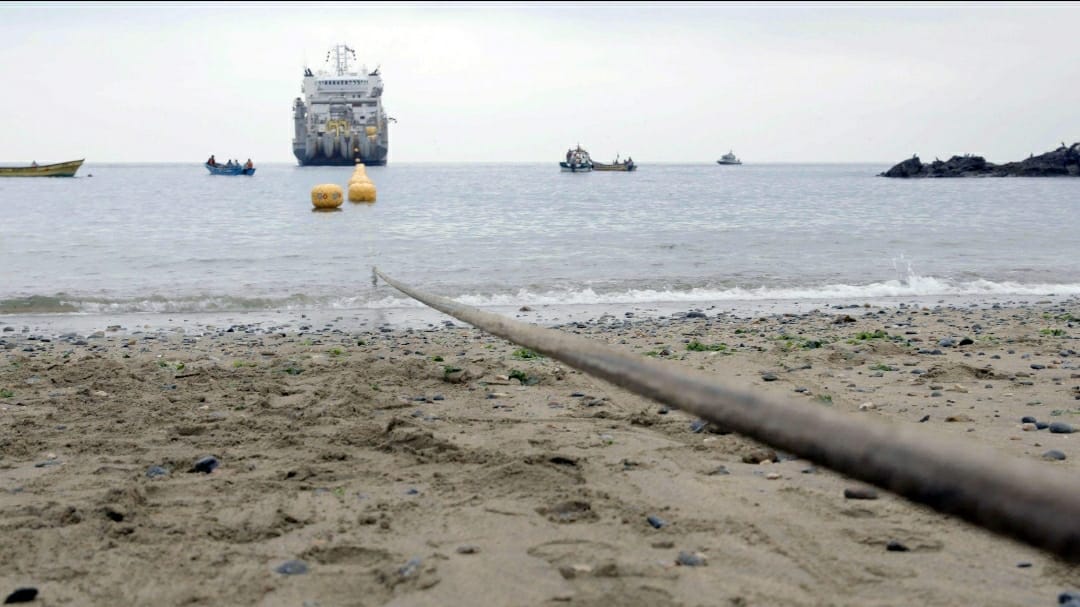





The vulnerability was demonstrated dramatically in March 2024, when damage to four major submarine cables — ACE, SAT-3, WACS and MainOne — disrupted connectivity across several West African countries, including Nigeria.
Beyond Fibre Cuts, Cable Faults: Why Nigeria’s Digital Economy Is at Risk
By Lukman Omikunle
Nigeria’s digital economy is expanding rapidly, but the infrastructure carrying that growth is facing a problem that goes beyond the number of fibre cables, submarine systems or network facilities in the ground and at sea.
The bigger question is whether the system can continue functioning when one of its critical components fails.
That question has become increasingly important as telecommunications connectivity moves deeper into almost every part of economic and public life — from banking and digital payments to commerce, healthcare, education, government services and everyday communication.
The vulnerability was demonstrated dramatically in March 2024, when damage to four major submarine cables — ACE, SAT-3, WACS and MainOne — disrupted connectivity across several West African countries, including Nigeria.
The incident also exposed a less obvious weakness in infrastructure planning.
The Internet Society found that the cables converged around the same physical area off Côte d’Ivoire, meaning that what appeared to be several separate systems could still be exposed to a common physical point of failure.
The lesson is significant for Nigeria: having several cables or networks does not automatically mean having several independent routes.
The same concern is visible on land.
The Nigerian Communications Commission (NCC) reported more than 5,000 fibre-cut incidents in the first six months of 2026, with road construction, excavation and related civil works among the major causes.
The Commission has subsequently worked with the Federal Ministry of Works on measures to protect fibre infrastructure during road projects.
For the telecommunications industry, a fibre cut can mean damaged infrastructure and the cost of repairs. But the consequences do not stop with the operators.
A disrupted route can affect businesses processing transactions, customers making payments, hospitals relying on communications, government platforms delivering services and workers whose jobs depend on digital connectivity.
That is why the resilience of telecommunications infrastructure has increasingly become an economic issue.
The NCC’s designation of telecommunications networks, fibre-optic cables, data centres, towers and Internet exchange points as Critical National Information Infrastructure reflects the growing importance of these assets.
Once connectivity becomes critical infrastructure for banking, commerce, public services and emergency response, the issue is no longer simply how quickly a damaged cable can be repaired.
It is also about what happens while the repair is taking place.
Can traffic be diverted?
Can critical services continue?
Can another route absorb the load?
Can hospitals, financial institutions, businesses and government agencies remain connected?
Those questions point to the difference between capacity and resilience.
Nigeria can continue adding fibre and submarine cables, but if several systems depend on the same road corridor, landing facility, metropolitan network or other common infrastructure, a single incident can still have consequences far beyond the point of physical damage.
Physical diversity therefore matters.
Different submarine cables need sufficiently diverse landing and inland routes.
Fibre networks need alternative corridors rather than unnecessary concentration along the same roads. Critical facilities need alternative connectivity and power arrangements, while networks require enough spare capacity to absorb traffic when another route fails.
Geographic diversity is equally important.
A network can contain several assets and still be vulnerable if those assets share the same physical environment.
This is particularly relevant as Nigeria expands its national fibre infrastructure.
Project BRIDGE, which is intended to substantially expand the national fibre backbone and improve route diversity, provides an opportunity to make resilience an important consideration in infrastructure planning.
The measure of progress should therefore not be only the number of kilometres of fibre deployed.
It should also be how many genuinely independent routes connect critical locations and how much traffic can continue to move if one route becomes unavailable.
The same principle applies to Nigeria’s international connectivity.
More submarine cables can increase capacity, but resilience also depends on where those cables land, how traffic is carried inland and whether alternative systems have sufficient capacity to handle traffic during a major outage.
There is, however, another dimension to the resilience question that cannot be ignored: government intervention.
The Nigerian Communications Act gives the NCC emergency powers under Section 148 in specified circumstances involving a public emergency or public safety.
Those powers include measures such as suspending a licence, taking temporary control of network facilities and withdrawing the use of services or facilities from a licensee, person or the general public.
Such powers have a legitimate place in circumstances involving public safety and emergencies.
But as connectivity becomes more deeply embedded in economic and public services, any intervention affecting communications infrastructure can have consequences beyond its immediate purpose.
An action taken to address an emergency, for example, can also affect the continuity of services that depend on the network being available.
That makes continuity an important consideration alongside the immediate objective of an emergency intervention.
The issue is not whether government should possess emergency powers. The more practical question is whether the resilience of essential digital services is sufficiently considered when those powers are exercised.
The law itself recognises the importance of survivability and recovery.
Section 149 of the Nigerian Communications Act provides for disaster plans relating to the survivability and recovery of telecommunications services and network facilities during disasters, crises and civil emergencies.
That principle is increasingly relevant to a digital economy where connectivity failures can quickly become economic disruptions.
Restoration remains important, but critical services cannot always wait for restoration.
A bank may eventually restore its connection. A hospital may eventually recover communications. A government platform may eventually return to service.
The more important question is what happens in the period before that recovery.
Can payments continue?
Can emergency communications remain available?
Can businesses switch to alternative routes?
Can networks absorb traffic displaced from a failed system?
This is why the resilience debate cannot be reduced to fibre vandalism alone.
The sources of disruption are varied.
A submarine cable can fail. A road project can sever fibre. Equipment can malfunction. Power can be lost. Vandalism can interrupt a route. A cyber incident can affect critical systems. And an emergency intervention can restrict access to communications infrastructure.
The response must therefore be equally broad.
Nigeria needs physical diversity in its fibre and submarine systems, technical alternatives for critical facilities, geographic diversity in network routes, sufficient spare capacity and practical arrangements for service continuity.
It also needs regulatory safeguards that recognise the wider connectivity consequences of emergency measures without weakening the ability of government to respond to genuine public emergencies.
The NCC’s major-outage reporting requirements can provide useful information about where failures repeatedly occur.
The value of that information goes beyond repairing individual incidents.
It can help identify common dependencies linking apparently separate networks and show where a failure in one part of the system could affect several others.
That becomes increasingly important as the digital economy grows.
Nigeria cannot eliminate every infrastructure failure. Fibre will be cut, equipment will malfunction, submarine cables will require repairs and emergencies will occur.
The objective should be to prevent the failure of one route, facility or intervention from becoming a wider failure of essential digital services.
The country’s digital infrastructure is no longer simply a telecommunications issue.
It is part of the infrastructure that keeps businesses operating, money moving, public services functioning and people connected.
The next phase of Nigeria’s digital development must therefore ask a question beyond how much more capacity the country can build.
It must ask how much of the economy can keep moving when part of that infrastructure stops working.