


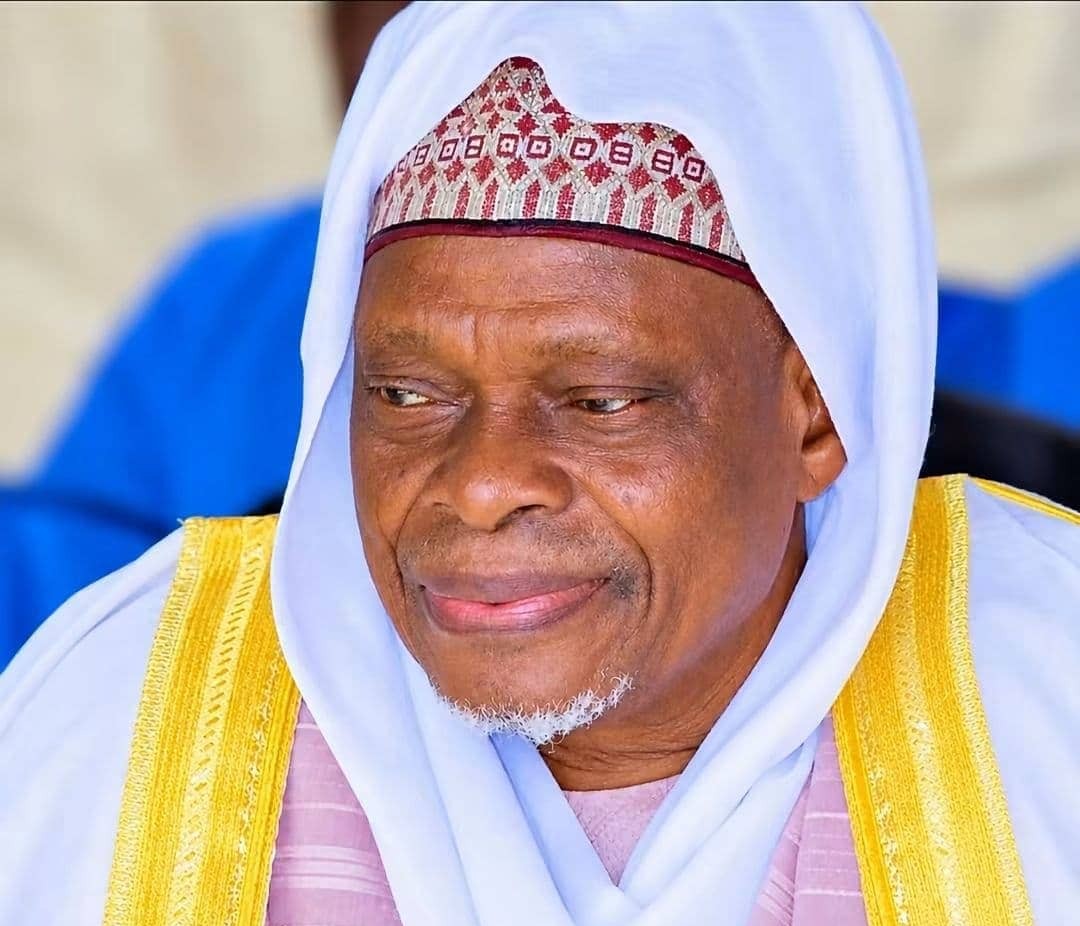





Renowned Islamic scholar Sheikh Nasirdeen Sa’adudeen Ajara (RTA) dies at 85. Read about his remarkable life, Islamic scholarship and legacy

Sheikh Nasirdeen Sa’adudeen Ajara Dies at 85, Ota Muslim Community Mourns Legendary Islamic Scholar
By Lukman OMIKUNLE
The Ota Muslim community in Ogun State has been thrown into mourning following the death of renowned Islamic scholar and preacher, Sheikh Nasirdeen Sa’adudeen Ajara (RTA), who passed away on Friday, November 13, 2026, at the age of 85 after a brief illness.
His death has come as a painful loss to generations of Muslim faithful, Islamic scholars, students and admirers whose lives were shaped by his decades of religious teachings, Quranic expositions and commitment to the propagation of Islam.
Although Sheikh Ajara had attained the age of 85, his passing has been received with profound sadness, reflecting the enormous influence he wielded in Ota, Aworiland and the wider Nigerian Muslim community. For many, his departure marks the end of an important chapter in the religious history of Ota, where he spent more than five decades building institutions, nurturing Islamic scholars and strengthening the foundations of Islamic education.
His life was defined by scholarship, discipline, eloquence and an unwavering dedication to Dawah. From his formative years under some of the most respected Islamic scholars in the Ilorin Emirate to his emergence as one of the prominent voices of Islamic preaching in southwestern Nigeria, Sheikh Ajara’s journey was one of continuous learning, service and religious commitment.
Born in 1941 in Ota, Ogun State, into paternal and maternal families of distinguished Islamic clerics from Ilorin, Kwara State, Sheikh Nasirdeen Sa’adudeen Ajara spent much of his childhood with his maternal relatives in Ilorin. It was there that he grew under the guidance of his immediate elder brother of the same parents, the revered Sheikh Sarafadeen Sa’adudeen Ajara (RTA), who became one of his earliest mentors and important influences.

The Ajara brothers distinguished themselves from their formative years, displaying qualities that would later define their respective contributions to Islamic scholarship. Their intellectual and spiritual development was significantly influenced by one of the most respected grand scholars to emerge from the Ilorin Emirate, Sheikh Mubashir Woleola (RTA).
Beautiful things do not ask for attention because they naturally attract it. That description aptly captures the early promise of the Ajara brothers, whose upbringing and association with eminent Islamic scholars placed them on a remarkable path of religious learning and service.
Sheikh Mubashir Woleola, an exceptional Islamic scholar renowned for his commitment to Dawah, devoted his life to spreading the teachings of Islam. Through his painstaking tutelage, he imparted invaluable knowledge and discipline to young Nasirdeen and his elder brother, laying the intellectual and spiritual foundations for their eventual emergence as respected Islamic figures.
Woleola’s commitment to Islamic propagation extended far beyond Nigeria. During his numerous missionary journeys across the country, he frequently travelled with Nasirdeen Sa’adudeen Ajara and other students under his guidance, exposing them at an early age to the practical demands and responsibilities of religious propagation.
His ambition to spread Islam was not limited to Nigeria. He extended his missionary activities to different parts of West, Central and Southern Africa, visiting countries including Cameroon, the Republic of Benin, Togo, Ghana, Côte d’Ivoire, Sierra Leone, the Democratic Republic of Congo, Zambia and Liberia.
Young Nasirdeen was privileged to accompany the grand scholar on several of these journeys, travelling across national borders by land and sea. The experiences provided him with an exceptional opportunity to witness Islamic missionary work beyond his immediate environment and understand the importance of perseverance, knowledge and religious service.
His last journey with Sheikh Woleola was to Monrovia, Liberia, in 1961. Following their return for that year’s Eid-el-Kabir celebration, Nasirdeen enrolled at the Arabic school of the renowned Sheikh Kamaldeen Al-Adaby in Ilorin to pursue further studies in Arabic and Islamic education.
Having acquired an elementary foundation in Arabic and Islamic studies under his earlier guardianship, Sa’adudeen Ajara joined Baba Kamaldeen Al-Adaby’s Ile Kewu in June 1961 to deepen his knowledge and prepare himself for a life of religious scholarship.
His years at the institution proved particularly formative. In 1963, Baba Kamaldeen recruited prominent Egyptian Islamic scholars, including Sheikh Hassan and Sheikh Toha, to strengthen the standard of Arabic education and improve the quality of instruction at the school.
Sa’adudeen Ajara benefited immensely from their expertise, receiving instruction from the Egyptian scholars alongside distinguished Nigerian Islamic teachers, including Baba Oniwaasi Agbaye, Baba Alfa Nla and Sheikh AbdulRahman Salah.
He belonged to the pioneering generation of students who benefited from the combination of Egyptian and renowned Nigerian Islamic scholarship made possible through Sheikh Kamaldeen’s commitment to academic excellence.
These experiences helped shape his understanding of the Quran, Islamic jurisprudence and the art of religious preaching, providing him with a solid foundation for the responsibilities he would later assume as a teacher, missionary and community leader.
After completing his studies, Sa’adudeen Ajara moved to Lagos in 1967, where his growing reputation and academic qualifications attracted offers from several communities across southwestern Nigeria seeking his services as the head of established Islamic and Arabic schools.
Among the places that sought his services were Ibadan, Ijebu-Igbonhan, Lagos and Ota. Despite the opportunities available to him, he eventually chose Ota, his birthplace, a decision that would shape the rest of his life and establish him as one of the most influential Islamic figures in the history of Aworiland.
His return to Ota was initially prompted by the housewarming ceremony of Sheikh Abdullah Alabi Olohungbebe (RTA), another highly revered Islamic scholar and mentor.
In 1970, while living in Lagos after completing his studies, Sa’adudeen joined other family members from Lagos and Ilorin to celebrate the opening of Olohungbebe’s new residence in Ota.

Olohungbebe, who was then engaged in the business of conveying Muslim pilgrims to the Holy Land for Hajj, persuaded the young scholar to remain in Ota and look after his family during his absence in Mecca.
What initially appeared to be a temporary arrangement became a defining moment in Sheikh Ajara’s life. The request redirected his journey towards Aworiland, where he would eventually establish a permanent home and devote the greater part of his life to Islamic propagation.
He relocated permanently to Ota in 1971, beginning a remarkable journey that would span more than five decades and leave an enduring imprint on the town’s religious and educational landscape.
His decision was influenced by several considerations. First, Ota was his birthplace, having been born there in 1941 while his parents were on their Islamic missionary journeys across Nigeria. Second, among the towns and cities that had offered him employment, Ota was particularly in need of a modern Islamic and Arabic educational institution. Third, his father’s remains, following his death in 1969, had been buried in Ota, further strengthening his attachment to the town.
His choice was therefore more than a career decision. It was a commitment to his roots, his family heritage and the religious development of the community that had given him his identity.
Upon settling in Ota with his wives, Sheikh Ajara became actively involved in the Alhaji and Alhaja Group, an Islamic association established to organise prayers for intending Hajj pilgrims before their departure to Saudi Arabia and after their return.
The association was initially led by Sheikh Olohungbebe as its Missioner and later came under the leadership of Baba Hibathullah. Through the group, Sheikh Ajara began to establish a stronger presence within Ota’s Muslim community, participating in religious activities and gradually emerging as an important voice in the town’s Islamic affairs.
A significant milestone came in 1971 when Sheikh Olohungbebe commissioned his first mosque. Sheikh Ajara was entrusted with preparing the welcome address for the historic occasion, which attracted prominent Islamic personalities, including the highly revered Sheikh Niyas, who commissioned the mosque.
The event became an important reference point in the development of Islam in Ota and further demonstrated the confidence reposed in the young scholar by the community’s religious leadership.
In December 1972, barely a year after his permanent relocation to Ota, Sheikh Ajara embarked on his first pilgrimage to Mecca. The journey followed Sheikh Olohungbebe’s decision to hand over the leadership of the Alhaji and Alhaja Group to him. Interestingly, the same year marked the first Hajj pilgrimage of his elder brother, Sheikh Sarafadeen Sa’adudeen Ajara.
By this time, however, Sheikh Ajara had already begun establishing himself as a preacher. Even before undertaking his first Hajj, he had commenced public Islamic preaching at meetings of the Alhaji and Alhaja Group and other religious societies and associations in Ota, its surrounding communities and beyond.
His reputation grew steadily, driven by his remarkable command of language, ability to simplify complex religious teachings and captivating style of Quranic exposition.
One of the most prominent platforms through which his influence expanded was the annual Ramadan evening Tafsir, which attracted hundreds of Muslim faithful and admirers eager to listen to his interpretations of the Holy Quran and teachings of Prophet Muhammad (SAW).
Under Sheikh Olohungbebe’s leadership, the annual Ramadan Tafsir was taken to different communities across Ota for 24 years, from 1971 to 1995. The programme became a major feature of the town’s religious calendar, bringing Islamic teachings closer to residents and providing a platform for religious enlightenment.
The exercise came to an end in 1995 following Sheikh Olohungbebe’s return from a visit to the United Kingdom, by the will of Allah (SWT).
However, the tradition left a lasting legacy. The venue where the Ramadan evening Tafsir was subsequently held continued to attract large crowds, often becoming filled to capacity every night throughout the holy month, even after the death of its originator, Sheikh Olohungbebe.
Sheikh Ajara’s contribution to Islamic education was equally significant. In 1971, he assumed leadership of Zumrat-ul-Ujaaj Arabic School from its inception, helping to establish it as an important centre for Islamic learning in Ota.
The institution attracted several prominent personalities who joined its administration and teaching activities. Among them were Alhaji Yakub Abdulsalam, Alhaji AbdulRaoufi from Ilorin, Alhaji Wazir Hibatullah, who later became a lawyer, Alhaji Munir Haroon and Alhaji Yusuf Ibrahim.
Their involvement strengthened the institution’s administration and academic activities, while Sheikh Ajara remained at the centre of its development until he retired as its head in December 1991.
His departure from Zumrat-ul-Ujaaj did not signal a retreat from Islamic education. Rather, it marked the beginning of another chapter in his efforts to develop religious scholarship and nurture future generations of Muslim leaders.
In 1992, he established Mujahideen, an Islamic educational institution founded with the support of three pioneering lecturers: his son, Alhaji Abdulrazak Sa’adudeen Ajara, who later relocated to the United States; Sheikh Barrister Ali Daudu; and Sheikh Kamaldeen Olohungbebe.
The institution continued to develop beyond its founding years, with Alfa Samsodeen Abdul Yekeen subsequently serving as its head.
Beyond his educational and institutional contributions, Sheikh Nasirdeen Sa’adudeen Ajara became widely recognised across Nigeria for his distinctive preaching style, remarkable oratory and ability to communicate the message of the Holy Quran in a manner that resonated with ordinary Muslim faithful.
His narratives, illustrations and command of language made complex religious subjects easier to understand, earning him admiration among different generations of Muslims. His preaching combined scholarship with storytelling, allowing his audiences to appreciate the practical lessons embedded in Quranic injunctions and the teachings of Prophet Muhammad (SAW).
Over the course of more than five decades, he established himself as a respected Islamic authority whose influence extended beyond Ota to different parts of Nigeria and the West African subregion.
He was widely regarded as a wordsmith, a narrator of uncommon ability and an embodiment of Islamic knowledge and wisdom. These qualities earned him the distinguished title of Aafin Imo, meaning the Custodian of Knowledge.
The title was formally conferred on him in 1975 when he was turbaned as the Aafin Imo of Aworiland by the then Chief Imam of Ota, an honour that reflected his growing standing within the Muslim community and his contributions to Islamic scholarship.
Another significant recognition came in 2014 when he was announced and turbaned as the Zonal Missioner for the Western Zone of the Ilorin Descendants Progressive Union, further affirming his standing within the wider Ilorin Islamic community.
His emergence as a revered Islamic scholar was the product of years of rigorous learning, exposure and mentorship under distinguished religious figures. Sheikh Mubashir Woleola, Sheikh Kamaldeen Al-Adaby and Sheikh Ibrahim Alabi Olohungbebe were particularly instrumental in shaping his intellectual and spiritual development.
Through their guidance and the permission of Allah (SWT), he acquired the knowledge, discipline and preaching skills that distinguished his religious career and enabled him to make lasting contributions to Islamic propagation.
From his early journeys across Africa as a young student of Sheikh Woleola to his years of advanced Arabic education in Ilorin, and eventually his decades of religious service in Ota, Sheikh Nasirdeen Sa’adudeen Ajara’s life represented an enduring commitment to knowledge and the propagation of Islam.
His death on November 13, 2026, therefore, represents a significant loss to Ota’s Muslim community and the wider circle of Islamic scholarship.
For the thousands of people who encountered his teachings, benefited from his religious guidance or passed through institutions associated with his leadership, his legacy will remain closely connected to the development of Islam and Arabic education in Aworiland.
At 85, Sheikh Nasirdeen Sa’adudeen Ajara leaves behind a history defined not merely by the years he lived, but by the generations he taught, the institutions he helped establish, the religious platforms he strengthened and the knowledge he devoted his life to sharing.
May Allah (SWT) forgive his shortcomings, accept his good deeds, grant him Al-Jannatul Firdaus and comfort his family, students, followers and the entire Ota Muslim community. Ameen.











 dies at 85. Read about his remarkable life...)