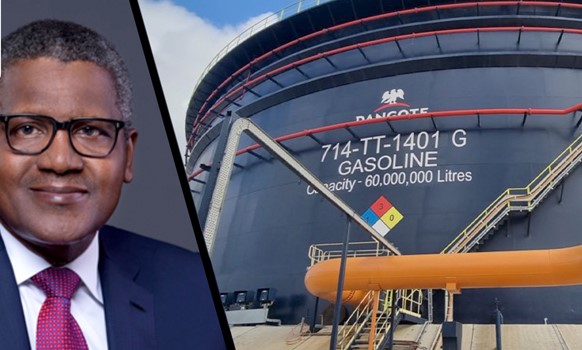
Aliko Dangote announces a major petrol price cut to ₦740 per litre as his refinery drops gantry price to ₦699, accuses NMDPRA of economic sabotage

Dangote Slashes Petrol Price to ₦740, Accuses Regulator of Sabotaging Local Refining
Nigerians are set for relief at the pumps as the Dangote Petroleum Refinery has announced a significant reduction in the price of Premium Motor Spirit (PMS), bringing pump prices down to ₦740 per litre starting Tuesday, December 16, with Lagos taking the lead.
President and Chief Executive Officer of Dangote Industries Limited, Aliko Dangote, made the announcement on Sunday during a press conference at the Dangote Petroleum Refinery, where he also launched a blistering attack on the leadership of the Nigerian Midstream and Downstream Petroleum Regulatory Authority (NMDPRA).
Dangote disclosed that the refinery had reduced its gantry price to ₦699 per litre, assuring Nigerians that the savings would be fully reflected at the retail level.
“So if you come to the refinery today, you will get PMS at ₦699 per litre,” he said.
According to him, MRS filling stations will be the first to sell petrol at prices not exceeding ₦740 per litre, beginning in Lagos, with nationwide adjustments to follow.
Dangote accused the NMDPRA, under the leadership of Engr. Farouk Ahmed, of economic sabotage, alleging collusion with international traders and fuel importers to frustrate domestic refining through continued issuance of import licences.
He further alleged that the regulator’s leadership was living beyond its legitimate means, raising concerns about conflicts of interest in the downstream sector.
“Such expenditure raises serious questions about integrity and regulatory oversight in the petroleum industry,” Dangote said.
Despite what he described as “frustration and sabotage,” Dangote insisted that Nigerians would ultimately benefit from local refining, even if fuel importers suffer losses.
“Anyone who chooses to continue importing despite the availability of locally refined products should be prepared to face the consequences,” he declared.
The refinery boss revealed that the company had reduced its minimum purchase requirement from two million litres to 500,000 litres, enabling more marketers, including members of the Independent Petroleum Marketers Association of Nigeria (IPMAN), to participate.
Dangote also disclosed plans to deploy Compressed Natural Gas (CNG) trucks, with an initial fleet of 4,000 units, adding that more would be procured if necessary to sustain affordable nationwide distribution.
Highlighting product quality, Dangote said fuel supplied by the refinery was straight-run PMS, unlike imported blended products.
“Nigerians have a choice to buy better quality fuel at a more affordable price or buy blended PMS at a higher rate. Importers can continue to lose, so long as Nigerians benefit,” he said.
Dangote stressed that the refinery was driven by legacy rather than profit, revealing plans to list the facility on the Nigerian Exchange to allow Nigerians to own shares.
“We want every living Nigerian to have the opportunity to benefit, no matter how small their holding. If the market takes 55 per cent and I retain 45 per cent, I am satisfied,” he said.
He added that discussions were ongoing with the Securities and Exchange Commission (SEC) to enable Nigerians to buy shares in naira while receiving dividends in dollars.
Dangote also accused the NMDPRA of misrepresenting refinery capacity by publishing offtake figures instead of actual production levels.
“We have the capacity to meet local demand, and we have sufficient refined products in stock. But to keep prices high, imports are deliberately encouraged,” he said.
He warned against attempts to force the refinery into exporting products only for them to be re-imported into Nigeria at higher prices.
“This refinery is for Nigerians first, and I am not giving up,” Dangote declared.
He further revealed that the refinery currently imports about 100 million barrels of crude annually from the United States, a figure projected to rise to 200 million barrels due to inadequate domestic crude supply. The refinery also sources crude from Ghana and other countries while exporting jet fuel and gasoline to the U.S.
With the latest price cut, Dangote reaffirmed his commitment to ensuring Nigerians enjoy the full benefits of domestic refining and lower fuel costs.