


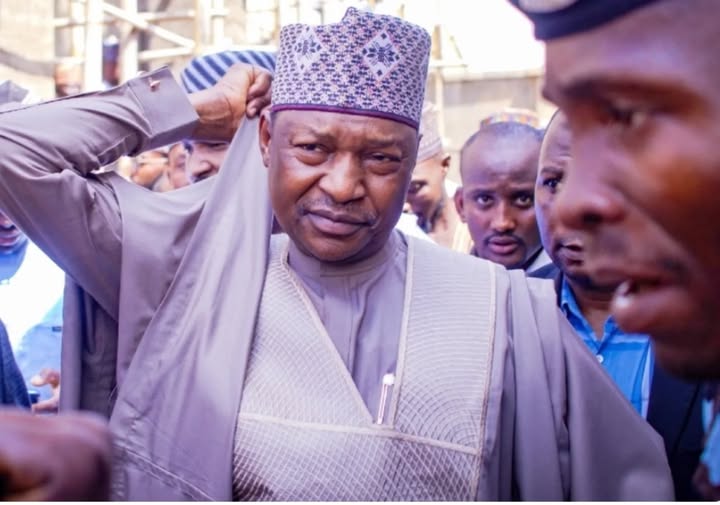
Abubakar Malami’s 2027 Kebbi governorship ambition faces uncertainty as EFCC prosecution, property forfeiture and political backlash deepen tensions in the state
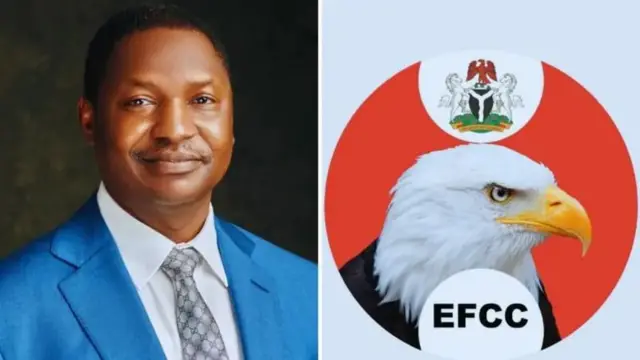
EFCC Case Deepens Crisis in Malami’s 2027 Kebbi Governorship Bid
The political camp of former Attorney-General of the Federation and Minister of Justice, Abubakar Malami (SAN), has been thrown into visible disarray following his deepening legal battle with the Economic and Financial Crimes Commission (EFCC)—a development widely viewed as a major setback to his 2027 governorship ambition in Kebbi State.
Malami had, in July 2025, defected from the All Progressives Congress (APC) to the African Democratic Congress (ADC) and formally declared his intention to contest the 2027 governorship election, pledging to “restore hope” to Kebbi State.
While the declaration initially injected fresh momentum into the state’s opposition politics, reactions were sharply divided. Supporters hailed the move as bold and timely, while critics dismissed the ambition as “dead on arrival.”
Among the most vocal critics was Yahya Sarki, Chief Press Secretary to Kebbi State Governor Nasir Idris, who openly questioned Malami’s eligibility for elective office, citing integrity concerns and the corruption allegations trailing him.
Barely four months after his declaration, Malami was arrested by the EFCC on December 8, 2025, over allegations bordering on money laundering, conspiracy, and abuse of office.
The anti-graft agency is prosecuting Malami alongside his son, Abdulaziz Malami, and an employee of Rahamaniyya Properties Limited, Hajia Asabe Bashir, over alleged concealment of proceeds of unlawful activities running into billions of naira. The alleged offences are said to have occurred between November 2015 and June 2025.
Although Malami has consistently denied all allegations, including claims involving N12 billion, a Federal High Court in Abuja recently ordered the interim forfeiture of 57 properties allegedly linked to him.
The ruling, delivered by Justice Emeka Nwite following an ex parte application filed by the EFCC through its counsel, Ekele Iheanacho (SAN), further unsettled Malami’s political base.
Political Camp in Disarray
Investigations by NewsHeadline247 indicate growing uncertainty among Malami’s supporters in Kebbi State. A visit to his residence at Gesse Phase II, Birnin Kebbi, revealed an unusual calm, with the once-busy compound largely deserted.
Similarly, activity at the ADC secretariat along Emir Haruna Rasheed Road was minimal—marking a sharp contrast to the political buzz that followed Malami’s defection to the party.
Many party faithful privately attributed the lull to uncertainty surrounding the former AGF’s legal troubles.
Rising Political Pressures
Malami has remained under intense political pressure since announcing his ambition. In September 2025, he narrowly escaped death when his convoy was attacked by suspected political thugs in Birnin Kebbi, leaving about 10 vehicles destroyed and several supporters injured.
Political observers had linked the incident to attempts by rivals to weaken his growing influence.
With the unfolding EFCC case, analysts believe Malami now faces serious distractions ahead of the 2027 polls—potentially clearing the path for incumbent Governor Nasir Idris, who is widely believed to have no formidable challenger.
Before Malami’s entry into the race, the opposition PDP had suffered a major setback following the defection of key figures, including Senators Adamu Aliero, Yahaya Abdullahi, and Garba Musa Maidoki, to the APC.
Claims of Witch-Hunt
Despite the developments, Malami’s camp insists the case is politically motivated.
His Special Assistant on Media, Mohammed Bello Doka, accused the EFCC of engaging in a media trial aimed at tarnishing Malami’s image.
“The EFCC has chosen to weaponise a routine judicial process and spin it into a sensational narrative to damage Malami’s reputation,” Doka said.
Former Vice President Atiku Abubakar also criticised the EFCC, describing the prosecution as “a full-blown political witch-hunt” and alleging selective targeting of opposition figures.
The ADC in Kebbi State echoed similar sentiments, insisting Malami did not violate any bail conditions and accusing the EFCC of attempting to undermine his governorship ambition.
What Lies Ahead
Political analysts note that while Malami remains constitutionally eligible to contest as long as he is not convicted, the outcome of the trial—and his ability to sustain grassroots mobilisation—will largely shape his political future.
As the case unfolds, observers say Malami faces a defining test: whether he can retain political relevance while defending himself in what is fast becoming one of the most consequential corruption trials in recent Nigerian political history. Read More