
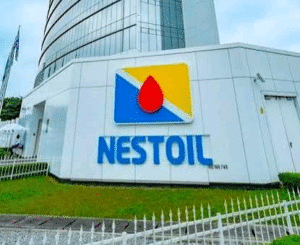

The EFCC has recovered $60m from Nestoil and paid the funds to lenders as part of efforts to resolve the oil firm’s long-running debt crisis
EFCC Recovers $60m From Nestoil as Debt Talks Advance
Nigeria’s anti-corruption agency, the Economic and Financial Crimes Commission, has recovered $60 million from indigenous oil and gas company Nestoil Limited as efforts intensify to resolve the company’s long-running debt dispute with a consortium of lenders.
The recovery followed an intervention by the EFCC aimed at facilitating an agreement between Nestoil and the lenders after the company’s indebtedness triggered a prolonged legal battle with major implications for some of Nigeria’s financial institutions.
It was gathered that an engagement facilitated by EFCC Chairman, Ola Olukoyede, resulted in Nestoil and the consortium of lenders agreeing to a structured repayment arrangement as the agency sought to recover funds owed by the company.
Sources familiar with the development said $60 million had so far been recovered from Nestoil and paid to the lenders during the course of the EFCC’s intervention, investigation and subsequent meetings involving the parties.
Oguzi Moses, Head of Investigation at the EFCC’s Lagos Zonal Directorate 2, was said to have facilitated the payments made so far.
The development could provide a major opening for the resolution of the bitter dispute, which has dragged through several levels of Nigeria’s courts and involved claims running into more than $1 billion and hundreds of billions of naira.
The lenders have reportedly welcomed the $60 million recovery as an important first step, while stressing that a substantial portion of the outstanding debt remains unpaid.
An EFCC spokesperson, Dele Oyewale, did not respond to calls seeking confirmation of the development. However, a senior official of the commission, who spoke on condition of anonymity because he was not authorised to discuss the matter publicly, confirmed the recovery and said the EFCC became involved because of the wider economic implications of the dispute.
Nnenna Azudialu-Obiejesi, an executive director at Nestoil, also did not respond to calls seeking comment.
The latest recovery comes against the backdrop of a major legal and financial dispute between Nestoil, its affiliate Neconde Energy and a consortium of lenders led by FBNQuest Merchant Bank and First Trustees Limited.
The dispute centres on loans obtained by Nestoil from several lenders over the years and subsequent defaults despite restructuring arrangements. The lenders have sought to recover debts which, according to figures contained in court-related filings and lenders’ statements, have risen to more than $1 billion and hundreds of billions of naira.
The case became particularly contentious in October 2025 when the Federal High Court in Lagos granted an order authorising First Trustees and FBNQuest Merchant Bank to take control of Nestoil’s assets. The order restrained dealings in $1.012 billion and N430.014 billion, figures stated as the company’s total indebtedness as of September 30, 2025.
Police subsequently sealed Nestoil’s corporate headquarters in Lagos after the company was placed under receivership, escalating the dispute between the oil company and its lenders.
The legal battle later moved through the Court of Appeal and Supreme Court, with questions surrounding the receivership, interim injunctions and the legal representation of Nestoil and Neconde.
In June 2026, the Supreme Court set aside an ex parte order previously granted by the Court of Appeal. The lenders subsequently clarified that the apex court’s decision did not extinguish Nestoil’s underlying indebtedness or automatically terminate the receivership.
The lenders said in a statement following the Supreme Court ruling: “Prior to the Court Action, Nestoil obtained several bilateral loan facilities from eight (8) lenders dating back to 2010 and serially defaulted on all the various repayment obligations.”
“Nestoil subsequently proposed restructuring the bilateral loan facilities to bring the Lenders into a Global Club to ease the administration of the indebtedness. Lenders, in good faith, agreed to this restructuring, but Nestoil has again serially defaulted on its repayment obligations since the restructuring became effective in 2023,” the lenders added.
The lenders have also maintained that the Supreme Court ruling should not be interpreted as absolving Nestoil of its debt obligations, saying the substantive issues surrounding the indebtedness remained before the appropriate lower courts.
The scale of the dispute has raised concerns beyond the immediate parties because of the potential impact on the balance sheets of some of Nigeria’s largest banks. The lenders have previously argued that Nestoil’s distressed loans have contributed to significant financial pressure on affected institutions.
The consortium has identified First Bank, United Bank for Africa and Access Bank among institutions affected by the troubled exposure, while earlier court documents also listed a wide range of other financial institutions as affected parties.
The $60 million recovery therefore represents more than a partial repayment in a long-running commercial dispute. For the lenders, it provides an early indication that negotiated recovery may offer a path out of a legal battle that has consumed significant time and resources. For the EFCC, the intervention places the agency at the centre of an effort to protect the wider economic interests potentially affected by the unresolved debt.
The recovery also comes as the EFCC continues to pursue investigations and actions involving companies affiliated with Nestoil. In April 2026, a Federal High Court in Abuja set aside interim orders that had restrained the commission from investigating two Nestoil-affiliated companies, clearing the way for the EFCC to proceed with its probe into alleged infractions.
With $60 million now recovered and paid to the lenders, attention will shift to whether Nestoil can sustain the structured repayment arrangement and whether the parties can finally reach a comprehensive settlement over the much larger outstanding debt.
For Nigeria’s banking sector, the outcome could have significant implications, particularly as lenders continue efforts to clean up non-performing loans and strengthen their balance sheets. For Nestoil, the latest payment could mark a critical step towards resolving one of the most closely watched corporate debt disputes in the country.