

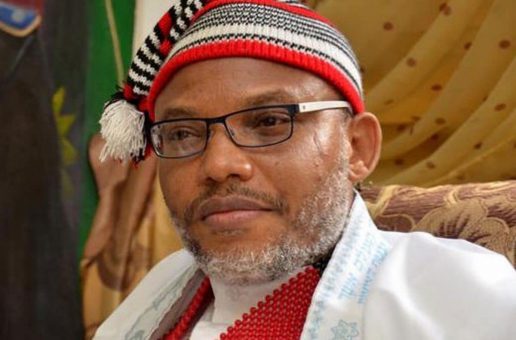
IPOB leader Nnamdi Kanu names high-profile politicians and military chiefs, including Wike, Danjuma, Buratai, Sanwo-Olu, and Uzodinma, as witnesses in his defence at the Federal High Court, Abuja
Kanu Lists Wike, Danjuma, Buratai, Sanwo-Olu, Uzodinma, Others as Defence Witnesses in Ongoing Terrorism Trial
Abuja, Nigeria — The detained leader of the Indigenous People of Biafra (IPOB), Nnamdi Kanu, has listed several high-profile current and former government officials as compellable witnesses in his ongoing terrorism trial at the Federal High Court, Abuja.
Among those Kanu seeks to summon are Nyesom Wike, Minister of the Federal Capital Territory (FCT); Lt. Gen. Theophilus Danjuma (rtd), former Chief of Army Staff; Lt. Gen. Tukur Buratai (rtd), former Chief of Army Staff; Governor Babajide Sanwo-Olu of Lagos State; and Governor Hope Uzodinma of Imo State.
Others named include Dave Umahi, Minister of Works; Okezie Ikpeazu, immediate past Governor of Abia State; Ahmed Rufai Abubakar, immediate past Director-General of the National Intelligence Agency (NIA); and Yusuf Bichi, former Director-General of the Department of State Services (DSS).
It remains unclear how Kanu intends to use the testimonies of the listed officials in his defence or whether any of them had prior knowledge of his move to subpoena them.
According to the News Agency of Nigeria (NAN), Kanu personally filed a new motion dated 21 October 2025, titled:
“Notice of Number and Names of Witnesses to be Called by the Defendant and Request for Witness Summons/Subpoena and the Variation of the Time Within Which to Defend the Counts/Charges Against the Defendant.”
The application follows a September ruling by Justice James Omotosho dismissing Kanu’s no-case submission and directing him to begin his defence.
Just last week, a court-ordered medical panel declared him fit to stand trial, paving the way for the court to schedule Thursday, 23 October, for the opening of his defence.
In his motion, the IPOB leader said he plans to call a total of 23 witnesses, grouped into two categories — “ordinary but material witnesses” and “vital and compellable witnesses” — the latter to be summoned under Section 232 of the Evidence Act, 2011.
Kanu, who holds dual citizenship of Nigeria and the United Kingdom, told the court that he intends to testify personally to “deny the allegations” and “explain the political context” of his statements and actions.
Kanu also asked the court for an extension of the six consecutive days earlier granted for his defence, seeking instead a 90-day timeframe to enable him to conclude his presentation of witnesses.
He assured the court that his defence would not cause unnecessary delays, adding that “justice must not only be done but must also be manifestly seen to have been done.”
The IPOB leader further promised to provide sworn statements from all voluntary witnesses and to duly notify the prosecution within a reasonable time.
The prosecution had closed its case on 19 June 2025 after presenting five witnesses who testified that Kanu’s social media rhetoric incited violence, killings, and destruction of property in the South-east.
A series of health-related complaints and interlocutory motions thereafter stalled the opening of the defence, prompting the latest court directive to begin on 23 October.
Meanwhile, Kanu has also filed a preliminary objection challenging the jurisdiction of the court to continue hearing the case, a move that coincided with the medical panel’s confirmation of his fitness to stand trial.
As the court proceedings unfold, Abuja witnessed renewed protests on Monday under the #FreeNnamdiKanuNow banner, led by human rights activist Omoyele Sowore, demanding Kanu’s unconditional release.
Police, however, arrested 12 participants — including Aloy Ejimakor, a member of Kanu’s defence team, and Emmanuel Kanu, the IPOB leader’s brother — for allegedly violating a judicial order restricting the protest from certain high-security areas in the capital.
A Magistrate’s Court in Kuje has since ordered that the detainees be remanded at the Kuje Correctional Centre pending arraignment on 24 October for charges of disobedience to a lawful order and incitement of public disturbance.
With the court’s directive for the IPOB leader to commence his defence this week, legal analysts say the inclusion of such politically and militarily influential witnesses could mark a new twist in a case that has drawn both national and international attention.
Kanu’s trial, which began in 2015, remains one of Nigeria’s most closely watched legal battles — a test case for free speech, national unity, and the limits of political expression within the context of Nigeria’s sovereignty. Read More
(NAN)