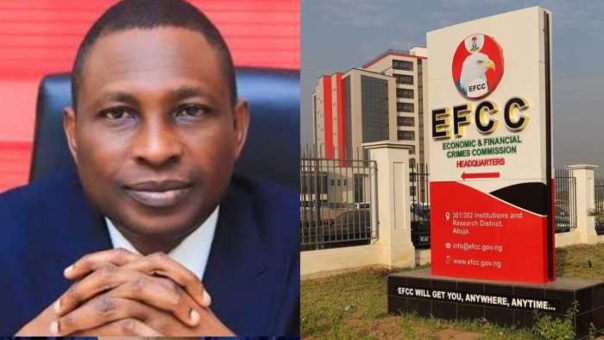
A special task force has been set to begin physical inspections of estates nationwide, starting from Abuja
Money Laundering Scandal: EFCC Probes Real Estate Boom Funded by ‘Corrupt Civil Servants’
The Economic and Financial Crimes Commission (EFCC) has launched a nationwide investigation into Nigeria’s real estate sector, identifying it as a major channel for laundering stolen public funds—particularly by civil servants.
Speaking at a policy dialogue on Nigeria’s real estate ecosystem in Abuja, EFCC Chairman, Ola Olukoyede, declared that the agency has begun probing property developments across the country, many of which are allegedly financed with illicit money.
“What we have been able to find out is that most of these estates are funded by civil servants who have stolen money,” Olukoyede revealed.
He disclosed that the EFCC has already secured interim forfeiture orders on 15 such properties, many of which have remained abandoned or uncompleted for over a decade, suggesting a drying up of the illicit cash flows that funded them.
“It will shock you that some of these estates have been abandoned for between 10 and 20 years. They just take the construction to a certain level and abandon it,” he added.
“The moment they leave public service and the money is no longer coming, they abandon the estates.”
Olukoyede has set up a special task force to begin physical inspections of estates nationwide, starting from Abuja. He also stressed the need for the Beneficial Ownership Register to become operational, as it would expose the actual owners behind shady corporate entities and anonymous property investments.
The anti-corruption czar raised an alarm over the increasing use of the real estate sector for money laundering, describing the trend as “extremely rampant” and difficult to regulate due to the lack of transparency in land and property transactions.
“No one goes to a Nigerian bank and borrows at 30% interest to invest in real estate and makes a profit,” he said.
“Real estate development takes time—sometimes five years. So, if someone is pumping billions into estates without viable financing, the source of funds becomes suspicious.”
Olukoyede also stressed that the nation’s cash-based economy worsens corruption, calling for a shift toward a credit-based system and electronic transactions.
“A thousand EFCCs will not be able to scratch the surface of our corruption problem if we continue with our cash-based economy,” he warned.
“You want to buy a house, it’s cash. A car, it’s cash. Everything is done by cash. This must change.”
He revealed that some suspects under investigation admitted they diverted public funds out of desperation to meet family needs due to societal pressure.
“Some will come to you and say: ‘Yes, I did it. There’s no other way to pay my children’s school fees or survive. Please, I’m at your mercy.’”
The event, organised by the Abuja-based legal firm Law Corridor, also featured the President of the Nigerian Bar Association (NBA), Mazi Afam Osigwe (SAN), and the Director-General of the Bureau of Public Procurement (BPP), Dr. Adebowale Adedokun. Both joined the EFCC chair in calling for urgent reforms in Nigeria’s land administration and procurement processes.
Osigwe criticized the archaic land documentation system, lamenting how difficult it is to verify property ownership in Nigeria.
“I can sit down here and, with the payment of appropriate fees, confirm ownership of a property in the UK. But I can’t do that here,” he said.
“The current system is not working and cannot work. We must embrace technology for a transparent and seamless process.”
Adedokun added that a large number of housing projects are publicly funded and, unless procurement and execution are properly monitored, real estate will continue to be a soft target for laundering diverted public funds.
“What gives people funds to launder is the difference between actual project cost and what is claimed,” he explained.
“Since they can’t bank the extra money, they turn to real estate—because it’s poorly regulated.”
All three speakers called for the creation of special low-interest funds for real estate investments through institutions like the Federal Mortgage Bank and Aso Savings and Loans to discourage illicit investments and promote genuine development.
They concluded that without reforms in land registration, property ownership transparency, and financial regulation in the real estate sector, the fight against money laundering in Nigeria will remain an uphill battle. Read More