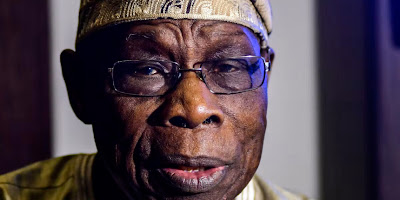



Former President Olusegun Obasanjo blames the 1979 civilian government for lifting his rice import ban, saying it led to kickbacks, policy failure, and Nigeria’s ongoing rice importation crisis
Obasanjo Drops Bombshell: 1979 Rice Import Ban Lift “Set Nigeria Back Decades” – Shares Infamous $5m Kickback Scandal
Former President Olusegun Obasanjo has pointed accusing fingers at the civilian administration that succeeded his military government in 1979, blaming their swift decision to lift a rice import ban for locking Nigeria into decades of costly food importation dependence.
Delivering the keynote at the International Memorial Lecture and Leadership Conference in Abuja on Thursday to mark 50 years since the assassination of Gen. Murtala Muhammed, Obasanjo revisited one of his administration’s proudest unfinished achievements.
“By the time we left in July 1979, we wanted to be self-sufficient in rice production. We asked that a report be prepared on what was in the fields. The report showed that we would be self-sufficient that year,” he said.
Armed with that data, his regime banned rice imports just before the October 1979 handover.
“When the civilian administration came in, one of the first things they did was to lift the ban on rice importation so they could allocate import licences to their supporters and political associates,” he added.
Obasanjo narrated a notorious case of alleged abuse that still embarrasses the nation:
“Let me give you an example. One of the barons who obtained a rice import licence from America ordered rice and then asked the suppliers to add $5m to the cost.
“They added the $5m and supplied the rice. He then went back to New York and demanded $2.5m out of the $5m. They refused and gave him only $1 million.
“He reported the matter to the Nigerian embassy and to the Nigerian representative at the UN, who contacted the suppliers. The suppliers said they did not understand what the issue was.
“Eventually, the suppliers explained that the man had asked them to add $5m to the cost and that, without doing so, they would have lost the contract.
“They took the risk and secured the deal. He wanted $2.5m but had taken no risk, so they gave him $1m.
“The ambassador said he felt like digging a hole and sinking into it. That was your country,” he said.
Obasanjo declared the long-term damage irreversible:
“Since the lifting of the rice import ban in 1979, we have not recovered from it. That is why we are still importing rice today.
“These are the kinds of things that go wrong, and then we ask whether Africa has come of age. I wonder.”
He lamented Nigeria’s broader economic regression, noting the country once ranked 37th globally and could have reached the top 10 with sustained progress.
“There was a time when Nigeria ranked 37th among the economies of the world. If we had continued at that rate for 20 years, we would by now have been among the top 10. Today, I do not even know where we stand,” he said.
Citing agriculture as proof of policy inconsistency, Obasanjo revealed how cocoa output tripled under his elected presidency from 150,000 to 450,000 metric tonnes, only to fall back to around 300,000 today.
He stressed the urgent formula for continental progress: “What we need to do is reform and produce. Reform and produce.”
For Africa to truly “come of age,” Obasanjo argued it must sustain 9–10% annual GDP growth—a feat he insisted is achievable.
Reflecting on leadership, he praised Gen. Murtala Muhammed’s greatest legacy while admitting a shared failure:
“The greatest achievement of Murtala, in my view, was that he created a successor who could continue after him. The failure of all leaders after Murtala, including myself, is that we have not been able to create successors who could go on after us.”
The address, tied to Murtala’s iconic “Africa Has Come of Age” speech, served as both a tribute and a stark wake-up call on policy continuity, corruption, and the cost of short-sighted political decisions. Read More