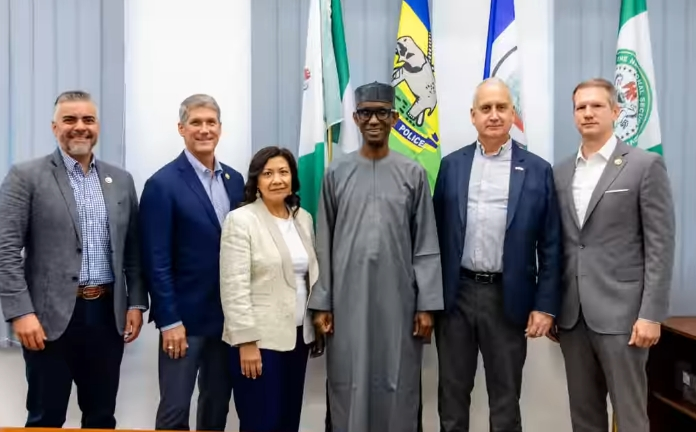
A US Congressional delegation has met Nigeria’s NSA Nuhu Ribadu in Abuja to discuss counter-terrorism and concerns in Washington over alleged religious persecution
A United States Congressional delegation has arrived in Abuja for high-level security and diplomatic talks with Nigeria’s National Security Adviser (NSA), Nuhu Ribadu, as debates intensify in Washington over allegations of religious persecution in Nigeria.
Mr Ribadu confirmed the engagement in a statement on Sunday, noting that he received the lawmakers “on a fact-finding mission to Nigeria,” following earlier discussions in Washington, D.C., focused on shared security concerns.
The visiting delegation included Representatives Mario Díaz-Balart, Norma Torres, Scott Franklin, Juan Ciscomani, and Riley Moore. The US Ambassador to Nigeria, Richard Mills, also joined the meeting—an indication, Mr Ribadu said, of “the importance both nations attach to this engagement.”
According to the NSA, discussions centered on counter-terrorism cooperation, regional stability, and strengthening Nigeria’s strategic security partnership with the United States.
“I’m optimistic this engagement will deepen trust, collaboration, and our shared commitment to peace and security,” Mr Ribadu said.
Sunday’s meeting follows Mr Ribadu’s recent trip to Washington, where he led a high-level delegation amid heightened congressional scrutiny and renewed efforts by some US lawmakers to classify Nigeria as a “Country of Particular Concern” (CPC) over alleged persecution of Christians.
During that visit, the Nigerian delegation met with several top officials, including US Secretary of War, Pete Hegseth.
Mr Hegseth said he discussed “horrific violence against Christians” in Nigeria and noted that Washington was working “aggressively with Nigeria to end the persecution of Christians by jihadist terrorists.”
The Nigerian team also held talks with Rep. Riley Moore, one of the most vocal promoters of what officials in Abuja describe as a false “Christian genocide” narrative.
Mr Moore said the conversations were “frank, honest, and productive,” adding that Nigerian officials explained their concerns about counterterrorism operations, security assistance, and the protection of vulnerable communities.
A Deeply Divided US Congress
Since September, several American politicians and advocacy groups—including Senator Ted Cruz, Mike Arnold, and various Christian leaders—have amplified claims that Islamist militants in Nigeria are carrying out systematic attacks targeting Christians.
Senator Cruz has sponsored a bill proposing punitive measures against Nigerian officials, while a coalition of Christian leaders filed an October petition urging the US State Department to re-designate Nigeria as a CPC.
However, recent US congressional hearings have revealed deep partisan divisions. Reports have it that he US lawmakers clashed over the issue last week, with some framing Nigeria’s crisis as “Christian genocide,” while others argued the narrative oversimplifies a complex conflict involving multiple non-state armed groups.
Fact-Checks Challenge the ‘Genocide’ Claims
Independent security researchers, along with publications such as a BBC fact-check and a PREMIUM TIMES editorial, have cast doubt on several data points used to support the genocide narrative, noting that many claims cannot be independently verified.
Experts argue Nigeria’s security landscape is multifaceted—affecting both Christians and Muslims—and largely driven by criminal groups, jihadist elements, and communal conflicts, rather than religious motivations alone.
The Nigerian government has consistently rejected accusations of Christian persecution, describing them as “a gross misrepresentation of reality.” Officials insist terrorists attack anyone who resists their ideology, “regardless of faith.”