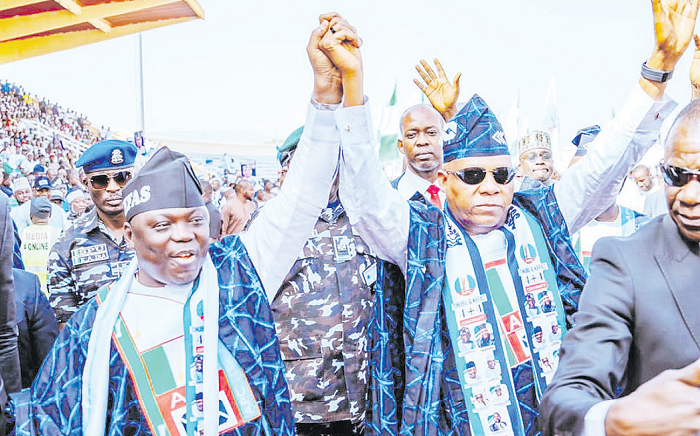
Taraba State’s political landscape shifted dramatically on Saturday, January 31, 2026, as Governor Agbu Kefas formally defected from the Peoples Democratic Party (PDP) to the All Progressives Congress (APC), ending the state’s long-standing reputation as the PDP’s last northern stronghold.
The symbolic presentation of the APC flag to Kefas by the party’s National Chairman, Nentawe Yilwatda, at the Jolly Nyame Stadium in Jalingo marked the climax of months of political maneuvering.
The colourful ceremony, attended by Vice President Kashim Shettima and six APC governors, underscored the strategic importance of the defection ahead of the 2027 general elections.
Speculation about Kefas’ movement began months earlier when he was introduced to President Bola Ahmed Tinubu at the Presidential Villa, Abuja.
Although plans for his formal reception into the APC were concluded in November 2025, the event was postponed in solidarity with Kebbi State following the abduction of schoolchildren.
Kefas later registered officially as an APC member in December, receiving his membership card at the TY Danjuma House in Jalingo.
Explaining the delay, Kefas said national concerns required empathy and restraint. But on the rescheduled date, he made his intentions clear.
“It is not for me; it is for you,” he told cheering supporters. “Taraba must align with the centre. I am not here for survival; I am here for service.”
Alignment With the Centre
Vice President Shettima described governance as “an act of partnership, not isolation,” reinforcing the APC’s message that alignment with the Federal Government guarantees accelerated development.
Senate President Godswill Akpabio, represented by Deputy Senate President Barau Jibrin, said Taraba now stood to benefit from stronger federal collaboration.
Professor Yilwatda called the defection “shifting cultivation,” assuring Kefas of the rewards of joining the progressive fold.
Since Nigeria’s return to democracy in 1999, Taraba had remained firmly under PDP control, resisting the APC wave that swept across much of the North.
Even neighbouring Adamawa and Gombe oscillated between parties, but Taraba stood loyal to the PDP until now.
Political observers note that PDP dominance had been waning.
In the 2023 governorship election, Kefas secured victory with 302,614 votes, while the combined votes of APC and NNPP surpassed his tally a sign of growing opposition strength.
Public reaction remains divided. Critics describe the defection as politically self-serving, while supporters argue it is a pragmatic move to attract federal projects and economic growth.
Federal roads such as Jalingo–Numan, Jalingo–Yola, and Jalingo–Wukari remain in poor condition, while long-awaited projects like the Ibi Bridge, Namnai Bridge, and the Mambilla Hydropower Project are cited as potential dividends of alignment.
The silence of influential elder statesman Theophilus Danjuma, long regarded as a political godfather in Taraba, has fuelled speculation of internal rifts ahead of 2027.
Meanwhile, quiet realignments toward the African Democratic Congress (ADC) suggest the political chessboard is still in motion.
With Kefas now flying the APC flag, Taraba’s political equilibrium has been disrupted.
Ethnic balancing, zoning considerations, and the “godfather factor” may shape the next electoral battle.
Whether this defection ushers in development or deeper political rivalry remains to be seen.
But one thing is clear: Taraba has entered a new political chapter — and 2027 promises to be decisive.