

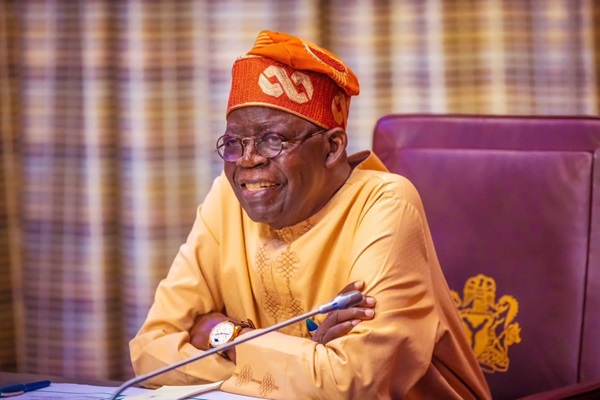

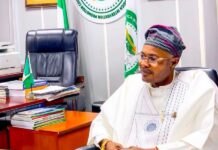


President Bola Tinubu has called for stronger national and international cooperation to tackle Nigeria’s emerging security threats and strengthen national unity
Tinubu Seeks Global Action Against Nigeria’s Emerging Security Threats
President Bola Ahmed Tinubu has called for stronger national and international cooperation to confront the “multifaceted” security challenges facing Nigeria and other parts of the world.
Tinubu said the evolving nature of security threats required coordinated and sustainable responses involving governments, international organisations, religious leaders and other stakeholders.
The President spoke in Abuja on Tuesday at a two-day international security conference organised by Jama’atu Izalatil Bidiah wa Iqamatis Sunnah, JIBWIS Nigeria, in partnership with the Muslim World League of Saudi Arabia.
The conference, themed “Diversity and Social Peace: Partnership for a Promising Future,” brought together religious leaders from Muslim and Christian communities, as well as scholars and representatives from Saudi Arabia and other African countries.
Represented at the event by the Deputy President of the Senate, Senator Barau Jibrin, Tinubu said his administration remained committed to collaborating with other countries and international organisations to build a stable and secure Nigeria while contributing to global security.
“Working within the Committee of Nations, [the government is] collaborating every day to ensure that security remains not only in our country but in the entire globe,” he said.
Tinubu said the conference was timely given the changing security landscape and the growing need for governments, faith leaders and other stakeholders to examine emerging threats to national and digital security systems.
According to him, the meeting was expected to assess trends placing pressure on Nigeria’s national and digital security architecture and develop recommendations capable of complementing the Federal Government’s ongoing efforts to tackle insecurity.
The President also called for the preservation of Nigeria’s unity, urging citizens to work together despite their religious, ethnic and other differences to protect the country’s cohesion and stability.
He commended the Muslim World League for selecting Nigeria as the venue for the conference, describing the decision as significant and assuring participants of the Federal Government’s support for initiatives designed to promote peace and security.
Tinubu expressed confidence that the deliberations would produce practical recommendations capable of strengthening the government’s security objectives and helping Nigeria respond more effectively to contemporary security challenges.
Also speaking at the conference, the National Chairman of the All Progressives Congress, APC, Nentawe Yilwatda, urged religious leaders to transform churches and mosques into centres of peace, stressing that religion should promote human dignity, tolerance and peaceful coexistence rather than hatred and division.
Yilwatda called on clerics to use their influence to foster peaceful relationships among Nigerians of different faiths, warning that religious convictions must never become a tool for inciting violence or hatred.
“Let us preach faith without hatred, conviction without contempt, and truth without incitement,” he said.
“We can preach truth without inciting people. That’s the whole way of teaching as a religious leader.”
The APC chairman said religious differences should never undermine the shared humanity of Nigerians, arguing that genuine faith must compel believers to protect the lives, dignity and freedom of people who worship differently.
“Can we truly change the people of faith if our faith does not compel us to protect the life, dignity, and freedom of those who worship differently from us?” he asked.
“If your religion does not protect the dignity of all human life, then we are not acting in religion.”
Yilwatda said his conviction about peaceful coexistence was shaped by his childhood in Yola, Adamawa State, where his father, a pastor, maintained a close relationship with a Muslim leader.
He recalled how the two families visited each other and celebrated religious occasions together, saying the experience taught him that differences in faith should not prevent Nigerians from building meaningful relationships and living peacefully.
However, he said his later experience of communal violence in Bauchi, where his family lost its home and possessions, exposed him to the devastating consequences of violence carried out in the name of religion or ethnicity.
“Sometimes they commit it in the name of religion, but I don’t believe they spare anybody. Sometimes it’s committed in the name of tribal diversity. I believe it spares nobody. All of us are victims,” he said.
According to Yilwatda, the experience of displacement and suffering further reinforced his belief that Nigerians have more in common than their religious and ethnic differences suggest.
“We have different places of worship and different religions, but in that moment of suffering, none of these different places will protect anyone,” he said.
“We may worship differently, but we suffer together. We dream together. We can build together, and ultimately, we can rise and fall together.”
The APC chairman also warned political leaders against exploiting religion and ethnicity for political advantage, urging them instead to promote unity and peaceful coexistence.
He called on traditional rulers to deploy their moral authority to encourage dialogue, reduce suspicion and strengthen relationships among communities.
Yilwatda further urged Nigerians to exercise caution when sharing claims and information capable of deepening religious and ethnic divisions, particularly where such claims could inflame tensions.
He said Nigeria should aspire to a society in which citizens protect and support one another regardless of religious identity.
The APC chairman urged Nigerians to build a country where future generations inherit schools, homes and opportunities rather than displacement camps and memories of violence.
He called on citizens to choose peace over violence and work collectively towards building a more united, secure and peaceful Nigeria.