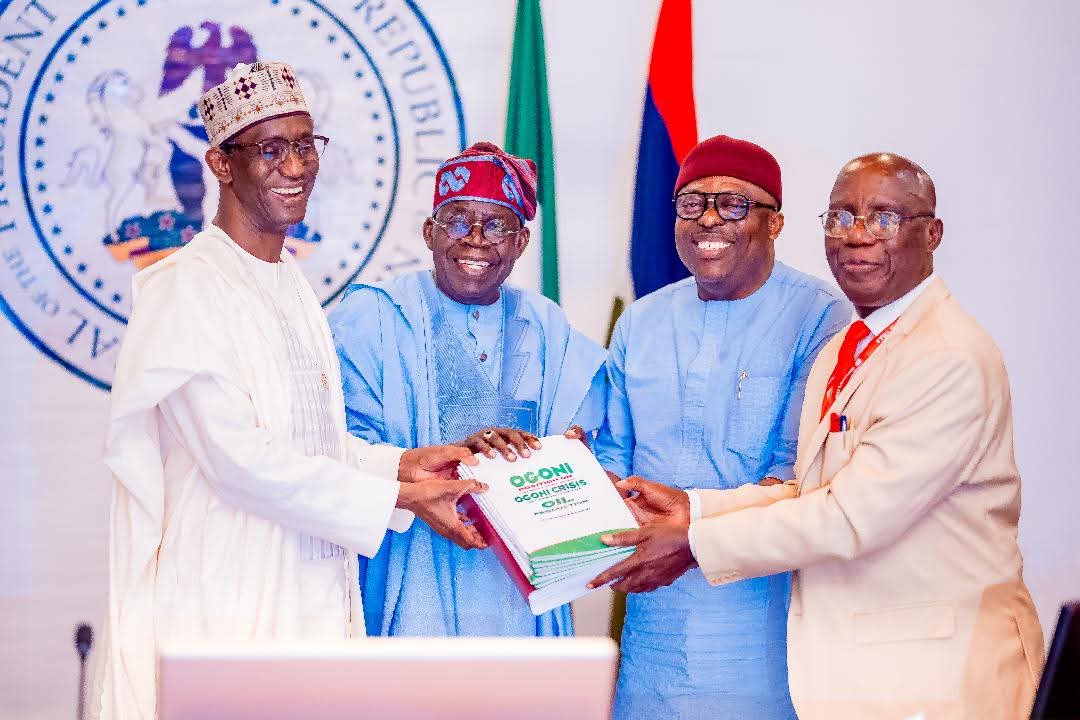
The President gave the directive on Wednesday in Abuja while receiving the report of the Presidential Committee on Ogoni Consultations, chaired by Professor Don Baridam
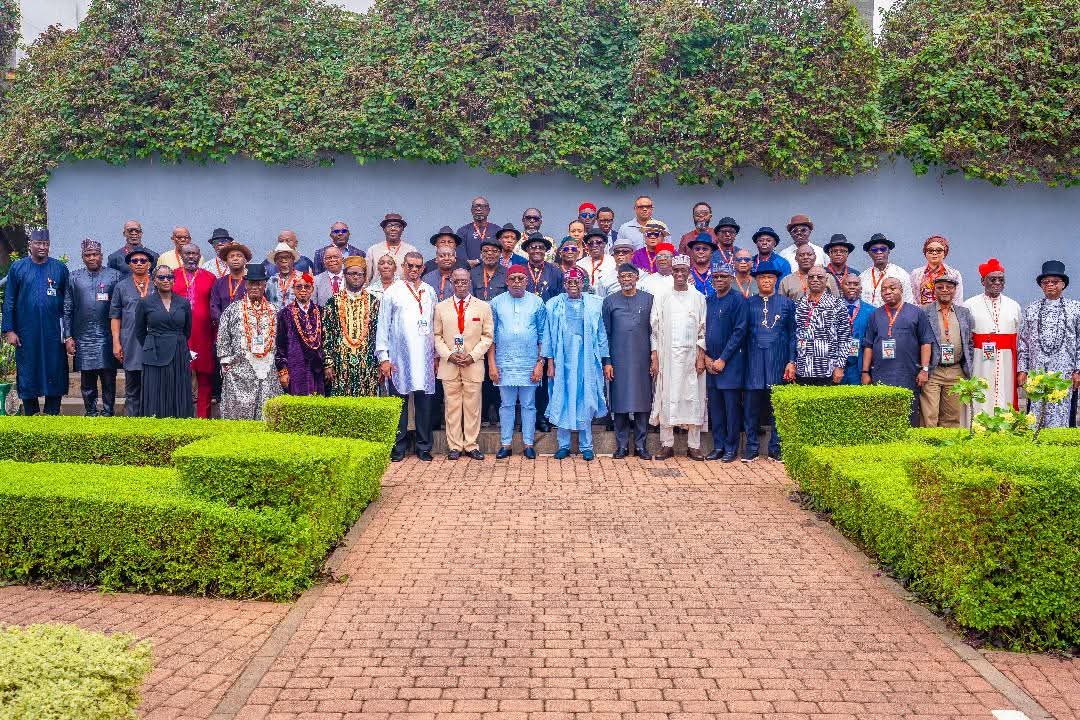
Tinubu Set to Revive Ogoniland, Directs NSA on Oil Production Framework
President Bola Ahmed Tinubu has set in motion a new phase in the long-running Ogoni struggle, directing the National Security Adviser, Mallam Nuhu Ribadu, to immediately engage the Nigerian National Petroleum Company Limited (NNPCL), the Ogoni people, and other key stakeholders to conclude modalities for the resumption of oil production in Ogoniland.
The President gave the directive on Wednesday in Abuja while receiving the report of the Presidential Committee on Ogoni Consultations, chaired by Professor Don Baridam.
Rivers State Governor, Siminalayi Fubara, led the Ogoni delegation to the State House for the presentation.
Tinubu said the federal government recognises the historical injustices and years of pain endured by the Ogoni people, pledging that his administration would safeguard their environment while unlocking shared prosperity through renewed dialogue and cooperation.
“We are not, as a government, taking lightly the years of pain endured in Ogoniland. We recognise that, otherwise, we would not be here today. The Federal Government truly acknowledges the long suffering of the Ogoni people, and today, we declare with conviction that hope is here and is back with us,” the President said.
As part of measures to heal old wounds, Tinubu conferred posthumous national honours of Commander of the Order of the Niger (CON) on four late Ogoni leaders—Chief Edward Kobani, Chief Albert Bade, Chief Samuel Orage, and Chief Theophilus Orage—who died in the course of the struggle for justice and environmental protection.
This follows his earlier recognition in June of Ken Saro-Wiwa and eight other members of the Ogoni Nine, executed under the Abacha regime.
The President underscored the need for reconciliation, urging Ogoni leaders and communities to close ranks and embrace dialogue.
He assured that his administration would provide the necessary resources to support remediation and economic inclusion, while emphasising that oil resumption would be anchored on fairness, equity, and community benefit.
Governor Fubara, speaking on behalf of the delegation, said the administration’s confidence-building measures had already translated into tangible progress on the East-West Road and the establishment of the Federal University of Environment and Technology.
Ribadu highlighted that the process leading to the report was built on careful mediation, dialogue, and inclusive consultations that helped to bridge longstanding divisions.
He explained that repositioning the Hydrocarbon Pollution Remediation Project (HYPREP) had emerged as a key consensus point, with stakeholders calling for a synchronised framework that integrates environmental restoration with renewed operations.
Baridam, in his remarks, commended Tinubu’s commitment and the foresight behind mandating the NSA to drive the dialogue.
He described the recognition of the Ogoni Nine as a powerful statement of acknowledgement for their sacrifices, while assuring that the Ogoni people were ready to embrace a new chapter of responsible oil production.
Tinubu, reaffirming his stance, told the delegation that reconciliation was not an erasure of history but a collective commitment to build a more prosperous future.
He said the overwhelming consensus of Ogoni communities to welcome oil resumption under equitable terms was a strong signal that decades of mistrust could now give way to progress.