into law, triggering fierce backlash from PDP, Labour Party, CUPP and civil society groups who warn of threats to Nigeria’s 2027 elections.%%primary_category%% %%sitename%% %%title%% %%sep%%)
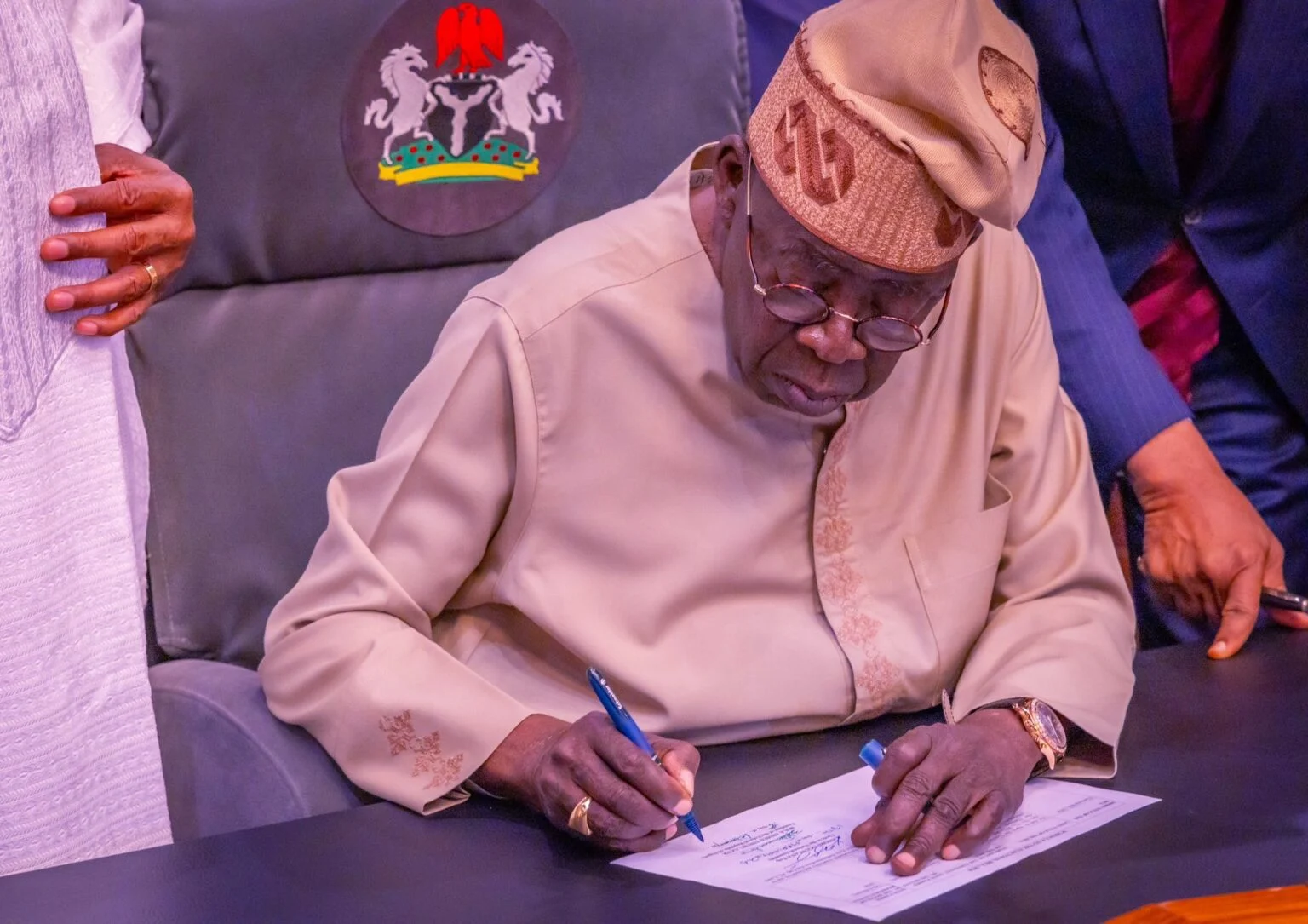
President Bola Tinubu has signed the Electoral Act 2026 (Amendment) into law, igniting a political firestorm as opposition parties and civil society groups accuse the ruling All Progressives Congress (APC) of undermining electoral integrity ahead of the 2027 general elections.
The President assented to the bill at about 5pm on Wednesday at the Presidential Villa, Abuja, less than 24 hours after its passage by the National Assembly of Nigeria.
The Peoples Democratic Party (PDP) described the development as “a dark day for democracy,” alleging that fear of defeat in 2027 drove what it called a rushed and premeditated approval of the contentious amendment.
In a statement by its National Publicity Secretary, Ini Ememobong, the party said the swift assent confirmed a “well-choreographed drama” by the APC, insisting the amendment weakens demands for mandatory real-time electronic transmission of results.
The controversy centres on provisions allowing both electronic and manual transmission of election results — a hybrid model critics argue creates room for manipulation.
Civil society organisations were equally scathing.
Samson Itodo, Executive Director of YIAGA Africa, described the amendment as “a reform in name and a regression in substance,” faulting lawmakers for failing to strengthen safeguards around electronic transmission and the independence of the electoral umpire.
Similarly, Friday Odeh of Accountability Lab Nigeria warned that the law poses a “huge danger of rigging,” calling it a reversal of progress made in recent electoral reforms.
However, Auwal Musa of the Civil Society Legislative Advocacy Centre adopted a measured tone, urging Nigerians to work within the new framework while continuing advocacy for improvements.
The Labour Party caucus in the House of Representatives staged a walkout during plenary, protesting the inclusion of manual transmission clauses. Caucus leader Afam Ogene questioned the speed of presidential assent, suggesting the executive had little time for thorough review.
The Coalition of United Political Parties (CUPP) also accused the President and National Assembly of disregarding public demands for mandatory electronic transmission, describing the amendment as a betrayal of citizens’ aspirations.
Defending the amendment, Tinubu raised concerns about Nigeria’s broadband capacity and technical readiness for full real-time electronic transmission nationwide.
He argued that elections are ultimately managed by people, not machines, stressing that credibility depends on proper oversight at polling units where votes are manually cast and counted.
Senate President Godswill Akpabio said the amended law eliminates manipulation between polling units and collation centres by mandating electronic transmission to INEC’s Result Viewing Portal, while retaining manual backup in areas with poor network coverage.
He also highlighted new provisions introducing direct primaries for political parties and mandating fresh elections where winners are disqualified by courts, rather than declaring runners-up as victors.
Speaker Abbas Tajudeen added that reducing the election notice period from 360 to 300 days could see presidential and National Assembly polls held in January 2027, potentially avoiding voter apathy during Ramadan.
The amendment comes days after the Independent National Electoral Commission (INEC) released the timetable for the 2027 general elections, heightening suspicion among opposition figures that the law is strategically timed.
Meanwhile, Federal Capital Territory Minister Nyesom Wike commended the President for signing the bill within 24 hours, describing it as a demonstration of commitment to strengthening Nigeria’s democracy.
As political tensions mount, the Electoral Act 2026 (Amendment) has set the stage for what promises to be an intense battle over transparency, credibility and trust in Nigeria’s 2027 polls.