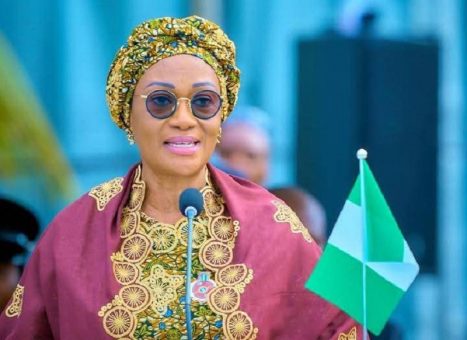


Senior Nigerian lawmakers have described the public recognition of Nigeria’s First Lady, Senator Oluremi Tinubu, by United States President Donald Trump as a significant diplomatic victory for Nigeria and a boost to the country’s global image.
The Senator representing Ondo South and Ambassador-designate, Jimoh Ibrahim (CFR), alongside the Senator representing Edo North, Adams Oshiomhole, said the moment underscored the growing international visibility of Nigeria under President Bola Ahmed Tinubu’s administration.
Ibrahim praised the First Lady’s participation in high-level international religious engagements, particularly her presence at the 74th Annual National Prayer Breakfast in Washington, D.C., which was attended by President Trump. He described her intervention as strategic diplomacy that helped correct what he called long-standing misconceptions about Nigeria’s security challenges.
According to Ibrahim, the First Lady’s engagement helped counter narratives portraying Nigeria’s insecurity as religiously motivated or state-sponsored persecution.
“The fact that President Bola Ahmed Tinubu is married to a pastor clearly dispels allegations of religious genocide, which Nigeria is not known for,” he said.
As Chairman of the Senate Committee on Inter-Parliamentary Affairs, Ibrahim noted that the First Lady’s presence at influential global forums had helped reposition Nigeria’s security issues as a national concern rather than a religious agenda, a shift he said would promote fair and merit-based international support for Nigeria.
He stressed that diplomacy often extends beyond formal negotiations, describing Senator Tinubu’s engagement as influence-driven rather than rhetorical.
“For her to gain access to that level of engagement demonstrates influence rooted in religious diplomacy, which lies at the heart of global misunderstandings about Nigeria,” Ibrahim said.
He added that international relations are largely interest-driven and that religious sentiment had shaped perceptions of Nigeria among some global actors. According to him, the First Lady’s appearance sent a clear message that while Nigeria faces security challenges, the President bears no role in religious persecution.
Describing her as a stabilising diplomatic force, Ibrahim said her intervention achieved in a moment what could have taken years of traditional diplomacy.
“This is a case of action speaking louder than words. History will be kind to her,” he added.
Speaking separately, former Edo State governor Adams Oshiomhole described President Trump’s public acknowledgment of the First Lady as a positive diplomatic gain and a moment of national pride.
Oshiomhole spoke after meeting President Bola Ahmed Tinubu at the State House in Abuja on Friday, saying Trump’s description of the First Lady as “a very respected woman” reflected Nigeria’s rising profile on the global stage.
He said the recognition went beyond personal commendation and carried symbolic importance for Nigeria’s international standing and diplomatic relations.
The senator also highlighted the message of religious harmony conveyed by the President’s Muslim faith and the First Lady’s Christian background, noting that diversity within national leadership could coexist peacefully.
He urged Nigerians to draw inspiration from the development by prioritising unity and collective progress over division, adding that such recognition should serve as a morale booster for the country.
Oshiomhole called on citizens to project confidence and patriotism while working together to confront national challenges and ensure development gains are equitably shared.
The First Lady had recently met President Trump during the February 4, 2026 National Prayer Breakfast in Washington, where the US leader publicly praised her and referenced her pastoral role in the Redeemed Christian Church of God, one of Nigeria’s largest Christian denominations. Trump also invited her to join him on stage during the event.
The programme featured discussions on faith, global religious freedom and US–Nigeria security cooperation against terrorism.
The encounter came amid heightened US scrutiny of Nigeria’s security situation, including Washington’s late-2025 designation of Nigeria as a “country of particular concern” over reported violence against Christians—a label the Nigerian government has strongly disputed.
Observers say the First Lady’s participation forms part of Nigeria’s broader soft-power diplomacy aimed at strengthening bilateral relations, with Trump reiterating commitments to support Nigeria’s efforts to combat terrorism and insecurity.
Oshiomhole said his visit to the Presidential Villa was also to convey New Year greetings to President Tinubu and to celebrate the international recognition accorded the First Lady during her US appearance.
Trump’s Praise of Remi Tinubu a Major Diplomatic Win for Nigeria – Oshiomhole, Jimoh Ibrahim