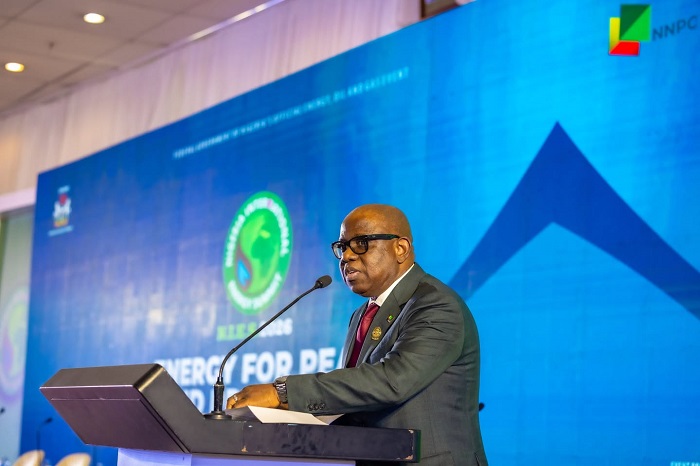
The Group Chief Executive Officer of Nigerian National Petroleum Company Limited (NNPC Ltd), Bayo Ojulari, has defended the decision to halt operations at Nigeria’s state-owned refineries, describing the move as a necessary response to harsh economic realities rather than political considerations.
Ojulari spoke at the Nigeria International Energy Summit (NIES) amid growing national debate over the shutdown of the four government-owned refineries in Port Harcourt, Warri and Kaduna.
According to him, an internal commercial review revealed that continued operation of the refineries under their existing structure was destroying value and draining public resources.
“We were just wasting money,” Ojulari said. “The refineries were leaking value, and there was no clear line of sight on how those losses would ever turn into profits.”
Nigeria’s four state-owned refineries have a combined installed capacity of 445,000 barrels per day, yet have for decades operated far below capacity, often producing little or no refined products while consuming billions of naira annually in operating and maintenance costs.
Ojulari said the decision to halt operations was taken after it became clear that keeping the refineries running merely for appearances made no commercial sense.
“When you are trained to look at profitability and commerciality, you cannot ignore an asset that turns crude oil into lower-value products while contractor costs keep rising,” he said. “That is not business. That is value destruction.”
Between 2010 and 2023, the Federal Government reportedly spent over ₦11 trillion on refinery rehabilitation and turnaround maintenance. Despite the heavy spending, Nigeria remained heavily dependent on imported petrol, diesel and aviation fuel, placing sustained pressure on foreign exchange reserves and exposing the economy to global supply disruptions.
Ojulari noted that while NNPC’s refineries operated efficiently in the 1980s and much of the 1990s, performance declined in the 2000s as institutional focus shifted from operational excellence to EPC contracting, O&M structures and financing-driven interventions. This shift weakened preventive maintenance culture, eroded in-house technical capacity and entrenched costly turnaround maintenance cycles.
Against this backdrop, he said the 2025 shutdown represents a pragmatic attempt to halt value loss and reset Nigeria’s refining framework on a sustainable footing.
The NNPC chief acknowledged the intense public pressure to keep the refineries running, even at a loss.
“The pressure was extreme. Nigerians were angry. Expectations were high,” he said. “But leadership is not about maintaining broken systems for optics. It is about stopping the bleeding and reassessing.”
Describing the shutdown as an act of responsible governance, Ojulari insisted it should not be seen as failure.
“Halting operations is not failure. It is discipline. It is honesty. It is admitting that a system is not working and must be fundamentally restructured,” he said.
He also cited the emergence of the Dangote Refinery as a critical factor that has given Nigeria the breathing space to rethink its refinery strategy without risking fuel shortages.
“Whether you love Dangote or not, thank God it is a Nigerian refinery, built in Nigeria and working in Nigeria,” Ojulari said. “It has allowed us to step back and ask hard questions about what we want to do with our own assets.”
Looking ahead, Ojulari outlined a new strategic direction for NNPC’s refinery assets, arguing that Nigeria’s core mistake was treating refineries as projects rather than as long-term businesses.
“To make a refinery work, you need three things: financing, a competent EPC contractor, and world-class operational capacity,” he said. “Historically, we focused on the first two and ignored the third.”
Under a new model approved by the NNPC board, Ojulari said the company would seek to bring in experienced global operators with equity stakes and long-term operational responsibility.
“We are not selling Nigeria,” he said. “But we are open to selling some equity to bring in operators who have skin in the game and can run these assets sustainably.”
He added that early investor interest had already begun to emerge, with major international petrochemical firms conducting inspections.
For Ojulari, the refinery shutdown marks a decisive break from decades of inefficiency.
“This system was designed for everyone to take from it, not to put anything into it,” he said. “We are ending that era.”