



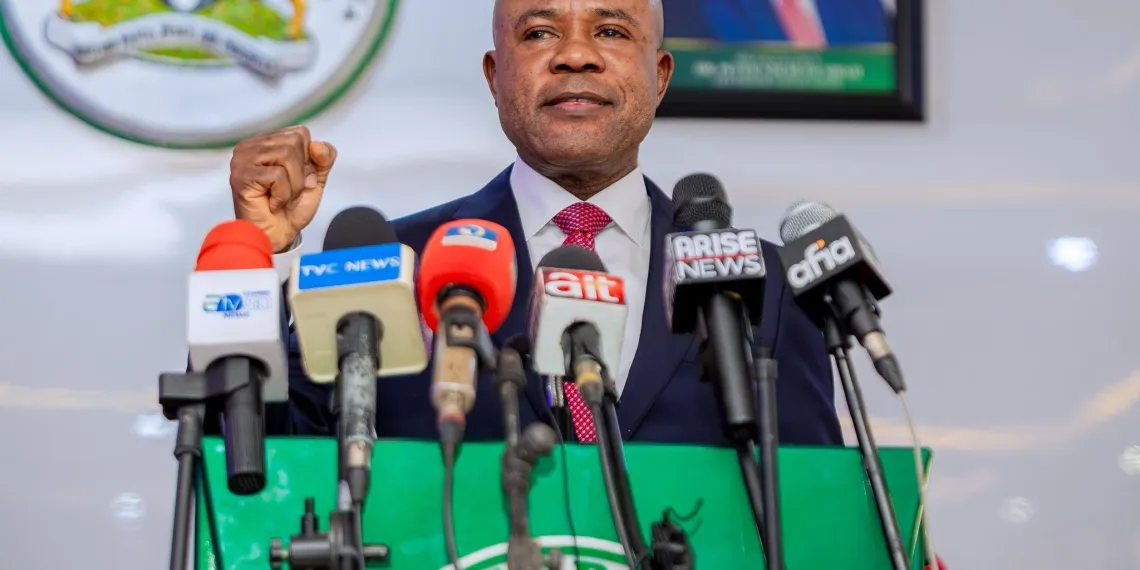
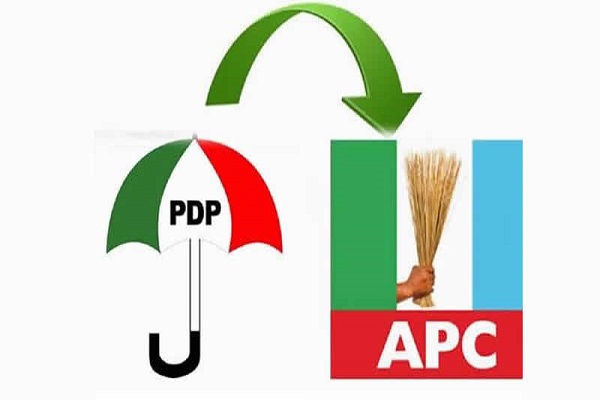
Governor Peter Mbah of Enugu State has defected from the Peoples Democratic Party (PDP) to the All Progressives Congress (APC), accusing the PDP of sidelining the South-East and pledging to give the region a stronger voice at the federal level
Why We Dumped PDP For APC – Gov. Peter Mbah
Says South-East Deserves Fair Voice in National Politics
ENUGU, Nigeria — In a political twist that reshapes the power map of Nigeria’s South-East, Governor Peter Mbah of Enugu State on Tuesday announced his defection from the Peoples Democratic Party (PDP) to the ruling All Progressives Congress (APC), citing the “consistent marginalization” of the region by his former party.
In a state-wide broadcast from the Government House, Mbah said the move was borne out of a desire to ensure that the South-East’s voice is heard in Abuja after years of neglect under the PDP.
“For decades, the South-East – especially Enugu – has stood firmly behind the PDP, showing loyalty that shaped the party’s success,” the governor said.
“Yet despite this history, our voices were too often disregarded when it mattered most. It has therefore become necessary to seek affiliation where our interests as a region are represented in the form of fair partnership.”
Governor Mbah’s defection did not come alone. He crossed over to the APC with his entire cabinet, all 17 local government chairpersons, councillors, members of the state assembly, and at least 80 percent of PDP executives in the state — effectively dismantling PDP’s long-standing dominance in Enugu.
With this move, the PDP now controls only nine states — Adamawa, Bauchi, Bayelsa, Osun, Oyo, Plateau, Rivers, Taraba, and Zamfara — while the APC strengthens its hold with 24 states nationwide.
The defection also marks a historic collapse of PDP’s influence in the South-East, a region that had loyally supported the party since 1999. Enugu now joins Ebonyi and Imo under APC control, leaving only Anambra (APGA) and Abia (Labour Party) outside the ruling party’s grip.
“Let me be clear,” Mbah declared, “I will represent our state and our region with the same strength of purpose as I have always done. Our Igbo DNA does not change; our destiny does not change. What changes is that our vision now finds stronger reinforcement at the federal level.”
Mbah’s departure is the culmination of a prolonged internal crisis within the PDP over the position of National Secretary — a battle that pitched the South-East leadership against the party’s National Working Committee (NWC).
The NWC’s insistence on retaining Samuel Anyanwu as National Secretary — despite the South-East’s preference for Sunday Udeh-Okoye — had deepened divisions and sparked legal confrontations up to the Supreme Court.
Though the apex court, on March 21, 2025, reinstated Mr. Anyanwu, the judgment further alienated South-East leaders who accused the national leadership of “disrespect and insensitivity.”
By June 2025, zonal leaders had openly threatened to quit the PDP if the party failed to ratify Udeh-Okoye’s nomination. Mbah’s defection now makes good on that threat.
In his address, Mbah described the decision as “painful but necessary,” stressing that it was guided by principles of fairness, respect, and integrity rather than resentment.
“Leadership sometimes demands difficult – even painful – decisions in the service of higher principles and goals. And there always comes a time when everyone must make a bold choice to determine their destiny,” he said.
“We are not moving from a place of resentment or fear. We are confident of our future. We have no axe to grind, no personal point to make. But fairness, respect and integrity must guide our choices for that future to be ours.”
Mbah, who was elected governor in 2023 under the PDP banner, expressed optimism that the new alignment with the APC would strengthen Enugu’s access to federal support and improve the region’s developmental prospects.
Political observers say his defection represents not just a shift in party loyalty but a strategic alignment with the ruling party ahead of the 2027 general elections, a move that could redefine the political landscape of the South-East.






 to the All Progressives Congress (APC))