






Dapo Akande: The Nigerian Scholar at the Centre of Global International Law
By Lukman OMIKUNLE
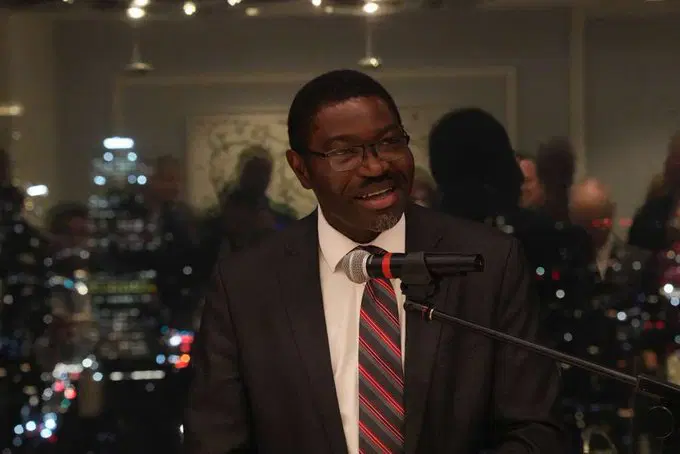
When the United Kingdom announced the nomination of Professor Dapo Akande to the prestigious International Law Commission, it was more than a routine diplomatic endorsement.
It was a powerful acknowledgement of a legal mind whose influence stretches from the lecture halls of Oxford to the courtrooms of the world’s highest judicial institutions. For many observers in Nigeria and beyond, the moment signified the global consolidation of a career built on scholarship, integrity and quiet but formidable impact.
Akande’s nomination for the 2023–2027 term was formally backed by the United Kingdom’s then Foreign Secretary, Dominic Raab, who did not mince words in his praise. “The United Kingdom is pleased to nominate Professor Dapo Akande as our candidate for the International Law Commission for the period 2023–2027,” Raab said at the time. He emphasized that the UK had always been a strong supporter of the Commission and expressed confidence that Akande would strengthen that legacy. In a further endorsement of his stature, Raab described him as “one of the finest legal scholars in the UK” and “a world-renowned expert in public international law, as both an academic and independent practitioner.”
Behind the international acclaim is a story that begins in Ibadan, Oyo State. Born and raised in Nigeria, Akande’s intellectual journey was shaped early by academic discipline and exposure to jurisprudence at the highest levels. He earned his law degree from Obafemi Awolowo University in Ile-Ife, one of Nigeria’s most respected institutions. It was there that the foundations of his legal philosophy were laid — grounded in rigorous analysis, comparative understanding and a deep appreciation of the rule of law.
His early professional years brought him into close proximity with global legal thought when he worked as a research assistant to Bola Ajibola, a former Attorney-General of Nigeria and a Judge of the International Court of Justice. That experience offered Akande a front-row view of international adjudication and diplomatic lawmaking, exposure that would later define much of his professional trajectory.
Over the past quarter century, Akande has established himself as one of the most authoritative voices in public international law. Now a Professor of Public International Law at Oxford’s Blavatnik School of Government, he has authored more than sixty scholarly works that interrogate issues ranging from state responsibility and international criminal accountability to the evolving powers of global institutions. His writings are frequently cited in academic literature, policy debates and judicial reasoning across continents.
Yet Akande’s influence is not confined to scholarship. He has appeared as counsel and adviser before the world’s most significant judicial bodies, including the International Court of Justice, the International Tribunal for the Law of the Sea, the World Trade Organization, the International Criminal Court and the European Court of Human Rights. In these arenas, where geopolitical tensions often intersect with legal principle, Akande has built a reputation for clarity, precision and intellectual depth. His work has placed him at the intersection of some of the most complex international disputes of the modern era.
Beyond courtroom advocacy, he has advised major global institutions, including the United Nations, the African Union, NATO, the Food and Agriculture Organization and the Commonwealth Secretariat. These roles demand more than academic brilliance; they require diplomatic sensitivity and a sophisticated understanding of global governance structures. Akande’s career demonstrates a rare ability to navigate both theory and practice with equal authority.
Despite his global stature, his professional story remains inseparable from Nigeria. He has represented Nigeria in proceedings before international tribunals and has contributed to strengthening the country’s legal institutions through training and advisory engagements. In doing so, he has served as both advocate and mentor, helping to bridge Nigeria’s domestic legal development with international standards.
The International Law Commission, to which he has been nominated, occupies a critical role in shaping the codification and progressive development of international law under the auspices of the United Nations General Assembly. Its members are elected based on recognized competence in international law, and its work influences treaties, conventions and global legal norms that govern state conduct. Akande’s nomination therefore represents not merely a personal achievement but an affirmation of the intellectual contributions of Nigerian scholars to global legal architecture.
In an era marked by geopolitical uncertainty, armed conflicts, questions of accountability and the redefinition of sovereignty, international law has never been more central to global stability. The need for scholars who combine technical mastery with practical experience has become increasingly urgent. In Dapo Akande, the international community sees precisely that combination.
For Nigeria, his ascent reinforces a broader narrative about the country’s intellectual capital and its diaspora’s influence across global institutions. It is a reminder that excellence nurtured at home can shape conversations at the highest levels of global governance. For young Nigerian lawyers and scholars, his journey offers both inspiration and a blueprint — proof that academic rigor, sustained commitment and global engagement can converge into lasting impact.
As the United Nations General Assembly continues its work of electing members to its key legal bodies, Professor Dapo Akande stands as a symbol of transnational scholarship and principled advocacy. From Ibadan to Oxford, from Ile-Ife to The Hague, his story is one of continuity: a steady, deliberate shaping of international law in a world that urgently needs it.
For NewsHeadline247’s weekend readership, the profile of Dapo Akande is not merely a biography. It is a testament to the quiet power of ideas — and to a Nigerian scholar whose work continues to shape the legal foundations of the international order. Read More