

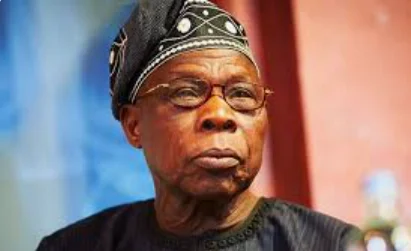
Former Nigerian President, Olusegun Obasanjo, has dismissed rumours about his death, declaring that at 89 he remains strong and healthy.
Speaking on Wednesday in Abeokuta during a colloquium organised to mark his 89th birthday, Obasanjo condemned the circulation of a fake letter allegedly written by him announcing his death, describing it as the handiwork of mischief-makers.
“I dey kampe,” the former president said, insisting that those spreading the false message were only wasting their time.
The event, themed “Burden and Blessing of Leadership: Reflections from Global Africa to the World,” was part of activities marking Obasanjo’s birthday. Born on March 6, 1937, the elder statesman said he believed God kept him alive and healthy for a purpose.
“For my final note in this address, I want to point your attention to the work of some never-do-well,” he said.
They publish and circulate a fake paper credited to me that I am writing, giving notice of my death. That is their wish and surely not God’s wish for me.”
According to him, God still has tasks for him to accomplish on earth.
“God has assured me that He has more for me to do on earth, and He has given me the wherewithal to do it… I dey kampe as usual,” he added.
Obasanjo Laments Africa’s Leadership Crisis
Beyond dismissing the death rumour, the former president also delivered a strong critique of leadership across Africa, blaming the continent’s struggles on failures of governance.
“Africa is not a problem to be managed but a promise to be fulfilled through honest, courageous, selfless, incorruptible and transformational leadership,” he said.
Obasanjo argued that Africa’s underdevelopment is not the result of geography or history but rather the failure of leaders entrusted with power.
“The primary cause is the failure of those entrusted with power to lead for the people and serve them rather than against them,” he said.
He warned that many leaders enter office with reform promises but soon begin to undermine democratic institutions, silence the press and manipulate the judiciary for personal or family interests.
Reflections on War and Leadership Decisions
Reflecting on his career, Obasanjo recounted the heavy moral burden leaders often face when making decisions that affect millions of lives.
He recalled commanding the Third Marine Commando Division during the closing days of the Nigerian Civil War, describing the dilemma he faced when thousands of civilians were trapped and starving.
No textbook told me what to do. No senior officer was going to make that call. It was mine alone, he said.
According to him, his decision not to shell Owerri helped save civilian lives.
Obasanjo also reflected on the personal cost of leadership, including his imprisonment under the regime of late military ruler Sani Abacha.
He was detained for three and a half years and tried by what he described as a “kangaroo tribunal,” a period during which he said he narrowly escaped execution.
“True leadership requires the willingness to hold a position when it is unpopular,” he said.
Achievements and Lessons
Despite the burdens of leadership, Obasanjo said it also carries significant rewards, pointing to achievements during his presidency between 1999 and 2007.
He highlighted the Paris Club debt relief deal secured for Nigeria and the establishment of the Economic and Financial Crimes Commission as major steps toward economic stability and anti-corruption reforms.
The elder statesman urged young Africans to take democracy seriously and work toward accountable and transparent governance.
“A continent that fails its youth does not merely waste a generation; it plants the seeds of instability that will haunt the next several generations,” he warned.
Reaffirming his health and longevity, Obasanjo insisted that rumours of his death were unfounded.
“God has assured me He has more for me to do on earth,” he said. “I dey kampe.”