





The race for the Oyo State governorship in 2027 is gathering momentum, with a mix of technocrats, grassroots mobilisers, and seasoned politicians positioning themselves across major political parties amid shifting alliances and internal crises.
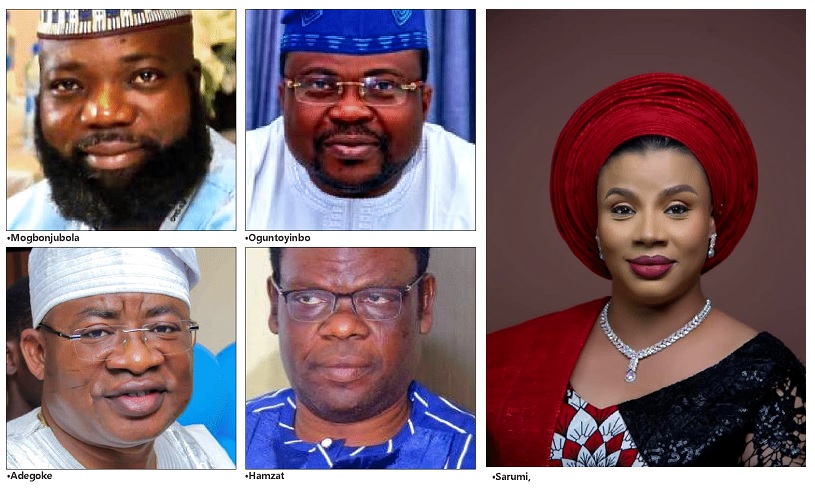
At the centre of early discussions is Mogbonjubola, a technocrat whose political profile remains largely undefined despite his growing influence within government. Having served as Deputy Chief of Staff to Governor Seyi Makinde in 2019 and later as Commissioner for Environment and Natural Resources, he currently oversees the Ministry of Public Works, Infrastructure, and Transport.
With over 368 kilometres of roads reportedly completed under his watch and key projects like the Ibadan Circular Road underway, Mogbonjubola’s strength lies in administrative competence and insider knowledge. However, his low political visibility and lack of a structured support base may hinder his chances if he decides to formally enter the race.
In contrast, Ambassador Olufemi Ajadi Oguntoyinbo, popularly known as Ajadi, has quickly emerged as a vibrant contender within the Peoples Democratic Party (PDP). His grassroots-driven approach, marked by philanthropy and empowerment initiatives, has earned him significant public attention.
Ajadi’s growing popularity and financial strength position him as a formidable aspirant. Yet, questions remain about his integration into the PDP’s internal power structure, with party loyalists watching closely to assess his long-term commitment.
Also in the PDP race is Hazeem Gbolarumi, a former Deputy Governor and a loyalist of the Federal Capital Territory Minister’s faction. With decades of political experience and deep grassroots connections, Gbolarumi presents himself as a resilient contender.
However, his opposition to Governor Makinde’s preferred succession plan may complicate his path, especially amid allegations of factional clashes within the party. His residence was recently attacked during a tense congress, highlighting the deepening divisions.
Beyond the PDP, the African Democratic Congress (ADC) is gaining traction as a viable alternative platform. Among its notable aspirants is Bolanle Aminat Sarumi (BASA), a former aide to Governor Makinde, who defected from the PDP citing internal crises. As the only female aspirant so far, she brings both experience and a strong grassroots network.
Oloye Adegboyega Adegoke, another prominent figure, has also pitched his tent with the ADC after resigning from the PDP. A philanthropist with a broad support base, Adegoke’s move reflects growing discontent within the PDP and signals a potential realignment ahead of the elections.
Meanwhile, the Accord Party is re-emerging as a dark horse in the race, with media personality Oriyomi Hamzat leading its charge. Founder of Agidigbo FM, Hamzat has leveraged his media influence and grassroots appeal to build a loyal following through his “Oyo Npe O” movement.
His campaign, centred on youth empowerment, transparency, and responsive governance, has resonated with many voters, positioning him as a disruptive force capable of challenging traditional political structures.
Political observers note that the ongoing leadership crisis within the PDP could significantly shape the outcome of the election.
The factional divide, particularly between loyalists of Governor Makinde and other power blocs, has already led to tensions and violence, raising concerns about party cohesion.
Recent developments, including a surge in campaign billboards by aspirants such as Stanley Olajide, Nureni Adeniran, and Bimbo Adekanmbi, signal an intensifying contest following the governor’s call for open declarations.
With the Independent National Electoral Commission (INEC) timetable in place, the coming months are expected to witness strategic alliances, defections, and intensified grassroots mobilisation.
As the political landscape evolves, the Oyo 2027 governorship race is shaping up to be a complex battle defined by ambition, party dynamics, and the quest for dominance in one of Nigeria’s key states.