



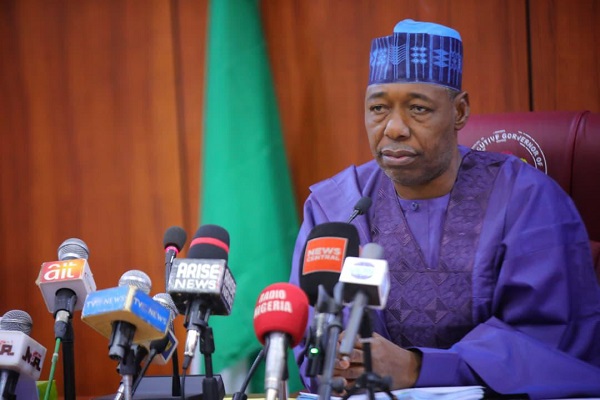
In Borno State, power rarely changes hands with noise. But Governor Babagana Umara Zulum’s recent declaration that he has “no anointed candidate” has stirred a quiet political storm ahead of the 2027 elections.
Rather than settle debates, the statement has deepened intrigue in a state where leadership transitions are traditionally shaped behind the scenes.
A Culture of Quiet Power Transitions
For nearly two decades, Borno’s political evolution has followed a carefully managed path—from Ali Modu Sheriff to Kashim Shettima, and now Zulum.
In this system, ambition is often muted, public declarations are rare, and consensus—rather than open contest—determines who emerges.
Zulum himself is a product of this model, making his public neutrality less of a departure and more of a calculated pause.
Cabinet Dissolution Changes the Game
The governor’s dissolution of the State Executive Council has added a new layer of complexity.
While constitutionally routine, the move has effectively erased the most reliable signal in Borno politics: resignation as a sign of endorsement.
By asking all cabinet members to step aside at once, Zulum has:
- Prevented early alignment around any candidate
- Shielded potential aspirants from premature scrutiny
- Retained firm control over the pace and direction of succession
The result is what analysts describe as “structured uncertainty”—a political environment where ambition exists but remains hidden.
Names Without Declarations
Despite the silence, several prominent figures are being quietly discussed as potential successors, including Senator Kaka Shehu Lawan, Senator Abubakar Kyari, Senator Baba Kaka Garbai, and Senator Mohammed Tahir Monguno, among others.
Yet, none has openly declared interest—highlighting a key rule in Borno politics: ambition without endorsement can be politically risky.
The Zulum–Shettima Axis
At the centre of the unfolding succession puzzle is the enduring alliance between Zulum and Vice President Kashim Shettima.
Shettima, who played a pivotal role in Zulum’s rise to power, remains a key influencer in the state’s political structure. Together, both men form the axis around which major decisions revolve.
Any serious contender is expected to align—directly or indirectly—with this power centre.
Unity on the Surface, Tension Beneath
For now, the ruling All Progressives Congress (APC) in Borno appears united.
No factions have openly emerged, and no camps have been formally declared. However, beneath this calm lies growing tension fueled by uncertainty and speculation.
With no clear direction, rumours are spreading, and political calculations are intensifying behind closed doors.
Waiting for the Signal
As Borno navigates post-insurgency recovery, the stakes of leadership succession remain high. Stability, continuity, and governance are deeply tied to who emerges next.
Zulum’s strategy—balancing silence with control—has, for now, preserved order while delaying confrontation.
But in Borno politics, silence is rarely empty.
It is where decisions are made. And when the moment finally arrives, the outcome may not be announced—it will simply unfold.