



President Bola Tinubu and Rwanda’s Paul Kagame have agreed to deepen trade, revive bilateral commissions, and consider visa-free access as both countries push for stronger AfCFTA implementation
Tinubu, Kagame Strengthen Nigeria-Rwanda Trade Ties, Discuss Visa-Free Access
President Bola Ahmed Tinubu and Paul Kagame have opened fresh talks aimed at deepening trade, easing visa restrictions, and expanding business opportunities between Nigeria and Rwanda in what analysts see as a major push for stronger African economic integration.
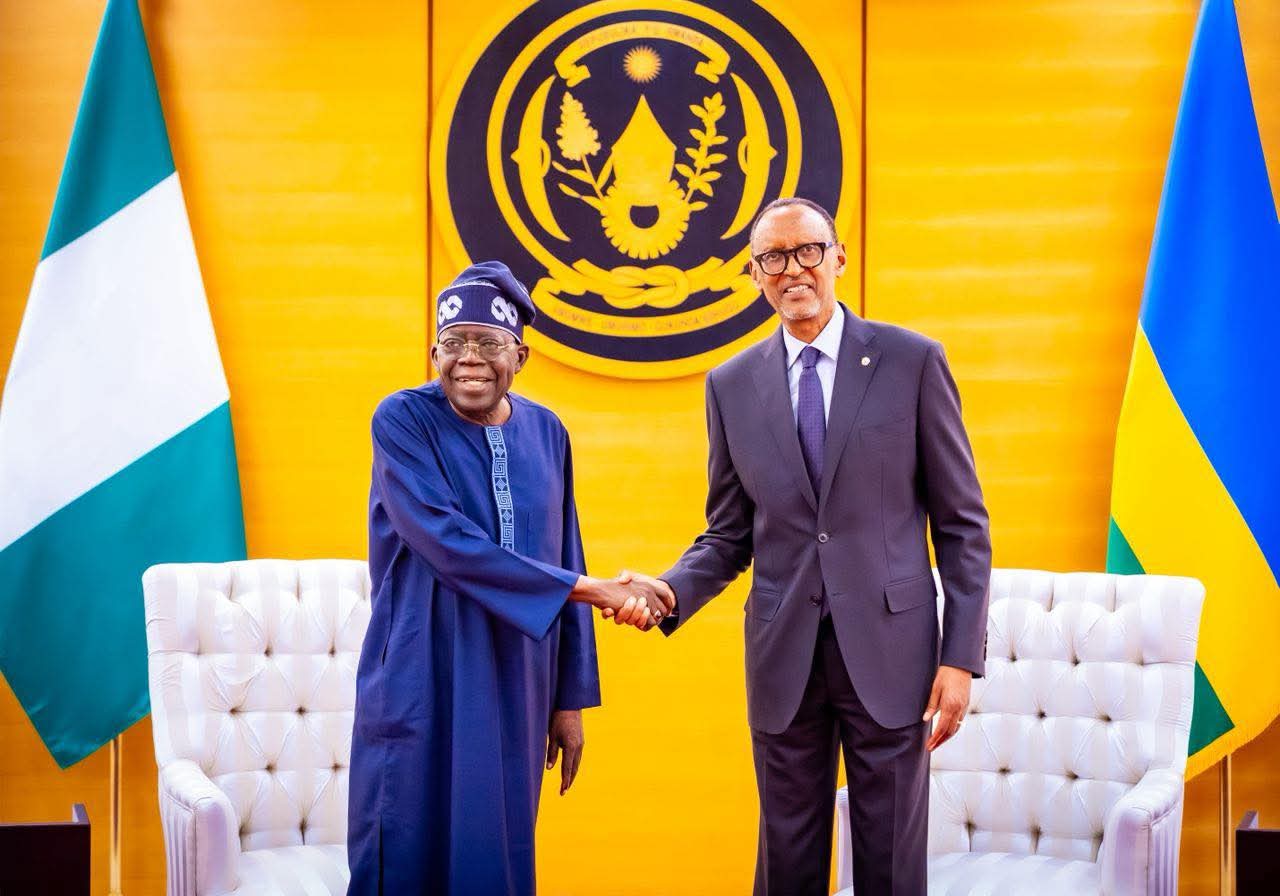
Tinubu, who arrived in Kigali for the Africa CEO Forum, held high-level discussions with Kagame at the Urugwiro Presidential Villa, where both leaders agreed to revive institutional frameworks, strengthen commercial cooperation, and accelerate implementation of the African Continental Free Trade Agreement (AfCFTA).
Central to the talks was the decision to reactivate the Nigeria-Rwanda Joint Permanent Ministerial Commission (JPMC), a diplomatic and economic framework first signed in 2021 but now being repositioned to drive deeper bilateral engagement.
Both leaders also agreed that Nigeria would host the next round of the Commission’s meeting, signalling Abuja’s intention to take a stronger leadership role in shaping regional economic partnerships.
According to a State House statement signed by presidential spokesman Bayo Onanuga, “Both leaders emphasised the importance of reviving the Joint Permanent Ministerial Commission (JPMC), originally signed by both countries in 2021, as a vital platform for advancing their shared objectives.”
For businesses and investors, the renewed commission goes beyond diplomatic symbolism.
It creates a structured pathway for trade facilitation, tourism partnerships, anti-corruption collaboration, and regulatory alignment — key areas expected to improve market access and policy certainty for businesses operating across African borders.
A major highlight of the discussions was visa liberalisation. Tinubu said Nigeria would “seriously consider reciprocating Rwanda’s 30-day visa-free status for Nigerians in the spirit of Pan-Africanism.”
If implemented, the move could significantly boost business travel, tourism, startup expansion, and entrepreneurial exchange between East and West Africa.
The two leaders also reviewed pending Memoranda of Understanding covering tourism, illicit drug control, and anti-corruption cooperation, sectors increasingly viewed as essential for creating stable commercial environments.
Another major economic focus was logistics and export expansion. Building on Nigeria’s existing air cargo corridor with Uganda Airlines, Abuja is now discussing broader cargo connectivity with RwandAir to improve export opportunities for Nigerian businesses across Africa.
The presidency stated that “Nigeria, which last year established an air cargo corridor with Uganda Airways, is now in discussions with RwandAir to facilitate greater export opportunities for Nigerian businesses across the continent.”
The move signals a wider economic strategy aimed at improving African supply chains, reducing export bottlenecks, and giving Nigerian manufacturers and agribusinesses greater continental reach.
Observers say the growing partnership between Africa’s largest economy and one of its most reform-driven business hubs reflects shared interests in market access, logistics integration, and stronger institutional cooperation.
With AfCFTA implementation still uneven across much of the continent, the Tinubu-Kagame engagement is increasingly being viewed as a practical bilateral model that could transform continental trade ambitions into measurable economic outcomes.
As the Africa CEO Forum opens in Kigali, Tinubu’s early diplomatic outreach suggests Nigeria is seeking not just visibility, but a central role in shaping Africa’s next commercial architecture.