

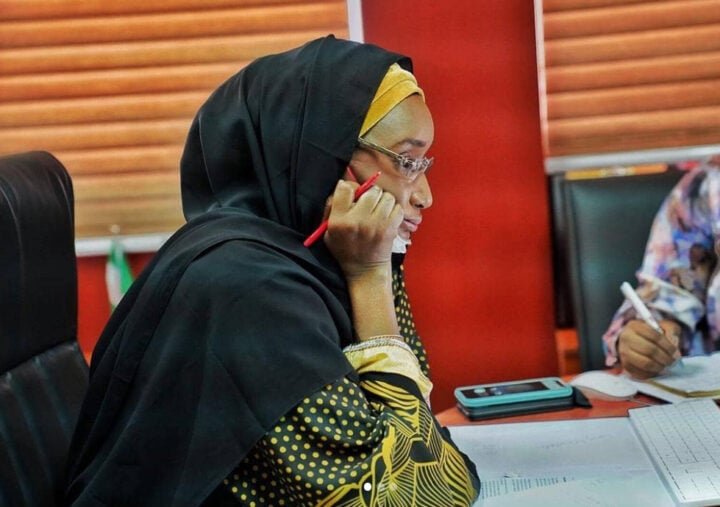





An Abuja High Court has dismissed former Minister Sadiya Farouq’s application to set aside a bench warrant issued over alleged diversion of $1.3 million and N746.7 million
Why Abuja Court Refused to Lift Arrest Warrant Against Ex-Minister Sadiya Farouq
The Federal Capital Territory High Court sitting in Apo, Abuja, has dismissed an application filed by former Minister of Humanitarian Affairs, Disaster Management and Social Development, Sadiya Umar Farouq, seeking to set aside the bench warrant and warrant of arrest earlier issued against her in an ongoing corruption trial.
In a ruling delivered on Monday, Justice Jude Onwuegbuzie held that Farouq failed to provide a convincing explanation for her repeated absence from court, insisting that criminal proceedings cannot be stalled without a legally justifiable reason.
Farouq is being prosecuted alongside Bashir Nura Alkali and Sani Nafiu Mohammed by the Economic and Financial Crimes Commission (EFCC) over allegations bordering on criminal conspiracy, abuse of office and the diversion of public funds amounting to $1.3 million and N746.7 million.
The court had previously issued a bench warrant and warrant of arrest against the former minister after she failed to appear for scheduled proceedings. Her legal team subsequently approached the court seeking to have the warrants vacated, citing health challenges, including arthritis and heart-related ailments, as reasons for her absence.
However, Justice Onwuegbuzie rejected the application, ruling that the defence had not demonstrated sufficient grounds to justify Farouq’s continued failure to appear before the court. According to the judge, the law empowers courts to issue arrest warrants where a defendant deliberately absents themselves from criminal proceedings without a valid excuse.
“The defendant, who is fully aware that this is a criminal proceeding, has willfully failed to appear in court without a valid reason. The law empowers the court, when it has been established that a defendant is absent without a valid reason, to issue a bench warrant of arrest,” the judge held.
Justice Onwuegbuzie further noted that no evidence had been presented to show why Farouq, despite her reported medical condition, could not seek treatment within Nigeria and still honour court appearances. He concluded that the application lacked merit and stressed that criminal proceedings must be conducted strictly in accordance with the law.
The ruling was welcomed by the prosecution. Counsel to the EFCC, Jacobs, SAN, described the decision as well-considered and urged the court to ensure compliance with an earlier undertaking by Farouq’s lead counsel, A.A. Ibrahim, SAN, who had promised to produce the defendant before the court.
Jacobs reminded the court that the medical report relied upon by the defence recommended a treatment period of six to eight weeks and argued that the maximum period had already elapsed on June 9, 2026.
“We plead with your lordship that the undertaking should not be taken for granted. We urge the defence counsel to cooperate and produce the defendant at the next adjournment to avoid the use of coercive powers,” Jacobs told the court.
Responding, A.M. Lawal, who appeared on behalf of Ibrahim, requested that the court allow the senior lawyer to personally address issues surrounding the undertaking. The request was granted by Justice Onwuegbuzie, who directed that Ibrahim be given the opportunity to appear and respond before any further action is taken.
Following the proceedings, the court adjourned the matter until July 2, 2026, when Farouq and her co-defendants are expected to be arraigned in the high-profile case that has continued to attract public attention amid the EFCC’s anti-corruption drive.