


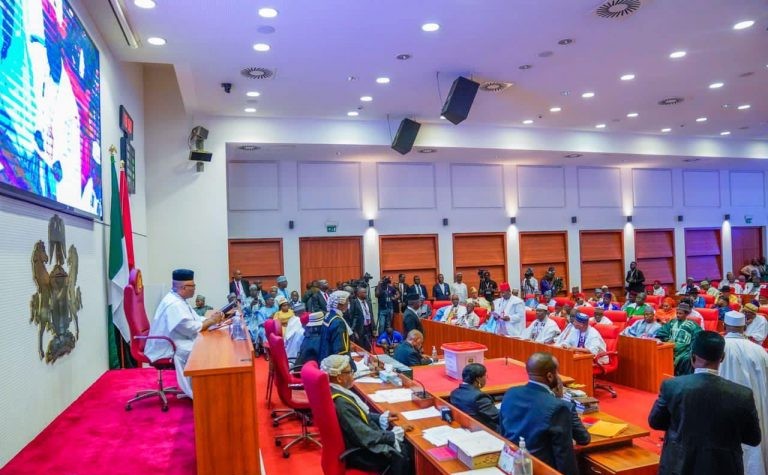





The Senate says it will transmit Nigeria’s State Police constitutional amendment bill to Tinubu after 32 state assemblies approved the proposal
Nigeria Moves Closer to State Police as 32 States Approve Bill, Senate Sends Bill to Tinubu
By Newsheadline247
Nigeria’s long-running push to establish state police has reached a major legislative milestone, with Senate Leader, Senator Opeyemi Bamidele, announcing that the National Assembly will transmit the State Police Constitution Alteration Bill, 2026, to President Bola Tinubu for assent this week after securing approval from 32 of the country’s 36 State Houses of Assembly.
Bamidele said the number of approvals had exceeded the constitutionally required threshold, clearing the way for the National Assembly to proceed with the next stage of the amendment process despite four outstanding state assemblies yet to communicate their positions.
He made the disclosure on Friday night while receiving The Sun Senator of the Year Award at Eko Hotels and Suites, Victoria Island, Lagos.
According to the Senate Leader, the 32 approvals represent more than the two-thirds majority of state assemblies required under Section 9(2) of the 1999 Constitution, which translates to at least 24 of the 36 states.
He described the development as a significant breakthrough in efforts to decentralise Nigeria’s policing system, noting that successive attempts to establish state police had remained unsuccessful for more than 15 years.
Bamidele said the National Assembly was still expecting reports from the remaining four state assemblies before lawmakers resume legislative activities on November 17, but maintained that their outstanding responses would not prevent the process from moving forward.
He said the legislature was determined to fulfil its constitutional responsibility and respond to growing calls for a more effective security arrangement capable of addressing the country’s peculiar security challenges.
The latest announcement represents an increase from the 30 state approvals Bamidele disclosed during Senate plenary on November 4, when the six outstanding assemblies were given until November 15 to communicate their positions.
The proposed constitutional amendment seeks to establish a decentralised policing structure that would allow individual states to operate their own police services alongside a Federal Police Service, replacing the existing arrangement in which the Nigeria Police Force operates as the country’s constitutionally recognised police organisation.
Section 214 of the 1999 Constitution currently provides for a single police force for Nigeria and prohibits the establishment of another police force for the federation or any part of it.
Consequently, constitutional alteration is necessary to provide the legal foundation for the proposed Federal Police Service and State Police Services.
However, the proposed reform is not expected to translate automatically into the immediate commencement of state police operations once the constitutional amendment process is completed.
Individual states would still need to enact appropriate enabling legislation and satisfy the applicable national standards governing the establishment and operation of their police services.
The proposed National Policing Bill is expected to provide an operational framework covering recruitment, certification, inspections, intelligence sharing, public complaints, accountability and transitional arrangements.
Issues surrounding sustainable funding, political interference, institutional independence and effective oversight are also expected to feature prominently in discussions about the implementation of state policing.
Bamidele dismissed concerns that decentralised policing could lead to the emergence of ethnic or state-based armies, insisting that the objective was to establish community-based security structures operating within clearly defined constitutional safeguards.
He maintained that the proposed reform reflected the commitment of the 10th National Assembly to proactive lawmaking and addressing national challenges before they deteriorated into major crises.
According to him, Nigeria must move away from reactive governance towards a system in which laws are informed by evidence, properly implemented, effectively monitored and periodically reviewed to ensure they deliver meaningful benefits to citizens.
Beyond the state police proposal, the Senate Leader highlighted several legislative initiatives of the 10th National Assembly, including the student loan programme, minimum wage legislation, tax reforms, investment and securities reforms, electoral reforms, insurance legislation and the establishment of regional development commissions.
Speaking on the Nigerian Education Loan Fund, Bamidele disclosed that more than N204bn had been disbursed to beneficiaries across 89 colleges, 108 polytechnics and 126 universities.
He said the interest-free loan scheme had helped many students remain in tertiary institutions by easing financial pressures that could otherwise force them to abandon their education.
The Senate Leader argued that the performance of the legislature should not be measured merely by the number of bills passed but by the tangible impact of its laws on the lives of Nigerians.
On relations between the executive and legislative arms of government, Bamidele said the principle of separation of powers should not be interpreted as a reason for unnecessary confrontation between the different arms of government.
He maintained that cooperation and constructive engagement were essential to achieving national development, peace and security, while preserving the independence and constitutional responsibilities of each arm.
Bamidele also expressed concern over the increasing misuse of social media, particularly the circulation of misinformation, character assassination, blackmail and deliberate distortion of facts.
While reaffirming his support for press freedom, media independence and an open parliament, he urged media organisations to promote responsible information dissemination across traditional and digital platforms.
He specifically called on the Newspaper Proprietors’ Association of Nigeria, Broadcasting Organisations of Nigeria, Nigerian Guild of Editors and Nigeria Union of Journalists to participate in discussions aimed at addressing the challenges associated with the unrestricted circulation of misinformation.
He said the growing influence of digital platforms made it necessary for stakeholders to develop responsible information-sharing standards without undermining fundamental freedoms.
Bamidele dedicated his Senator of the Year Award to President Tinubu, his colleagues in the Senate, his constituents and God, describing the recognition as an acknowledgement of the collective efforts of the 10th National Assembly rather than an individual achievement.
The award was presented by Senator Orji Uzor Kalu, founder of The Sun Publishing Limited and Chairman of the South East Development Commission.