





Huawei has unveiled new AI infrastructure solutions and announced plans to expand computing capacity in Nigeria before the end of 2026
Huawei to Expand AI Computing Infrastructure in Nigeria
By Lukman OMIKUNLE
Huawei has announced plans to expand its artificial intelligence (AI) computing infrastructure in Nigeria before the end of 2026, unveiling new enterprise computing, data protection and AI infrastructure solutions as it intensifies efforts to support the country’s growing digital economy.
The technology company disclosed the expansion plan at its IT Day 2026 event, where it showcased emerging computing technologies and locally developed AI applications alongside solutions from Nigerian technology partners.
The event, themed “Empowering Nigeria’s AI Development Together: Compute, Collaborate, Create,” attracted more than 350 customers and ecosystem partners to examine the opportunities and challenges shaping Nigeria’s AI ecosystem.
Huawei and its partners demonstrated infrastructure covering general-purpose and intelligent computing, as well as locally developed applications built on the company’s technology platforms.
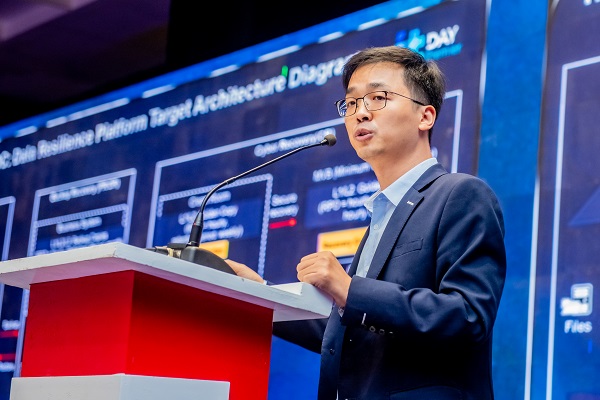
Speaking at the event, Huawei executives identified access to high-performance and cost-effective computing platforms, support for local technology partners and the development of a sustainable AI ecosystem as key priorities.
Zhang said the company’s planned expansion would take Nigeria’s infrastructure challenges, particularly unreliable electricity supply, into consideration, with a strong emphasis on energy efficiency to reduce operating costs and strengthen operational resilience.
He explained that the additional computing resources would also be accessible to local technology partners through Huawei’s open laboratory in Nigeria, enabling developers to test and demonstrate their solutions under local operating conditions.
Furkan Elcelik, a Huawei Turkey research and development engineer, examined how the emergence of agentic AI is changing the demands placed on computing infrastructure.
He projected that the increasing adoption of AI would significantly raise demand for central processing units (CPUs), potentially shifting the CPU-to-GPU ratio from 1:N towards 1:1.
Elcelik also forecast a 500 per cent expansion in the CPU market over the next five years, predicting that ARM could account for 70 per cent of the global server market by 2030.
He highlighted Huawei’s Kunpeng 950 processor, which features 96 cores, and the TaiShan 950 SuperPoD, which the company described as the industry’s first general-purpose SuperPoD featuring terabyte-level interconnect and memory pooling.
Huawei also showcased its DevKit, DataKit and OpenLab platforms, which it said had supported technology adoption across telecommunications, financial services, government and internet sectors.
According to the company, the solutions deliver up to 20 per cent higher per-core performance and more than 40 per cent power savings.
Demonstrating the growing role of local technology companies in Nigeria’s AI development, Vennote Chief Executive Officer, Azuka Onyia, introduced Stashio, a white-label cloud storage platform built on Huawei’s Kunpeng infrastructure and featuring an AI assistant powered by Ascend technology.
Onyia disclosed that the platform had already been deployed by a Tier-1 telecommunications operator, recording more than 500,000 active users, over 18 per cent paid conversion and 4.8 petabytes of locally retained data.
He also cited a 90-day deployment period and 99.99 per cent service availability as key performance indicators.
Bluechip’s Soyoola Sodunke presented the Bluechip Data Platform, which offers data ingestion, lakehouse, machine learning operations and model governance capabilities.
The platform can be deployed on Huawei infrastructure or Huawei Cloud, providing organisations with tools to manage and utilise enterprise data for AI development.
Sodunke stressed that reliable and properly governed data remained essential to successful enterprise AI adoption, particularly as organisations face growing requirements around data residency, security and governance.
Huawei Nigeria’s Chief Technology Officer for Data Centre Solutions, Li Chengyong, showcased the company’s Atlas AI infrastructure, highlighting four generations of development within four years.
He said the infrastructure had supported the training of more than 40 foundation models and over 65 model series, including DeepSeek, GLM and Qwen.
Li also highlighted the company’s adoption of neural processing units, unified memory technology and an air-cooled SuperPoD featuring 96 NPUs and 170 petaflops of computing performance.
He said Huawei’s CANN computing architecture was open-source and compatible with PyTorch and MindSpore, a development designed to make it easier for local developers to build and deploy AI applications.
Other demonstrations at the event featured technology solutions from Nigerian companies Odion and Seamfix.
Odion Chief Executive Officer, Mavino Ikein, showcased Attentive, a voice-based AI agent capable of supporting Yoruba, Hausa, Igbo, Nigerian Pidgin and English.
The company also demonstrated Covalence, a code-fixing agent, and Relay, a quality assurance agent.
Ikein said Attentive was developed to automate customer interactions, with the company targeting 70 per cent automatic resolution and 42 per cent labour savings over three years.
Seamfix’s Olajumoke Jackson-Emuraishe presented the company’s digital identity solutions, disclosing that it had created more than 300 million digital identities and verified 160 million.
Its technology includes optical character recognition, facial matching, liveness detection, deepfake detection and contactless fingerprinting, with joint deployments involving Huawei’s Kunpeng and Ascend platforms.
Huawei said it would continue strengthening collaboration with Nigerian technology companies through joint solutions, practical demonstrations and performance benchmarks.
The company reiterated its commitment to energy-efficient computing, local data retention and locally delivered technology services as it seeks to expand Nigeria’s AI infrastructure and accelerate the adoption of artificial intelligence across key sectors of the economy.