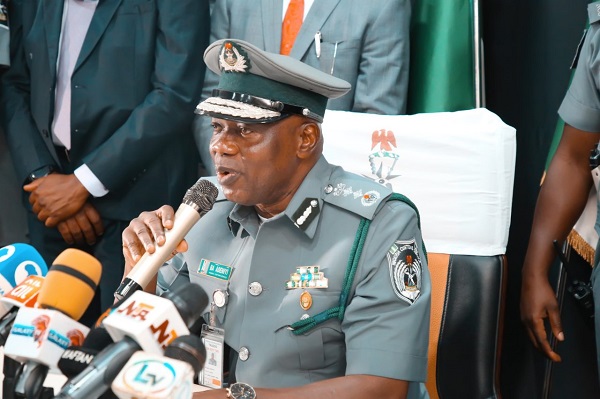


The Comptroller-General of Customs, Adewale Adeniyi, has reaffirmed the Nigeria Customs Service’s (NCS) commitment to strengthening regional trade facilitation, safeguarding transit cargo and deepening cross-border security cooperation with neighbouring countries, particularly the Republic of Niger.
Adeniyi stated this during a high-level bilateral meeting between the Nigeria Customs Service and the Niger Republic Customs Administration, led by its Director-General, Muhammadu Yaqouba, held at the Customs House, Maitama, Abuja.
The engagement focused on improving cooperation in the movement of transit goods destined for Niger through Nigeria, enhancing intelligence and information sharing, addressing shared security challenges, reducing delays along critical transit corridors and ensuring that legitimate trade contributes meaningfully to economic growth in both countries.
Congratulating Yaqouba on his appointment, Adeniyi noted that both Customs administrations share a long history of professional collaboration, strengthened through years of engagement at World Customs Organisation (WCO) platforms and bilateral initiatives aimed at modernising customs operations.
“Cooperation between our two Customs services is shaped not only by shared borders but also by international obligations, particularly Nigeria’s responsibilities under Articles 124 to 132 of the United Nations Convention on the Law of the Sea, which guarantee landlocked countries access to the sea,” Adeniyi said.
The Comptroller-General acknowledged the operational challenges faced by landlocked countries, explaining that reliance on neighbouring ports and infrastructure often raises transaction costs and weakens trade competitiveness.
“The Nigeria Customs Service has remained committed to facilitating trade for our landlocked neighbours, including the Republic of Niger. This commitment will be sustained irrespective of political differences, because trade, security and regional stability are deeply interconnected,” he added.
Addressing concerns over transit bottlenecks, Adeniyi disclosed that President Bola Ahmed Tinubu had approved the provision of safe corridors and guaranteed passage for loaded trucks awaiting clearance.
He assured that transit cargoes, particularly those originating from Apapa Ports and Nigerian airports and destined for neighbouring countries, would continue to be processed and moved within 48 hours, without compromising national security or economic interests.
The Comptroller-General also revealed that strict measures had been put in place to prevent diversion of transit cargo, warning that operators who violate transit regulations would face stiff sanctions.
“Non-compliance by a few operators creates non-tariff barriers and undermines trust. We are determined to enforce compliance, streamline documentation and remove avoidable bottlenecks along key corridors such as Illela–Sokoto–Kamba–Niger Republic, as well as routes linking Apapa ports and airports to neighbouring countries,” he said.
Describing the meeting as the beginning of a renewed phase of cooperation, Adeniyi stressed that sustained follow-up actions would help redefine operational procedures, reduce trade costs, increase cargo volumes and make the transit corridor more attractive to transport operators.
Earlier, the Director-General of Niger Republic Customs, Muhammadu Yaqouba, described the visit as a working engagement between two professional Customs administrations bound by shared responsibilities.
He thanked the Nigeria Customs Service for the warm reception accorded to him and his delegation, noting that it reflected the longstanding fraternity between both countries and their Customs institutions.
According to Yaqouba, the visit was prompted by two major concerns: the prolonged blockage of trucks transiting from the Republic of Benin to Niger Republic, and persistent security challenges across the region.
“We face common threats, particularly terrorism and banditry, and engagements like this give us the opportunity to find lasting solutions through cooperation and coordination,” he said.
He disclosed that Niger Republic has intensified counter-terrorism efforts since 2024 with the launch of Operation Saran Kasa, a multi-agency security initiative that has recorded notable successes.
As part of the operation, scanners have been deployed to inspect all goods entering Niger Republic, underscoring the critical role of Customs administrations in combating terrorism, arms trafficking and cross-border crime.
Yaqouba recalled previous bilateral engagements, including the last meeting held in April 2023, and expressed confidence that both administrations would continue to work together to deliver tangible outcomes.
Also speaking, the National Coordinator of the National Counter-Terrorism Centre, Office of the National Security Adviser (ONSA), Major-General Garba Laka, congratulated Yaqouba on his appointment and extended condolences to the Government and people of Niger over the recent terrorist attack near Niamey Airport.
Describing the incident as painful, he condemned the attack and sympathised with the families of the fallen soldiers, while reaffirming the shared determination of Nigeria and Niger to prevent a recurrence.
Major-General Laka stressed that Nigeria and Niger share deep historical, cultural and familial ties, particularly among border communities where people live and trade across both countries.
“Insecurity in any part of the Sahel affects all of us. Arms trafficking, drug smuggling and the concealment of ammunition in cargo vehicles remain major threats that require coordinated and sustained action,” he said.
He disclosed that the Nigerian government places high priority on Niger-related matters, including trade, energy supply and security, noting that requests from Niger—especially on petroleum products and gas—receive prompt attention at the highest level.
The counter-terrorism chief advocated the revival of bilateral security frameworks, including cross-border right-of-pursuit arrangements, and called for joint Nigeria–Niger operations and sustained inter-agency collaboration to combat terrorism and organised crime effectively.
Customs Pledges Faster Transit, Stronger Security Cooperation with Niger Republic