Lucia Onabanjo Funeral: Why Drag Otunba Gbenga Daniel into a Seating Saga He Knows Nothing About?
By Seunmanuel Faleye
There is an old saying that if you want to hide something from a black man, put it in a book. In our contemporary reality, if you want to obscure the truth, simply wrap it in a viral narrative and let social media do the rest.
This is precisely what has happened with the controversy surrounding the burial service of late Chief (Mrs.) Lucia Onabanjo, wife of the first civilian Governor of Ogun State, a controversy that has inexplicably dragged in a name that had no business being mentioned.
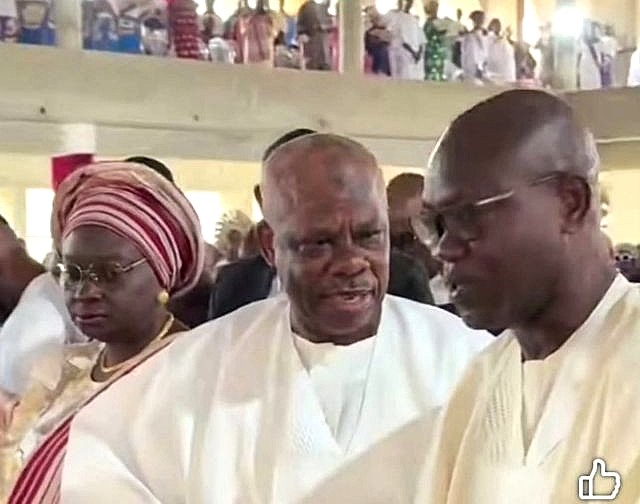
Otunba Gbenga Daniel attended a funeral to pay his last respects. What should have been a straightforward act of honouring a departed matriarch has been twisted into a narrative that seeks to position him at the centre of a non-existent power play.
But here is the question that deserves an answer; why? Why must a man who simply sat where he was directed become a character in a drama he never auditioned for? Why must his name be weaponised to give currency to stories he had no hand in crafting? These go to the heart of what is wrong with our public discourse today.
Let us examine what actually transpired. At that church service, Otunba Daniel was seen occupying a seat clearly marked for him. He was not involved in any discussions about seating arrangements. He did not approach protocol officers or make demands about where anyone else should sit. He simply showed up, took his place, and fulfilled his obligation as a mourner.
Interestingly, those who were present have confirmed that Senator Iyiola Omisore was already seated in the church before Daniel arrived. The seat adjacent to Daniel’s was designated for the Head of Service. If Omisore later occupied that seat when the Head of Service did not appear, that decision was his alone. To suggest that Daniel had anything to do with it is to engage in the kind of speculative journalism that does a disservice to everyone involved, and more importantly, to the memory of the deceased.
This incident, however, points to a deeper issue that has become characteristic of public events in Ogun State. There appears to be a recurring pattern where protocol, the delicate art of according proper recognition, is either misunderstood or deliberately disregarded by those charged with organising state functions. This is particularly unfortunate when the occasion is meant to honour a figure of her stature.
This is not an isolated observation. The opening ceremonies of the last Gateway Games come to mind as another instance where protocol seemed to take a backseat. When such patterns emerge repeatedly, it ceases to be a series of unfortunate coincidences and begins to look like a system of approach.
The consequence is that individuals who have contributed significantly to the state find themselves in uncomfortable positions at events where they should be accorded due respect. Some have responded by quietly withdrawing, choosing only to honour functions where they receive proper invitations. This quiet withdrawal speaks volumes, even if it goes unremarked upon by those who prefer sensational headlines to substantive reporting.
What we are witnessing in the aftermath of this burial is not journalism. It is opportunistic narrative-building. Stories are being crafted not to inform the public but to serve political ends. Facts are being arranged and rearranged like furniture in a room, not to reflect reality but to create a particular impression.
And in this arrangement of facts, Otunba Gbenga Daniel’s name has been dragged in, not because he did anything, but because his name carries weight. Because invoking him adds credibility to otherwise questionable narratives. Because in the economy of viral content, a familiar name is currency.
This must be resisted. Not because Otunba Daniel is beyond criticism or above scrutiny. Every public figure must be accountable for their actions. But when a man is implicated in a matter where his only action was sitting on a labelled chair, we have crossed the line from legitimate public interest into character assassination by association.
The deceased deserved better than to have her funeral become the backdrop for political point-scoring. The mourners deserved better than to have their solemn gathering dissected for propaganda purposes. And certainly, individuals who attended in good faith deserve better than to have their names dragged through the mud of social media speculation.
What happened at that church was simple: a former governor attended the burial of Ogun State’s maiden First Lady, sat where he was directed, and left. Everything else is noise manufactured by those who have convinced themselves that every public event must be interpreted through the lens of political rivalry.
Perhaps it is time for those who organise state functions to take notice. Perhaps it is time for protocol to be handled with the seriousness it deserves. Perhaps it is time for all of us to remember that funerals are for honouring the dead, not for settling scores or advancing political narratives.
Until then, the least we can do is refrain from dragging innocent names into controversies they never created. The least we can do is demand that those who craft narratives provide evidence, not just insinuation. The least we can do is remember that behind every name dragged through the mud is a human being who simply came to pay their final respect, sat down, and left.
May her soul rest in peace.
Ire o! Read More