


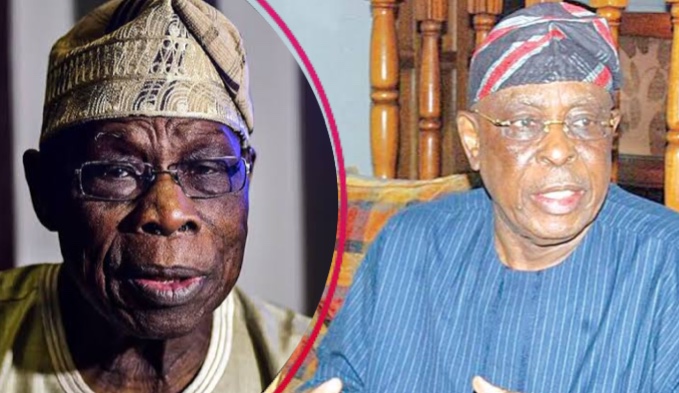
Former President Olusegun Obasanjo and former Ogun State Governor Olusegun Osoba have reignited their long-running disagreement over the events leading to the controversial 2003 general election, with fresh claims and counterclaims drawing renewed attention to one of Nigeria’s most debated political episodes.
The dispute resurfaced following the republication of excerpts from Osoba’s autobiography, Battlelines: Adventures in Journalism and Politics, under the title How Obasanjo Deceived Us in 2003. In the publication, Osoba alleged that Obasanjo persuaded Afenifere leaders and the six governors of the defunct Alliance for Democracy (AD) to support his re-election in 2003 based on promises that were later abandoned after he secured a second term.
Obasanjo rejected the allegations in a strongly worded response titled Reply to Your Inaccurate Posture: ‘How Obasanjo Deceived Us in 2003’, insisting that he never deceived the AD governors and arguing that Osoba did not possess full knowledge of the negotiations that took place.
The renewed exchange has also fuelled speculation that the dispute is linked to recent political developments in Ogun State, particularly the failure of Obasanjo’s daughter, former Senator Iyabo Obasanjo-Bello, to secure the All Progressives Congress (APC) governorship ticket ahead of the 2027 elections. After losing out to Senator Solomon Olamilekan Adeola (Yayi), she resigned from the APC, accused the party of sidelining her, and later returned to the Peoples Democratic Party (PDP), where she secured the Ogun Central Senatorial ticket.
According to Osoba, Obasanjo sought the support of the AD governors during a politically challenging first term marked by tensions with the National Assembly, impeachment threats and a strained relationship with then Vice President Atiku Abubakar. He claimed the governors insisted that any political understanding must involve Afenifere leaders, including the late Chief Abraham Adesanya.
Osoba further alleged that Afenifere presented Obasanjo with proposals including restructuring, devolution of powers, fiscal federalism, transparent census processes, merit-based appointments and constitutional reforms. He said Obasanjo gave assurances that many of the proposals would be pursued during a second term, prompting the AD not to field a presidential candidate against him in 2003.
However, the arrangement collapsed after the election, with the Peoples Democratic Party taking control of five South-West states, leaving only then-Lagos State Governor Bola Tinubu as the sole surviving AD governor. Osoba argued that the agreement was exploited to weaken the AD, although he acknowledged that no formal written accord existed to compel implementation of the alleged promises.
The former governor also claimed prominent Yoruba traditional rulers played key roles in facilitating discussions between the two sides. He alleged that concerns were raised over possible electoral manipulation, including reports of fake police officers being trained for the elections, but said Obasanjo dismissed the allegations and assured stakeholders that the polls would be credible.
Responding, Obasanjo denied misleading anyone and maintained that the AD governors had overestimated their political influence. He argued that the PDP already controlled the majority of states and enjoyed broad political support, insisting that the electoral outcome reflected voter sentiment rather than a coordinated effort to destroy the AD. He also accused Osoba of running an ineffective campaign and becoming disconnected from sections of the Ogun electorate before the election.
The renewed disagreement comes as political activities intensify ahead of the 2027 governorship election in Ogun State. Governor Dapo Abiodun is expected to complete his second term, while both Obasanjo and Osoba remain influential political figures whose positions could shape alliances and succession calculations in the state.