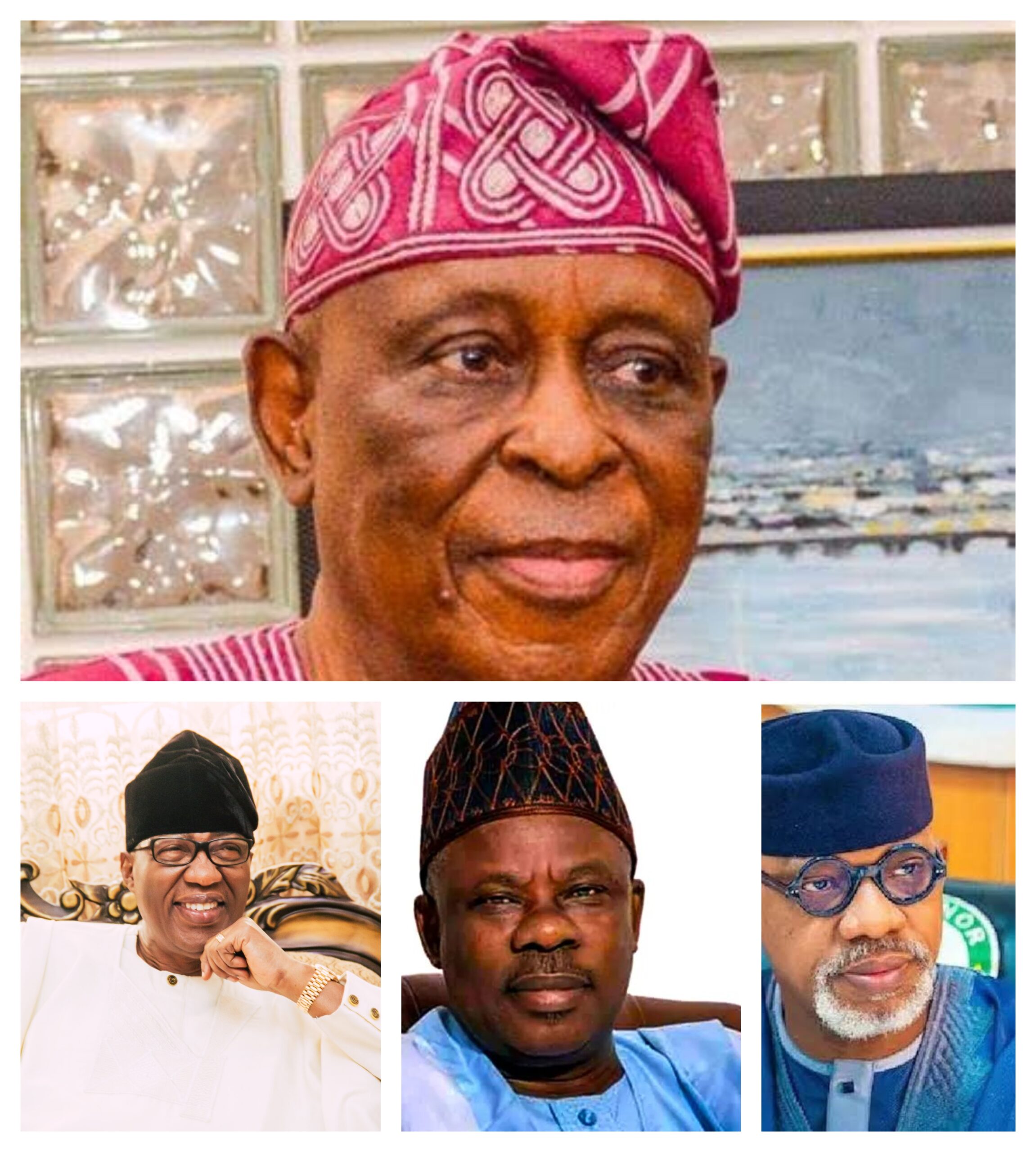
Fresh revelations suggest former Ogun Governor Olusegun Osoba may be strategically benefiting from the ongoing political clash between Dapo Abiodun, Gbenga Daniel, and Ibikunle Amosun. Is this a calculated revenge?
Osoba’s Silent Power Play—How Ogun’s APC Cold War Is Fueling a Powerful Revenge Strategy
Fresh revelations from the inner workings of Ogun State politics suggest that Olusegun Osoba, long considered a retired power broker, may in fact be quietly orchestrating one of the most strategic compoe state’s recent history, as the escalating conflict between Dapo Abiodun, Gbenga Daniel, and Ibikunle Amosun continues to fracture the ruling APC from within.
While party leaders and stakeholders have made repeated attempts to mend the widening divisions, Osoba has remained conspicuously silent and absent from reconciliation efforts, a posture that insiders now insist is far from accidental.
According to multiple high-ranking political sources, the former governor views the current turmoil not as a crisis to be resolved but as a moment of reckoning. Those familiar with his thinking claim he believes each of the key actors now locked in political battle played either direct or indirect roles in his political humiliation over the years, and for that reason, he sees little incentive to intervene. To him, the unfolding conflict represents a form of delayed justice, a chance to watch the very system that displaced him gradually unravel under its own weight. One senior APC insider described the situation bluntly, suggesting that in Osoba’s calculation, this is “payback season,” and that he would rather see his rivals weakened before making any decisive move.
At the heart of this lingering tension is the shadow of 2003, a year that remains pivotal in Osoba’s political memory. That election not only ended his tenure as governor but also ushered in a new political order that effectively dismantled his dominance in Ogun State. Those close to him say he has never fully reconciled with the circumstances of that defeat, and he continues to associate it with the emergence of a coalition that redefined the state’s power structure. Within that transformation, figures such as Gbenga Daniel, who succeeded him, Ibikunle Amosun, who rose within the same political wave, and Dapo Abiodun, who later consolidated influence under that evolving order, are all seen as beneficiaries of the system that replaced him. To Osoba’s loyalists, they are not just political actors but enduring symbols of a structure that pushed him aside.
His attempt to reassert control through strategic alliances also appears to have deepened his grievances. In 2011, Osoba reportedly threw his weight behind Ibikunle Amosun with the expectation that the alliance would dismantle Daniel’s political network and restore his own relevance. Instead, insiders say the relationship quickly deteriorated as Amosun consolidated power independently and sidelined the very structure that had supported his rise. By 2015, Osoba’s influence within the state had significantly diminished, and the fallout reportedly extended to his son, Olumide Osoba, whose political prospects were affected by the shifting dynamics.
A similar pattern of disappointment is said to define his relationship with Dapo Abiodun. Despite claims that Osoba played a role in Abiodun’s emergence as governor, sources within the party allege that his camp has since been marginalized. Loyalists reportedly found themselves excluded from key appointments and strategic decision-making processes, while his grip on party structures weakened considerably.
Tensions are believed to have escalated further when a commissioner aligned with Abiodun contested against Olumide Osoba during APC primaries, a move interpreted within Osoba’s camp as a calculated attempt to undermine his family’s political standing. Although the commissioner eventually stepped down, his subsequent reappointment reportedly deepened the sense of betrayal.
In this context, Osoba’s continued silence begins to take on a different meaning, one that aligns with a broader strategic outlook.
By allowing the conflict between Abiodun, Daniel, and Amosun to intensify, he is said to be benefiting from a situation in which no single faction can consolidate power. The ongoing hostilities keep Abiodun politically constrained, Daniel preoccupied, and Amosun locked in a struggle to maintain relevance. As each camp expends energy battling the others, Osoba’s position as an elder statesman and indispensable power broker is quietly reinforced. Those observing the situation closely suggest that the longer the crisis persists, the more it elevates his relevance, ensuring that no serious political calculation in Ogun State can afford to ignore him.
Even so, questions remain about whether he still possesses the structural strength to fully capitalize on this moment. Analysts point out that his political machinery is no longer as formidable as it once was, with an aging network of loyalists, limited grassroots regeneration, and weak succession planning posing significant challenges. Yet, despite these limitations, his experience, patience, and deep understanding of the state’s political terrain continue to command respect and caution among both allies and rivals.
As Ogun State’s political heavyweights remain locked in a prolonged battle for supremacy, a compelling narrative is taking shape around the man who has chosen not to speak. Whether by deliberate design or by the natural consequences of a fractured political landscape, Olusegun Osoba appears to be steadily reclaiming relevance at the very center of the unfolding drama. And if the current crisis continues along its present trajectory, it may ultimately confirm what some insiders already believe—that the quietest player in the room could yet emerge as the most consequential, having watched patiently as those who once inherited his throne struggle to hold on to it.