Zanzu is the name of a place in Sabah, about 500km before the capital city Tarabulous, also known as Tripoli capital city of Libyan Arab Jahmariya
The Zanzu Prison Escape – ‘Living In Libya’ Series | By Femi Omidiji
You may have heard of Zanzu from a popular song by Portable. Yes, it is actually called Zanzu. He may have heard the word from some of his Libyan returnees but got the pronunciation wrong. It’s the name of a place in Sabah, about 500km before the capital city Tarabulous, also known as Tripoli capital city of Libyan Arab Jahmariya
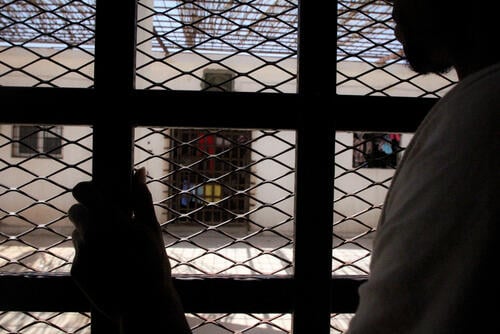
Zanzu is a deportation camp heavily guarded by armed policemen. It is like a four-corner fenced prison with inbuilt rooms built into the four corner fences but has an opening in the center where they allow deportees to walk around in the day. They have another high wire fence covering the whole property, just in case one escapes from the main building; the outer fence will deter the escapee from leaving the property.
THE ARREST
I was at home that lovely Sunday afternoon, listening to one of Keith Sweat’s songs. I can remember vividly when we got a knock, a loud bang at the door, and a voice saying ‘open the door’ in Arabic. We knew immediately that it was the police. We all panicked, knowing that none of us had complete papers to stay in the country at the time.
We actually thought it was the immigration police, but it happened to be the Libyan illicit drug department police – fearsome-looking guys. We opened the door; they barged in and started searching everywhere. They found nothing. One thing I have always been wary of is drugs. I remember my dad warned me never to indulge in anything that has to do with drugs, and it stuck.
The search did not yield anything except one thing that was illegal in Libya at the time – dollar notes. They discovered that we all had dollars kept in our pockets. They collected all the money and arrested everyone. We were taken into custody and transferred to the immigration department, where we were all sent to the deportation camp.
I remember having about 140 Libyan Dinars with me that night, which they never collected. We were taken in by the officers in charge after the count was taken.
I spent over a week at the deportation camp, a very terrible place to be because of its overwhelming crowd waiting for deportation. Some had spent months there, languishing, and some deaths had also been reported due to poor sanitary conditions, bed bugs, and lice everywhere. Some had gone loco and were kept in separate cells. We were given an egg and hopza (bread) daily. I got tired and fed up with the place after five days of waiting, hoping they would deport us sooner than later.
Deportation is mostly done by road. They take you in buses and drive you down to an Algerian border town called Tamanraset and leave you there to find your way back to wherever you came from. To get back to Tripoli from Tamanraset may take you years, especially if you don’t have money. Even if you do, you still have many police checkpoints to contend with, and the chances of you getting rearrested are 99% if you travel by road.
So, after spending about a week in Zanzu, I studied the security details of the place, the daily morning and night counts before they send us into the cells at night and lock the door.
I gathered a few of my trusted friends and informed them of my plans. Almost all of them were apprehensive, saying it wouldn’t work, that I should forget it. They left. I called one of them again the next day and informed him that the morning counts were what they did now, that they no longer did the night counts before sending us into the cells, and that the plan would work. He listened and got the idea, but fear was the issue. I told him I was ready to take all the risks involved. We gathered like five trusted guys, all Nigerians. As we had people from other countries in the camp from every part of the world, the only guys we didn’t really trust were the Nigeriens.
There is a cell in the property that is not occupied. Most times, guys go there to defecate. It’s messy and dirty, so the guards don’t usually go there because it’s messed up. I told my men that when it’s about time in the evening for us to be sent into our cells, I would hide in the dirty cell.
THE ESCAPE
I concealed myself inside the dirty cell while everyone was directed to the main cell, and the large iron door was secured at the back with a detachable bar that could only be opened from outside the cell. It was during the winter season, and I knew I had to wait until the peak period of the morning when the cold would be at its highest, and the guards would likely be inside the office warming up. I waited until approximately 4 a.m. and then stealthily exited my hiding place, opened the gate without making a sound, and alerted my fellow inmates, who were already on high alert.
We had secretly informed around 10 Nigerian inmates about our escape plan, and those who had spent longer periods in the cell were eager to join. They quickly got up, and those from other nationalities who were not informed about the plan woke up, but they were unaware of what was happening. They simply observed that some inmates were packing their backpacks and exiting. We maintained as much silence as possible. Now that we were outside the cell, our next challenge was to ascend the very high building.
However, I had a plan in place. I instructed the inmates to bring their blankets, which we tied together to create a longer rope. Our next hurdle was to get the blankets up to the concrete roof of the cell. I requested that the heftiest inmates carry one another on their shoulders to reach the rooftop.
This was successful, and we passed the blankets to the third inmate at the top, who had made it to the rooftop. He laid down on the decking, held on tight to the blanket, and we climbed up one after the other. I noticed that while this was happening, the inmates in the cells were becoming agitated. The Nigeriens, who were our arch enemies in the cell, perceived us as being arrogant and decided to teach us a lesson by raising the alarm.
Fortunately, all of us had climbed onto the roof, and our next step was to scale the compound fence, which was also high with a perimeter fence wire. We descended one after the other into the main compound and started climbing the fence. By this time, the guards had started coming out to investigate the noise.
I recall that the fence was too high for me to grab the top, and I tried repeatedly to jump but was unsuccessful. I tried again until I suddenly felt someone grab me and push me up to grab the fence.
By this time, gunshots were being fired everywhere, and we were being shot at, but thankfully, none of us were hit.
We made it to the other side and took off in different directions.
This happened in the 90s… Read More