


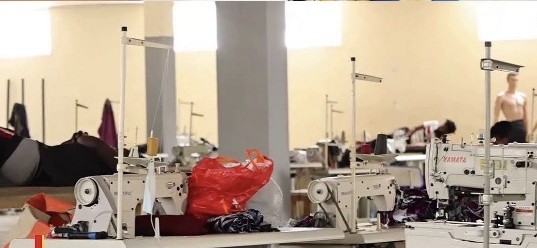
Across Nigeria today, nine fully operational garment and fashion hubs are running under the SMEDAN Shared Facility Scheme
This Silent Revolution May Turn Nigeria To World’s Fashion Capital
| By Olabode Opeseitan
When President Bola Tinubu declared his ambition to build a trillion dollar Nigerian economy, many expected the usual rhetoric. Instead, across multiple sectors, the administration began rolling out initiatives that signaled a deeper seriousness. In fashion, the government did not speak loudly. It acted. Quietly, a revolution is underway that may catch the global clothing industry unawares.
Across Nigeria today, nine fully operational garment and fashion hubs are running under the SMEDAN Shared Facility Scheme. These hubs are not symbolic. They are industrial clusters equipped with over 150 machines, solarized power, and subsidized access costing as little as N300 to N500 a day. The flagship Abuja hub, recently solarized in partnership with the UNDP, now provides tailors with uninterrupted 24 hour power.
In Lagos, the Eko Fashion Hub can service 380 tailors daily, reaching over 136,000 micro businesses annually. In Imo, the Owerri hub can handle 350 tailors a day, translating to 110,000 fashion entrepreneurs yearly. These are not theoretical capacities. They are active footprints.
Yet the most astonishing part is not the infrastructure. It is the scale of human capital being prepared to use it. The N3.6 billion ITF SUPA program is training 200,000 tailors nationwide. This is one of the largest coordinated artisan upskilling efforts in Africa. With incubation, certification, and industrial machinery placements, the initiative is projected to generate up to one million direct and indirect jobs within two years. Onboarding and certifying 200,000 tailors will inject immediate skilled labor into the informal market.
What Nigeria is building is not a fashion program. It is a manufacturing ecosystem. The hubs provide shared industrial infrastructure. SUPA provides skilled labor. The Cotton, Textile, and Garment roadmap provides raw material alignment. The revitalisation of historic factories like Kaduna’s Kakuri hub provides industrial backbone. When these pieces converge, Nigeria shifts from a consumption heavy importer to a production driven powerhouse.
The opportunity is staggering. Nigeria currently loses $6 billion annually to textile imports. But that is only the defensive play. The offensive play is far larger. Bangladesh earns $38.8 billion annually from garment exports. India earns $37.8 billion. If Nigeria captures even 10 percent of this global window, it would generate nearly $4 billion annually from fashion export alone. That figure complements Nigeria’s current crude oil earnings, which fluctuate between $3.5 billion and $5 billion monthly depending on production volumes and global prices. In other words, fashion is not a side industry. It is a potential macroeconomic equalizer.
To understand the magnitude of this opportunity, Nigeria currently earns less than $100 million annually from fashion and textile exports. That figure is so small it barely registers on the national balance sheet. Yet at full implementation of the ongoing execution including the SMEDAN hubs, SUPA’s 200,000 tailor pipeline, revitalized textile mills, and AfCFTA market access, Nigeria’s external earnings from fashion could jump to $4 billion annually. That is a leap of nearly 4,000%. And it sits on top of the additional $6 billion saved from eliminating textile import dependence. The combined swing is a $10 billion annual correction to Nigeria’s economic position, enough to rival and eventually eclipse the country’s volatile oil revenue.
The roadmap is clear. In the immediate term, Nigeria will experience a supply shock. Tailors will scale faster than textile mills can supply fabric. In the medium term, revitalised ginneries and mills will close the gap, enabling import substitution and mandatory local patronage for uniforms and institutional wear. In the long term, Nigeria becomes an export engine, leveraging AfCFTA’s 1.4 billion person market and duty free access to West and Central Africa.
The strategic pivot is already visible. Nigeria is moving from bespoke tailoring to mass ready to wear. Assembly line production increases speed by over 400 percent. Standardised sizing charts allow Nigerian garments to meet US, UK, and EU retail standards. Institutional off take contracts for uniforms and workwear provide predictable revenue.
The global brands are watching. As labour costs rise in Asia, Nigeria’s youthful workforce and SUPA trained artisans become attractive. With deep sea ports, shipping times to New York or London can be cut to 10 to 14 days, rivaling Turkey’s speed advantage. Compliance upgrades, including WRAP and OEKO TEX certifications, will unlock partnerships with H&M, Zara, and Target.
To catalyse private investment, Nigeria is deploying aggressive fiscal incentives. Zero duty on industrial machinery. Corporate tax holidays under Pioneer Status. Free Trade Zone concessions that eliminate federal, state, and local taxes. Single digit intervention funds from BOI and CBN. These are not minor tweaks. They are structural accelerators designed to attract billions in manufacturing capital.
What emerges is a simple truth. Nigeria is not trying to join the global fashion industry. It is positioning itself to dominate it. The hubs are real. The training is real. The incentives are real. The market is enormous. The roadmap is coherent. And the timing is perfect. A quiet revolution is underway, and when it matures, the world will not ask how Nigeria entered the fashion industry. It will ask how Nigeria became its capital.