


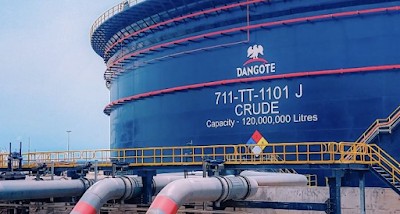





The U.S. agency disclosed that Nigeria’s seaborne petroleum product shipments averaged 561,000 barrels per day (bpd) in the second quarter of 2026
US Hails Dangote Refinery as Nigeria’s Petroleum Exports Surge Seven Times
The Dangote Petroleum Refinery has been identified as the key driver behind a seven-fold increase in Nigeria’s seaborne petroleum product exports since 2023, according to the latest report by the United States Energy Information Administration (EIA).
The U.S. agency disclosed that Nigeria’s seaborne petroleum product shipments averaged 561,000 barrels per day (bpd) in the second quarter of 2026, a significant increase from the annual average of 79,000 bpd recorded in 2023.
According to the EIA, the growth in exports has strengthened Nigeria’s position in the international petroleum products market at a time when supplies from several other regions have faced constraints.
The agency noted that the increase was largely underpinned by the commencement of operations at the Dangote Petroleum Refinery in January 2024. Data from energy intelligence firm Vortexa showed that of the 561,000 bpd shipped during the second quarter of 2026, about 350,000 bpd were exported, compared to an annual average of 46,000 bpd in 2023.
The EIA stated that increased production from the refinery has transformed Nigeria’s petroleum products market by reducing dependence on imports and boosting domestic supply.
“With increased supply of petroleum products from the country’s largest refinery, imports fell, exports increased, and Nigeria became more self-sufficient in refined petroleum products,” the agency said.
Before the start-up of the Dangote Refinery, Nigeria’s state-owned refineries collectively shipped less than 100,000 bpd of petroleum products, both domestically and internationally. The EIA observed that shipments rose significantly following the refinery’s commencement of operations and received a further boost after maintenance and expansion activities were completed in February 2026.
The agency explained that the refinery’s crude distillation capacity increased from 650,000 bpd to 700,000 bpd following the completion of the expansion programme, enabling higher output and greater product availability.
According to the report, total petroleum product shipments increased further as supply disruptions through the Strait of Hormuz created additional demand for alternative sources of refined products.
The EIA reported that intra-Nigerian shipments reached 211,000 bpd in the second quarter of 2026, compared with 81,000 bpd in 2025 and 33,000 bpd in 2023, reflecting the refinery’s growing role in supplying fuel across the country.
By providing refined petroleum products to different regions of Nigeria, the Dangote Refinery has significantly reduced the nation’s reliance on imported fuels. Nigeria, which imported nearly 400,000 bpd of petroleum products in 2023, saw seaborne imports decline to less than 130,000 bpd by the second quarter of 2026, according to the report.
The EIA also highlighted growing demand for Nigerian petroleum products in international markets. Vortexa data cited in the report showed that exports to Europe averaged 130,000 bpd in the second quarter of 2026, compared with 40,000 bpd in 2025 and 15,000 bpd in 2023.
The report underscores the increasing importance of the Dangote Petroleum Refinery in enhancing Nigeria’s energy security, supporting regional fuel supply, and positioning the country as a major exporter of refined petroleum products to global markets.
Recalled that Dangote Refinery has announced plans to bring an additional 700,000 barrels per day (bpd) of fully complex refining capacity on stream by the end of 2028. This would be added to its current capacity of about 700,000 bpd, potentially taking total capacity to around 1.4 million bpd. The refinery’s CEO, David Bird, said long-lead equipment has already been procured and construction contracts are being awarded











 in the second quarter of 2026)