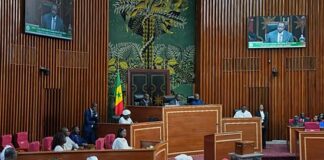








The FCT High Court in Abuja has dismissed Yahaya Bello’s application challenging jurisdiction and seeking to strike out a 16-count EFCC charge, ordering the trial to proceed
FCT Court Dismisses Yahaya Bello’s Application to Strike Out EFCC 16-Count Charge
The High Court of the Federal Capital Territory (FCT), Abuja, presided over by Justice Annenih, has dismissed an application filed by former Kogi State Governor, Yahaya Adoza Bello, seeking to strike out a 16-count charge brought against him by the Economic and Financial Crimes Commission (EFCC) in Charge No. FCT/CR/778/2024: FRN v. Yahaya Adoza Bello & 2 Ors.
Bello, through his lead counsel, J.B. Daudu, SAN, and other senior advocates, had asked the court to terminate the proceedings on the grounds that it lacked territorial jurisdiction to entertain the case. He also argued that the charge amounted to an abuse of court process, citing the pendency of a similar matter before the Federal High Court in Abuja in Charge No. FHC/ABJ/CR/98/2024.
The former governor’s legal team insisted that the issues raised in both cases overlapped and should not be tried simultaneously in different courts.
However, opposing the application, EFCC counsel, Kemi Pinheiro, SAN, urged the court to dismiss the motion, describing it as an attempt to delay trial proceedings. He argued that the offences before the court were properly filed under the Penal Code and therefore fell within the jurisdiction of the FCT High Court.
Pinheiro further maintained that the alleged offences were tied to properties said to have been acquired with proceeds of crime, all of which are located within Abuja, thereby conferring territorial jurisdiction on the court.
Responding to the claim of abuse of court process, the EFCC counsel argued that the two cases were distinct in both subject matter and parties. According to him, while the FCT High Court case involves allegations of criminal breach of trust and conspiracy under the Penal Code, the Federal High Court matter relates to alleged money laundering offences under the Money Laundering Act.
He also noted that the defendants in both cases are not the same, stressing that Bello is the sole defendant in the Federal High Court case, while he faces trial alongside two co-defendants in the FCT matter.
In a ruling delivered on June 16, 2026, Justice Annenih agreed with the EFCC’s submissions and held that the court has the requisite jurisdiction to hear the case. The judge further ruled that the proceedings do not constitute an abuse of court process as alleged by the defence.
With the ruling, the court dismissed Bello’s application in its entirety. A similar application filed by the third defendant was also rejected for lacking merit.
The court subsequently ordered that the trial should proceed without further delay. The EFCC was directed to continue its case with the testimony of its 16th witness (PW16), who was already present in court and prepared to give evidence.