



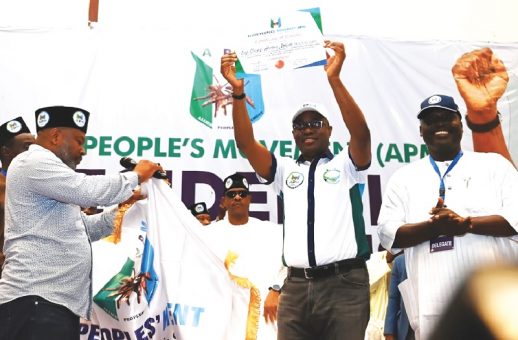
As political activities ahead of the 2027 general election gradually gather momentum, discussions are increasingly focusing on whether Oyo State Governor Seyi Makinde and the Allied Peoples Movement (APM) can emerge as a formidable force capable of disrupting Nigeria’s traditional two-party dominance.
Nigeria’s political landscape has historically been dominated by the All Progressives Congress (APC) and the Peoples Democratic Party (PDP). However, recent elections have shown that emerging political platforms can alter the political equation under the right circumstances.
The Labour Party (LP) provided the clearest example during the 2023 general elections when the presidential candidacy of Peter Obi transformed the party from a fringe platform into a major national contender. LP secured millions of votes, won legislative seats, and recorded victories in strategic states, demonstrating that alternative political movements can attract nationwide support.
Although the APM has yet to achieve a similar breakthrough, the party has steadily maintained a presence in Nigeria’s political space through participation in local, state and national elections.
Attention has now shifted to Governor Seyi Makinde, who is expected to complete his second and final term in office in 2027. Political observers believe his achievements in infrastructure development, fiscal management, civil service welfare, and the resolution of the long-standing Ladoke Akintola University of Technology (LAUTECH) ownership dispute have strengthened his credentials beyond Oyo State.
Makinde’s political standing within the PDP, however, remains complicated. His prominent role in the G5 governors’ rebellion during the 2023 presidential election and his open support for President Bola Tinubu while remaining a PDP member created divisions within the party but also projected him as an independent-minded politician willing to challenge party orthodoxy.
Despite these strengths, analysts argue that Makinde faces a significant hurdle in building nationwide recognition and the extensive political structures required for a successful presidential campaign.
The APM is widely viewed as a possible alternative platform should internal PDP politics prevent Makinde from securing the party’s presidential ticket. Unlike registering a new political party, taking over an existing platform offers a faster route to the ballot.
However, the party’s electoral performance remains modest. During the 2023 presidential election, APM secured just over 66,000 votes nationwide and failed to win any governorship, Senate or House of Representatives seat, limiting its influence across the country.
Political analysts note that without substantial financial backing, grassroots structures and nationwide mobilisation, the APM would struggle to compete effectively against established parties.
Even so, supporters believe Makinde’s growing influence, particularly among professionals and younger voters, could provide a foundation for expanding the party’s national appeal if strategic alliances are successfully built before the election.
Recent political meetings in Ibadan have further fueled speculation. Makinde hosted several opposition figures as discussions intensified over the possibility of presenting a united presidential candidate capable of challenging the ruling APC in 2027.
Nonetheless, persistent leadership crises, legal disputes and internal divisions across several opposition parties continue to cast doubt on the feasibility of such an alliance.
Within Oyo State, Makinde remains one of the state’s strongest political figures. Analysts believe he may ultimately prioritise preserving his political influence in the state over pursuing the presidency.
Some observers argue that the governor could use the APM as a bargaining tool in broader opposition negotiations, potentially trading a presidential ambition for concessions, including support for his preferred successor in Oyo State and favourable arrangements for legislative positions.
As political alignments continue to evolve ahead of the 2027 elections, the success of any Makinde-APM project is expected to depend less on the governor’s personal popularity and more on the party’s ability to transform itself into a credible national political platform capable of competing with the established dominance of the APC and PDP.