
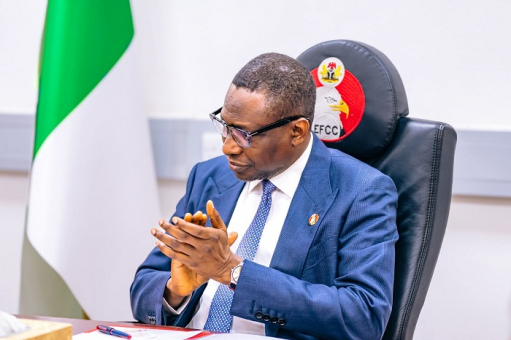




The EFCC is set to prosecute suspects and companies linked to ISIS and terrorism financing in Nigeria, while also pursuing money laundering charges involving $2.53 million against Miyetti Allah leader Bello Bodejo
EFCC to Arraign ISIS-Linked Suspects, Companies Over Terror Financing as Nigeria Intensifies Crackdown
Nigeria’s intensifying campaign against terrorism financing is set to enter a new phase as the Economic and Financial Crimes Commission (EFCC) prepares to file charges against a suspect and companies allegedly linked to the Islamic State of Iraq and Syria (ISIS), amid growing collaboration between Nigerian authorities and international partners to dismantle terrorist financial networks.
The planned prosecution follows months of intelligence gathering and investigations involving Nigerian security agencies and foreign counterparts, according to senior sources familiar with the matter. The development comes as authorities ramp up efforts to identify, disrupt and prosecute individuals and organisations suspected of providing financial support to terrorist groups operating within and beyond Nigeria’s borders.
A top EFCC source disclosed that the case has reached an advanced stage and is ready for prosecution.
“The EFCC will soon file charges against a suspect and three companies linked with ISIS in the country. This is already concluded,” the source said.
The source further noted that intelligence recently made public by the United States authorities had already been uncovered and assessed by Nigerian security agencies as part of ongoing counter-terrorism investigations.
Confirming the development, EFCC spokesperson Dele Oyewale said preparations had been concluded for the prosecution of suspects connected to ISIS and terrorism financing activities.
The anti-graft agency is simultaneously preparing to arraign Bello Abdullahi Bodejo of Miyetti Allah Kautal Hore before the Federal High Court in Abuja over allegations bordering on terrorism financing and money laundering involving $2.53 million.
According to court filings, the EFCC lodged a 12-count charge against Bodejo on June 22, accusing him of receiving and possessing substantial sums of foreign currency allegedly linked to proceeds of unlawful activities in violation of Nigeria’s anti-money laundering laws.
The charges allege that Bodejo accepted multiple cash payments running into hundreds of thousands of dollars without processing the transactions through financial institutions as required by law. Prosecutors claim that on January 11, 2022, he received $100,000 in cash from former Bauchi State Accountant-General Sa’idu Abubakar, exceeding the statutory threshold permitted for cash transactions. A separate count alleges that he accepted another $200,000 from the same source on January 21, 2022, under similar circumstances.
The EFCC further alleged that Bodejo received an additional $500,000 on March 20, 2024, and $980,000 on February 7, 2024, both in physical cash and above the legal limits stipulated under the Money Laundering (Prevention and Prohibition) Act, 2022.
Court documents also allege that he took possession of $980,000 under circumstances in which he knew, or reasonably ought to have known, that the funds represented proceeds of unlawful activities. The alleged offences are punishable under various provisions of the Money Laundering (Prohibition) Act, 2011, as amended, and the Money Laundering (Prevention and Prohibition) Act, 2022. He is expected to enter his plea in the coming days.
The latest developments coincided with a renewed declaration by the Federal Government that terrorists and their financiers would find no refuge within Nigeria’s financial system.
In a statement issued through the Nigerian Financial Intelligence Unit (NFIU), the Nigeria Sanctions Committee (NSC) welcomed sanctions imposed by the United States Office of Foreign Assets Control (OFAC) on Nigerian businessman Mukthar Muhammad Adamu and two Bureau De Change operators, Nine to Nine BDC Limited and Generation Currency BDC Limited, over alleged terrorism financing.
The committee revealed that the affected individuals and entities had already been included on Nigeria’s sanctions list on June 18 following extensive intelligence gathering, financial investigations and inter-agency assessments.
According to the committee, investigators established reasonable grounds to believe that the listed individuals and organisations facilitated, financed or otherwise supported the activities of the Islamic State West Africa Province (ISWAP) and other associated terrorist networks.
Also included on the sanctions list are Ibrahim Yakubu Ogirima, Adamu Chiroma, Ibrahim Abubakar, Abdullahi Umar Usman, Babangida Muhammed Adamu Hammajam and Abbal Bako and Sons Bureau De Change Limited.
The committee described the action taken by the United States as a strong indication of expanding international cooperation against terrorism financing and said the move would further strengthen efforts to cut off terrorist organisations from the global financial system.
Financial institutions and designated non-financial businesses were directed to fully comply with sanctions obligations, including freezing assets linked to listed persons and entities, filing Suspicious Transaction Reports and notifying relevant authorities of any confirmed matches.
The committee also commended the Federal Ministry of Justice, the Office of the National Security Adviser, the Central Bank of Nigeria, the Department of State Services, the EFCC and the NFIU for their roles in identifying and disrupting financial networks allegedly connected to terrorism.
Reaffirming Nigeria’s determination to combat terrorism financing, the committee said authorities would continue to work closely with domestic and international partners to safeguard the integrity of the country’s financial system and prevent terrorist organisations from accessing resources required to sustain their operations.
The impending prosecutions are expected to be closely watched as Nigeria seeks to demonstrate a tougher and more coordinated response to terrorism financing, money laundering and other financial crimes that threaten national and regional security.