




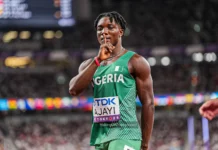
Team Nigeria’s men matched the women with five gold medals at the Glasgow 2026 Commonwealth Games as Nigeria finished seventh overall and emerged Africa’s top-ranked nation
Team Nigeria Men End Medal Drought, Match Women at Glasgow 2026 Commonwealth Games
For years, Team Nigeria arrived at major international competitions with a familiar script. Whenever gold medals were on offer, it was usually the women who delivered. From athletics and wrestling to weightlifting and para powerlifting, Nigeria’s female athletes consistently carried the nation’s medal ambitions while the men struggled to keep pace.
The trend became even more pronounced at the Birmingham 2022 Commonwealth Games, where all 11 of Nigeria’s gold medals were won by women before the women’s 4x100m relay title was later stripped following Grace Nwokocha’s failed doping test. Four years earlier in Gold Coast, Australia, women accounted for six of Nigeria’s nine gold medals despite being fewer in number than their male counterparts. The same dominance continued at the 2023 African Games in Ghana, where Nigerian women won 35 of the country’s 47 gold medals and contributed 71 of the 121 medals secured by Team Nigeria.
Historically, the Commonwealth Games have been kinder to Nigeria than the Olympics. Before Glasgow 2026, the country had amassed 269 medals across 15 editions of the Games, with more than 60 per cent coming since Manchester 2002. During that period, female athletes claimed 90 medals compared to the men’s 72, while the women’s superiority was even more evident in gold medals, winning 34 against the men’s 17. Although the men briefly outperformed the women at Manchester 2002 and Melbourne 2006, the balance shifted decisively in favour of the women from New Delhi 2010 onward.
Names such as Blessing Okagbare, Tobi Amusan, Ese Brume, Odunayo Adekuoroye, Blessing Oborududu, Rafiatu Lawal and Folashade Oluwafemiayo became synonymous with Nigeria’s success on the international stage. That long-standing narrative, however, changed dramatically at the Glasgow 2026 Commonwealth Games.
Team Nigeria concluded the Games seventh overall with 24 medals comprising 10 gold, seven silver and seven bronze to finish as Africa’s highest-ranked nation. More significantly, for the first time in many years, the men matched the women by winning five gold medals each, signalling a major shift in the country’s sporting fortunes.
National Athletics Head Coach Solomon Aliyu believes the transformation reflected a renewed sense of responsibility among the male athletes.
“The results speak for themselves,” he said.
“One of the biggest highlights was our performance in the men’s 400 metres. We all know how long it has taken Nigeria to return to the top level in that event, and the performances we saw here were encouraging.”
His assessment captured one of Nigeria’s biggest success stories in Glasgow. For years, the country searched in vain for male quarter-milers capable of challenging consistently on the world stage. Glasgow suggested that wait may finally be over.
Twenty-year-old Samuel Ogazi spearheaded the revival with a sensational victory in the men’s 400 metres, clocking 44.25 seconds to become the first Nigerian man to win Commonwealth Games gold in the event. Chukwuebuka Enekwechi also etched his name into history after producing a winning throw of 21.07 metres to secure Nigeria’s maiden Commonwealth Games gold medal in the men’s shot put.
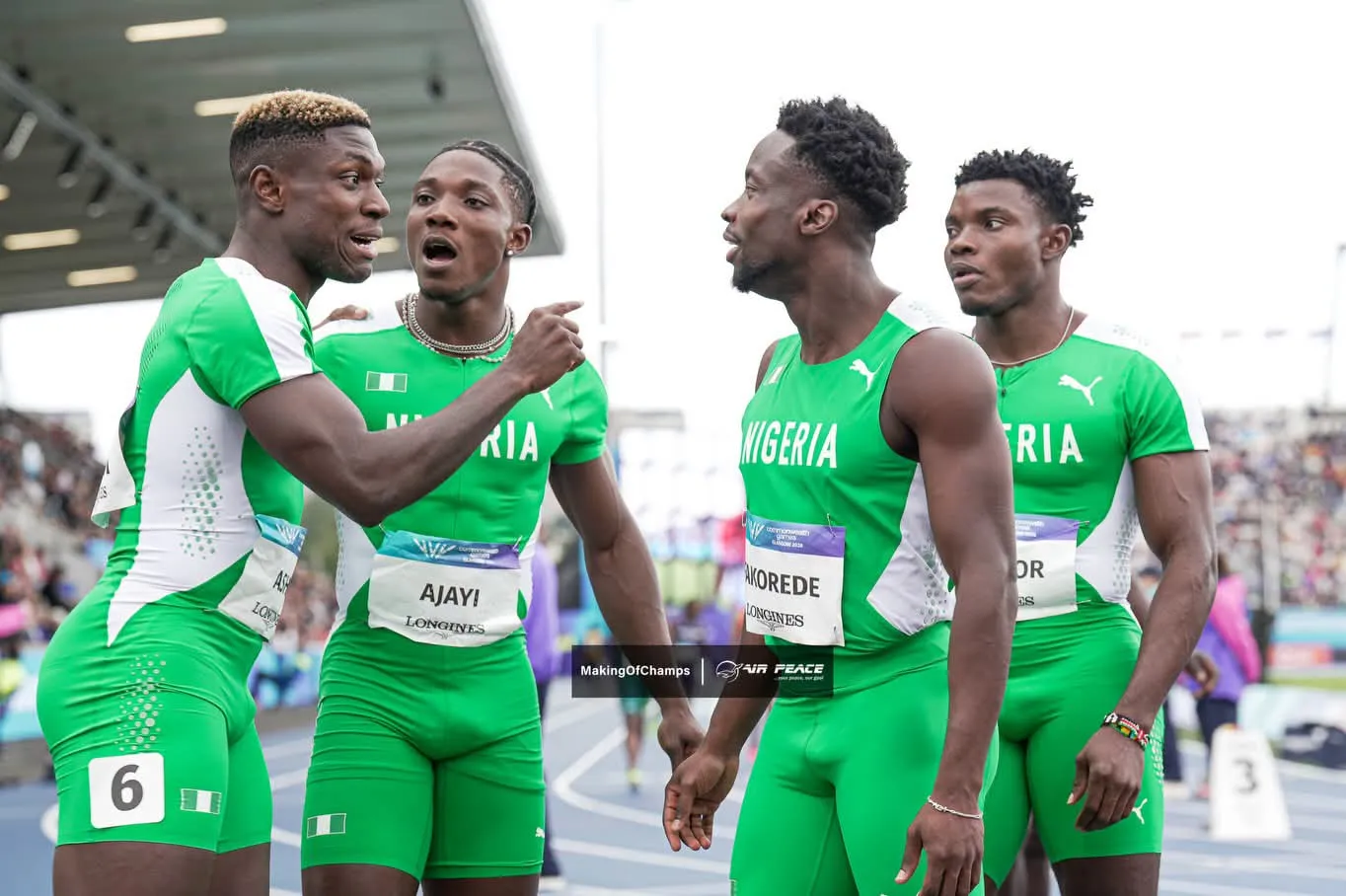
Nigeria’s sprint programme equally showed encouraging signs of resurgence. Udodi Onwuzurike improved from sixth place at Birmingham 2022 to claim silver in the men’s 200 metres with a season’s best 20.09 seconds. Kayinsola Ajayi ended Nigeria’s 20-year wait for a Commonwealth Games medal in the men’s 100 metres by winning bronze, while the relay quartet of Favour Ashe, Ajayi, Nicholas Fakorede and Onwuzurike also secured bronze in the men’s 4×100 metres after clocking a season’s best 38.12 seconds. The team was briefly elevated to silver following Canada’s disqualification before the decision was reversed on appeal, but the bronze still represented another significant milestone for Nigerian men’s sprinting.
Outside athletics, Rilwan Idris also made an immediate impact by winning gold on his Commonwealth Games debut in para powerlifting, underlining the men’s growing contribution across multiple sports.
Aliyu described the improvement as one of the most encouraging outcomes of the Games.
“One of my major takeaways from here is the performance of the men generally,” he was quoted as saying by Premium Times.
“In recent years, we’ve experienced a drought in terms of the men’s team delivering on the big stage. This time, the men rose to the occasion. They won major medals, including gold, whereas in previous championships it was mostly the women carrying the team.”
The numbers fully backed his assessment. Beyond matching the women’s five gold medals, the men added valuable silver and bronze medals across athletics and para sports to produce one of the most balanced medal contributions Team Nigeria has recorded in decades.
Explaining the turnaround, Aliyu credited the athletes’ mentality.
“I think the men accepted the challenge,” he said.
“They stepped up when it mattered most.”
That renewed confidence was evident throughout the Games as Ogazi, Enekwechi, Onwuzurike, Ajayi and Ezekiel Nathaniel either made history or brought an end to long-standing medal droughts. Instead of relying on a handful of stars, Nigeria’s men excelled across the 400 metres, hurdles, sprints, relays and field events.
The resurgence of the men did not diminish the achievements of the women, who once again proved why they remain one of Nigeria’s greatest sporting assets. Ruth Usoro claimed silver in the long jump after joining the team as a late replacement for Ese Brume. Ella Onojuvwevwo ended Nigeria’s 32-year wait for a Commonwealth Games medal in the women’s 400 metres by winning bronze, while Temitope Adeshina secured Nigeria’s first Commonwealth Games medal in the women’s high jump in 72 years. Tobi Amusan also battled through an injury-disrupted season to win bronze in the women’s 100 metres hurdles, as Nigeria’s female weightlifters and para-athletes continued their tradition of winning gold medals and setting world records.
Aliyu is convinced the women will return even stronger at future championships.
“At the same time, I believe the women will also respond,” he said.
“They have what it takes, and I’m confident they will come back stronger.”
Perhaps Glasgow’s greatest legacy is that Team Nigeria is no longer dependent on one half of its delegation. Emerging stars including Samuel Ogazi, Ezekiel Nathaniel, Edidiong Udo, Kayinsola Ajayi, Udodi Onwuzurike, Ella Onojuvwevwo, Ruth Usoro and Temitope Adeshina demonstrated that a new generation is ready to lead the country into the future.
With the women maintaining their tradition of excellence and the men rediscovering their winning edge, Team Nigeria produced one of its finest Commonwealth Games campaigns, finishing seventh overall, emerging as Africa’s highest-ranked nation and providing genuine optimism ahead of the Los Angeles 2028 Olympic Games.