


OGUN — As the 2027 governorship election draws closer, voters in Ogun State may need to look beyond campaign rhetoric and carefully examine the economic records, investments and public projects associated with the leading contenders.
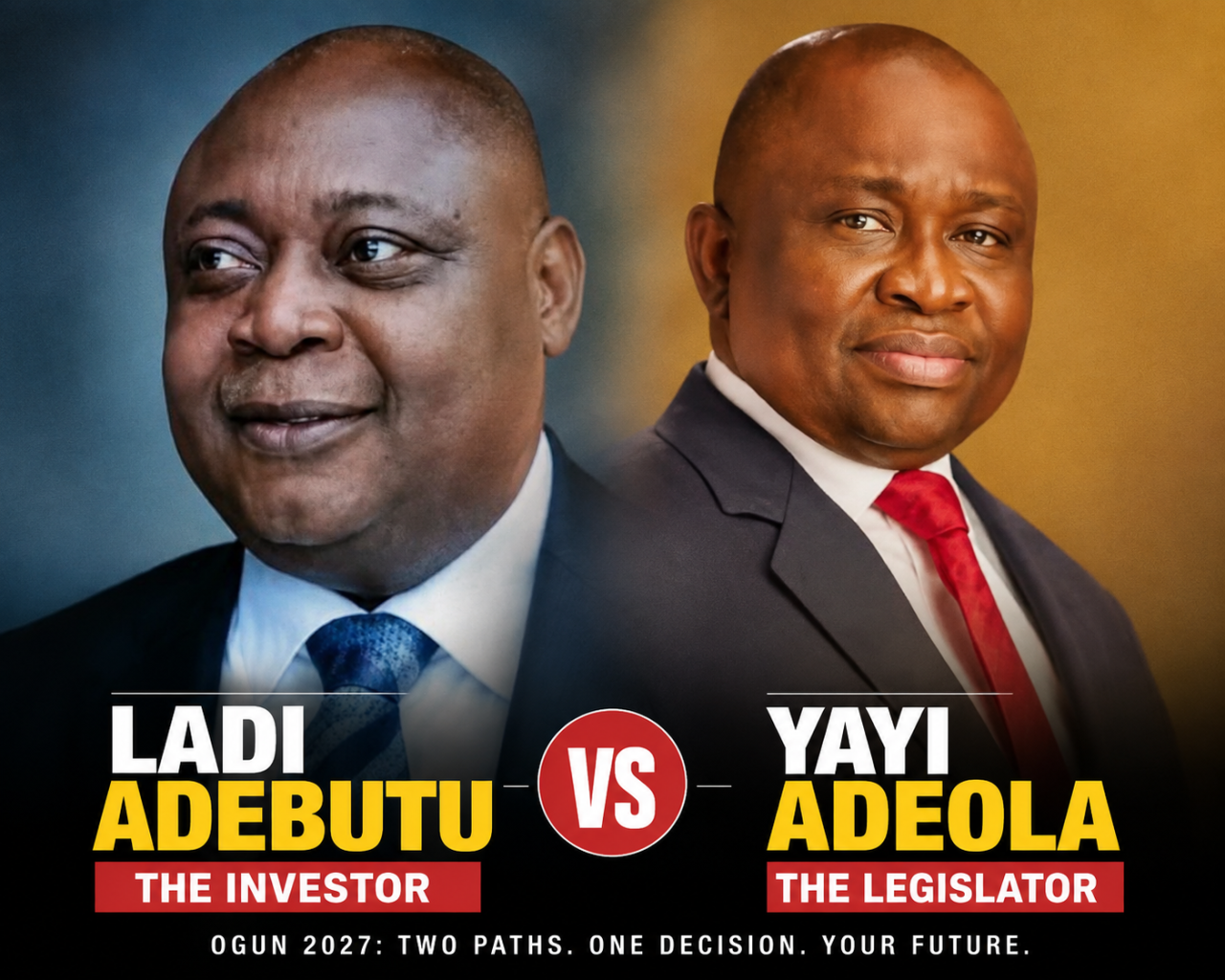
The political contest is increasingly shaping up around Peoples Democratic Party (PDP) candidate Ladi Adebutu and All Progressives Congress (APC) candidate Senator Solomon Olamilekan Adeola, popularly known as Yayi.
While both politicians have records they can present to the electorate, their backgrounds and approaches to public service differ significantly.
Yayi has built a substantial legislative profile and has facilitated numerous constituency interventions, while Adebutu has longstanding links to private enterprise, agriculture and employment generation in Ogun State.
The distinction between government-funded interventions and private-sector investment is therefore emerging as an important issue ahead of the election.
The 2026 Budget and Question of Attribution
The Federal Government’s 2026 Appropriation Act contains several projects across Ogun State and the wider South-West, including agricultural equipment, farmer training, market construction, youth and women empowerment, solar infrastructure and other interventions.
According to the article, the projects form part of federally appropriated expenditure.
This raises an important question for voters: when a project is contained in the Federal Government’s budget, should it be presented primarily as a politician’s personal contribution?
There is a clear difference between saying a politician facilitated the inclusion of a project in the government budget and claiming that the politician personally financed the project.
The former represents legislative intervention, while the latter implies personal expenditure.
The distinction, the article argues, is important for public accountability.
Yayi’s Legislative Interventions Under Scrutiny
Yayi’s own descriptions of some of his programmes provide context to the debate.
At his 2026 farmers’ empowerment programme, he reportedly described the intervention as complementary to the Federal Government’s agricultural agenda.
The programme reportedly benefited 2,557 farmers, who received items including tractors, tricycles, fertiliser, water pumps, planters, seeds and other agricultural equipment, alongside a N100,000 grant.
His Oloja Yayi programme has also been described as a micro-financing initiative implemented in partnership with the National Productivity Centre and aligned with President Bola Tinubu’s Renewed Hope economic programme.
The article argues that such programmes warrant greater clarity over their sources of funding.
Questions include how much was provided by the Federal Government, what was facilitated through the National Assembly, what came from government agencies and what, if anything, was personally contributed by the senator.
Such questions, the article maintains, should be viewed as matters of public accountability rather than attacks on Yayi.
Calls for Transparency on Constituency Projects
Another issue raised concerns budget entries referring to projects in “selected communities.”
The article argues that citizens should be able to determine which communities were selected, the criteria used, the beneficiaries, procurement procedures, contractors involved and the implementation status of the projects.
Ideally, public projects should be traceable from budget allocation to release, procurement, contractor, project delivery and beneficiaries.
According to the article’s argument, greater transparency would help prevent public expenditure from being presented as private political capital.
Ogun West and Osun Central Solar Project
The article also draws attention to a budget entry concerning the provision and installation of solar streetlights in Osun Central and Ogun West.
While acknowledging that there could be legitimate administrative or programme reasons for combining the locations, it argues that the public should have access to details showing how much was allocated to each area, which communities would benefit and who would be responsible for implementation.
The central concern, according to the article, is not the inclusion of Osun in the federal budget but the need for transparency when such projects become politically associated with individual politicians.
Adebutu’s Private-Sector Footprint
The article presents Adebutu’s economic background as a contrasting model.
It points to the Adebutu family’s longstanding private-sector interests in Ogun State, including agriculture and allied businesses.
Ladi Adebutu’s agricultural enterprise, SKAAL, is based in Iperu-Remo, while his brother, Segun Adebutu, has major industrial interests through Petrolex at Ibefun.
The article distinguishes such businesses from government-funded constituency projects, noting that private enterprises involve the deployment of private capital, creation of assets and employment outside the framework of government appropriations.
Public Projects and Private Investment Are Both Important
The article does not dismiss Yayi’s achievements, noting his representation of Ogun West in the Senate since 2023 and his previous legislative experience representing Lagos West.
It also references claims on his campaign website of more than 250 projects and over 40,000 beneficiaries, as well as reported participation in farmer and trader empowerment programmes.
However, it argues that voters should distinguish between personal philanthropy, private investment and government expenditure facilitated through elected office.
At the same time, Adebutu’s business background should not automatically be treated as proof that he would deliver better governance.
The real question, according to the article, is how either candidate would translate his experience into sustainable economic development across Ogun State.
Beyond Empowerment to Economic Transformation
While empowerment programmes can provide meaningful assistance to individuals and communities, the article argues that Ogun’s long-term economic future requires more than periodic interventions.
It identifies factories, farms, processing plants, industrial parks, technology companies, logistics hubs, export businesses and large-scale employment as areas requiring greater attention.
The state, it argues, needs leadership capable of attracting and retaining private capital while using government policy and infrastructure to create an environment in which businesses can grow.
The 2027 Election as a Test of Records
The article suggests that the 2027 election should become an examination of the candidates’ records rather than a contest over campaign spending, political structures or the volume of materials distributed at rallies.
Among the questions voters could consider are:
Who has demonstrated the capacity to create sustainable economic value?
Who has invested private capital?
Who has created lasting jobs?
Who has built productive assets?
Who has attracted investment?
Who understands government?
Who understands business?
Who can effectively combine both?
For Yayi, the article argues, voters should seek clarity over which projects were personally funded and which were facilitated through government budgets or public institutions.
For Adebutu, voters should equally demand a clear blueprint explaining how his business and agricultural experience would translate into industrialisation, agricultural modernisation and mass employment across Ogun State.
The Choice Ahead
Ultimately, the article frames the 2027 contest as a choice between different approaches to leadership.
One model emphasises legislative representation, constituency projects and government interventions, while the other can make a case around private enterprise, agriculture, investment and employment creation.
Neither approach, the article argues, should receive an automatic endorsement from the electorate.
Instead, voters should scrutinise both records and demand evidence of what each candidate has achieved, how those achievements were funded and what each intends to accomplish if elected governor.
The central question for Ogun voters, therefore, may be simple: What has each candidate built that will continue benefiting the state after the election is over?
The answer, according to the article, should help voters assess whether Adebutu’s private-sector experience, Yayi’s legislative record, or a combination of both represents the stronger path toward the Ogun State they want in 2027.