



By Newsheadline247
Tinubu says economic reforms are changing Nigeria’s growth outlook, citing 3.89% GDP growth and $10.37bn in capital importation in Q1 2026
Tinubu: We’re Rewriting Nigeria’s Decades of Economic Underperformance
President Bola Tinubu has defended his administration’s economic reforms, declaring that Nigeria is beginning to overcome decades of economic underperformance as he cited improved growth, rising capital importation and expansion in manufacturing as evidence of progress.
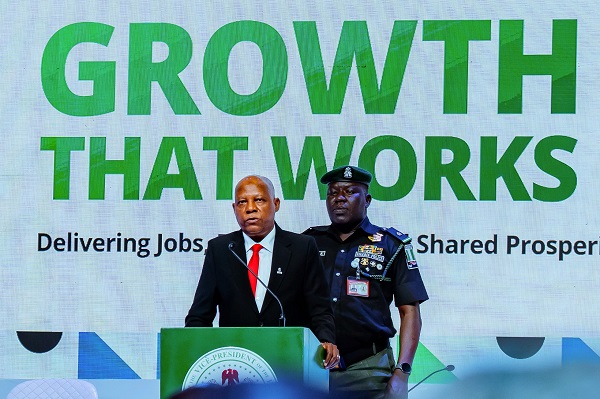
Tinubu spoke on Monday at the opening of the 32nd Nigerian Economic Summit in Abuja, where he was represented by Vice-President Kashim Shettima. He said the government had begun dismantling longstanding structural barriers that, in his view, prevented the country from translating its abundant human and natural resources into sustainable prosperity.
In a statement issued by Stanley Nkwocha, Senior Special Assistant on Media and Communications in the Office of the Vice-President, Tinubu acknowledged that the reforms had required difficult decisions but insisted that stabilising the economy was necessary to attract investment, create jobs and improve livelihoods.
“Distinguished ladies and gentlemen, we came to rewrite the story of a nation that has performed below its potential for far too long. But there is no shortcut to economic growth. This is why we began with a difficult reset. For us, rescuing the economy means rescuing livelihoods and transforming the fortunes of young jobseekers, farmers, manufacturers, entrepreneurs and innovators.
“We cannot harness the immense opportunities offered by our growing population without first stabilising the economy. We must also create the conditions for the public and private sectors to invest, expand and generate productive employment”, he said.
The President said the summit’s theme, “Growth That Works: Delivering Jobs, Productivity and Shared Prosperity”, reflected his administration’s ambition to ensure that economic reforms translate into measurable improvements in the lives of Nigerians.
According to him, the government had introduced measures aimed at removing structural obstacles to growth, restoring investor confidence and strengthening the foundations for a more productive economy.
“These reforms are restoring confidence, strengthening our economic foundations and laying the groundwork for sustainable growth”, Tinubu declared.
To support his argument, Tinubu cited National Bureau of Statistics figures showing that Nigeria’s inflation-adjusted gross domestic product grew by 3.89 per cent year-on-year in the first quarter of 2026, compared with 3.13 per cent in the corresponding period of 2025.
He said non-oil activities accounted for 96.08 per cent of GDP during the period, while manufacturing grew by 3.29 per cent and the oil sector recorded growth of 2.57 per cent. He described the figures as signs of progress in the government’s efforts to expand economic activity beyond oil and strengthen domestic production.
Tinubu also highlighted a rise in capital importation, saying Nigeria attracted $10.37bn in the first quarter of 2026, an increase of 83.83 per cent compared with the same period in 2025.
“In the first quarter of 2026, our capital importation reached $10.37 billion, an increase of 83.83% over the corresponding period in 2025. This comprised both portfolio and foreign direct investment. We will, therefore, continue to ease regulatory burdens, strengthen transparency and policy predictability, and expand access to finance”, he said.
However, the composition of the inflows is important to understanding the figures. Data from the National Bureau of Statistics show that portfolio investment accounted for the overwhelming share of capital importation in the first quarter, while foreign direct investment represented a much smaller proportion. The increase in total inflows therefore does not, on its own, establish that long-term productive investment has risen by the same margin.
Tinubu acknowledged that favourable economic statistics were not enough to determine whether the reforms were delivering the desired results. He said the government must also be judged by its ability to improve job quality, reduce underemployment and increase the productivity of workers and businesses.
“Our pursuit of prosperity demands greater productivity from every worker, enterprise and investment. We must judge infrastructure by the economic activity it generates and education by the skills and productivity it delivers.
“We must judge industrial policy by the competitiveness of our firms and investment incentives by the capital, technology, exports and jobs they attract”, he stated.
The President said his administration’s tax reforms were designed to establish a modern and equitable system capable of financing development while giving businesses greater certainty for long-term planning and investment.
He added that the same approach was guiding government interventions in electricity, agriculture, energy and solid minerals, sectors he described as critical to improving productivity and broadening the country’s economic base.
On electricity, Tinubu said the government was restructuring the market to improve power supply and attract investment across generation, transmission, distribution and alternative energy. Reliable electricity, he argued, would help businesses expand production and reduce operational constraints.
In agriculture, he said the administration was working to connect farms with storage facilities, processing centres and markets while expanding irrigation, mechanisation, agricultural financing and rural infrastructure.
He also outlined plans to move the solid minerals sector beyond the extraction and export of raw materials towards domestic processing, manufacturing and value-added exports. Such a shift, he said, could create more economic opportunities and help Nigeria retain a greater share of the value generated from its natural resources.
Despite the measures outlined, Tinubu acknowledged that considerable work remained. He expressed confidence that the creativity and global competitiveness demonstrated by young Nigerians in technology, financial services and the creative industries could support the country’s development if the right conditions were created.
Speaking at the summit, United Nations Deputy Secretary-General Amina Mohammed acknowledged gains from the government’s reforms but urged the administration to consolidate and stabilise progress while managing public expectations.
She also commended the African Development Bank’s emerging development financing architecture, particularly its emphasis on programmes designed to deliver measurable development outcomes across the continent.
The Minister of Finance and Coordinating Minister of the Economy, Taiwo Oyedele, used the summit to present a proposed Nigerian Economic Policy Framework, which he described as a national economic doctrine intended to guide policy decisions and provide credible standards for measuring progress.
Oyedele invited members of the Nigerian Economic Summit Group and private-sector experts to scrutinise the proposed framework and strengthen it through evidence-based recommendations.
He identified enterprise development, open but fair markets and coordination across government as guiding principles. Economic stability, human capital development and productivity were among the framework’s stated priorities.
Earlier, Nigerian Economic Summit Group chairman Olaniyi Yusuf commended the Federal Government’s efforts to improve the business environment, saying the reforms had altered important aspects of Nigeria’s economic structure.
Yusuf argued that the priority should now be to stabilise and consolidate the changes rather than reverse them. He challenged participants to develop practical measures capable of translating policy agreements into employment, higher productivity and shared prosperity.
BUA Group chairman and founder Abdul Samad Rabiu also praised the reforms, saying they were beginning to address longstanding difficulties faced by businesses operating in Nigeria.
While acknowledging the hardship experienced by ordinary Nigerians, Rabiu pointed to improved access to foreign exchange as one area where businesses had experienced greater predictability.
“For many years, one of the greatest challenges facing businesses was access to foreign exchange. You could have all the naira but be unable to obtain the foreign exchange needed to buy raw materials and machinery,” he recalled.
The summit brought together government officials, development partners and private-sector leaders, including Anambra State Governor Chukwuma Soludo, Lagos State Governor Babajide Sanwo-Olu, Budget and Economic Planning Minister Abubakar Bagudu, Industry, Trade and Investment Minister Jumoke Oduwole, Livestock Development Minister Idi Mukhtar Maiha and Minister of State for Budget and Economic Planning Doris Uzoka-Anite.
The 32nd Nigerian Economic Summit is focused on identifying practical ways to translate economic growth and policy reforms into productive employment, stronger national competitiveness and improved living standards.