


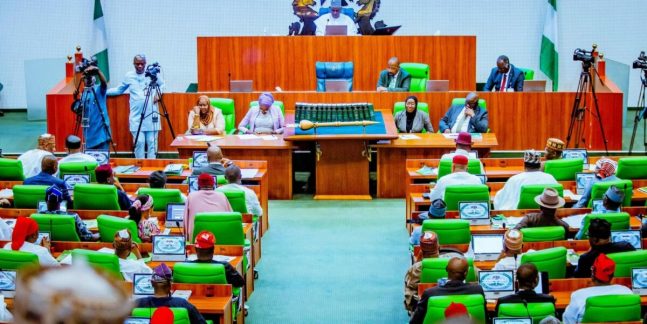





The National Assembly is set to vote on a landmark bill to establish state police in Nigeria, marking a major constitutional step aimed at strengthening national security and policing structure
National Assembly Moves to Approve State Police Bill in Major Constitutional Reform Push
The National Assembly is set to take a major step today in Nigeria’s ongoing security reform efforts as the House of Representatives prepares to vote on a proposed constitutional amendment seeking to establish state police, while the Senate is also expected to consider the bill for second reading.
The proposed legislation, which seeks to amend Section 214 of the 1999 Constitution, is being championed by Deputy Speaker Benjamin Kalu, who also chairs the House Committee on Constitution Review. Kalu confirmed that members of the House currently on oversight duties have been directed to return to Abuja for the crucial sitting.
A legislative source in the Senate also disclosed that the bill, alongside other constitutional amendment proposals, has already passed first reading and is scheduled for second reading on the Senate floor today. Senate Leader Opeyemi Bamidele had earlier indicated that the state police bill would be passed this week, citing the urgent need to address escalating insecurity across the country.
Under Nigeria’s current constitutional arrangement, policing remains on the Exclusive Legislative List, placing it solely under federal control. The proposed amendment seeks to move policing to the Concurrent Legislative List, thereby allowing states to establish and manage their own police structures alongside the federal police.
The bill, co-sponsored by several lawmakers including House Leader Julius Ihonvbere, Fatima Talba, Blessing Onuh, Tolani Shagaya and others, introduces new legal definitions for both state police and community policing under Section 318 of the Constitution.
In the draft proposal, state police is defined as “a law enforcement agency established to operate specifically at the state level to maintain law and order within its jurisdiction.” Community policing is also described as “a policing approach in which law enforcement personnel work in close partnership with residents, community institutions and local stakeholders to prevent crime, maintain public safety and resolve security concerns through collaboration, problem-solving, trust-building and regular engagement with the community.”
Clause 2 of the amendment proposes replacing Section 214 with a new framework that establishes both a Federal Police known as the Nigeria Police and State Police in each state of the federation. It further provides that all policing structures under the law shall be organised and regulated in line with an Act of the National Assembly, while officers will exercise powers as prescribed by law.
If passed by both chambers, the bill will proceed to the 36 state Houses of Assembly for ratification, where it must secure approval from at least two-thirds of the states before being transmitted to President Bola Ahmed Tinubu for assent.
The reform effort has already been supported by a high-level consultative meeting held at the Presidential Villa last week, chaired by Chief of Staff to the President, Femi Gbajabiamila, and attended by key stakeholders including the Inspector-General of Police Kayode Egbetokun and Attorney-General of the Federation Lateef Fagbemi (SAN).
Speaking ahead of today’s legislative action, Deputy Speaker Kalu said the National Assembly is fulfilling its constitutional responsibility to address the country’s security challenges through legislative intervention.
“When we say that the security of lives and property is the primary purpose of government, does that responsibility rest only on the executive? The answer is no,” he said.
“The House of Representatives has always been seen as a solution hub where the nation’s problems are brought for legislative solutions. That is why we decided to prioritise the issue of security and improve response time through constitutional amendments targeted at policing.”
Kalu added that there is growing consensus among key stakeholders in support of the reform.
“As it is today, there is a structure that has been agreed upon by the Inspector-General of Police and his team. There is a national consensus on it. The executive has bought into it, and the governors have bought into it,” he said.
He further expressed optimism about the outcome of the legislative process, stating that the initiative reflects a unified effort by lawmakers to improve national security outcomes.
“We are here to announce to Nigerians that hope is coming. The hope of having a better response time to incidents of crime is here,” he said, adding that the National Assembly is committed to prioritising state police as part of broader constitutional reforms aimed at strengthening security across the country.