

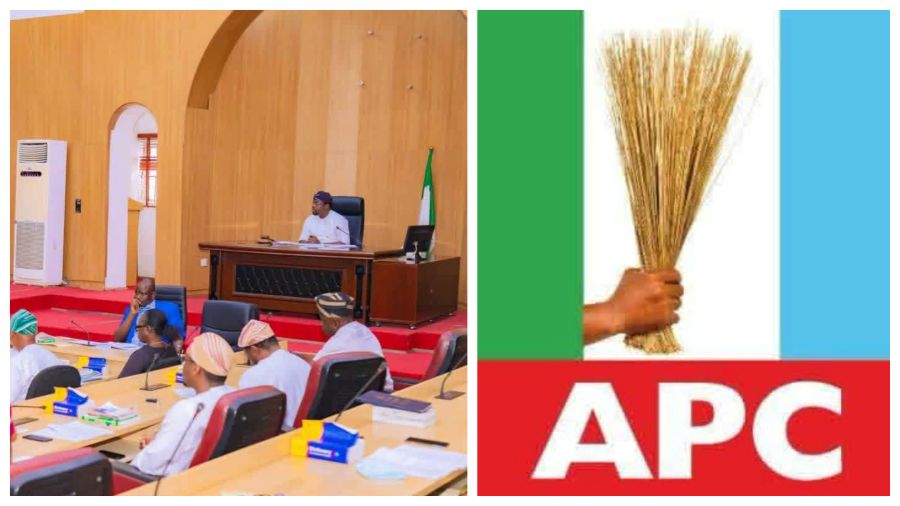



Osun Assembly has hit back at the APC over its opposition to the 2026 Integrated Transport, Traffic and Park Management System Bill
Osun Assembly Challenges APC to Court Over Transport Bill as Row Escalates
The Osun State House of Assembly has challenged the state chapter of the All Progressives Congress (APC) to test its interpretation of the 1999 Constitution in court rather than declaring the newly passed Osun State Integrated Transport, Traffic and Park Management System Bill, 2026 unconstitutional.
The Assembly’s position followed a statement by the Osun APC, signed by its Director of Media and Information, Mogaji Kola Olabisi, in which the party described the legislation as a “legislative harakiri”, “unenforceable” and a “recipe for crisis” while demanding its withdrawal.
In a statement issued on Thursday, September 25, 2026, by Olamide Tiamiyu, Chief Press Secretary to the Speaker of the Osun State House of Assembly, the legislature said the APC’s position was based on what it described as a selective interpretation of the 1999 Constitution, particularly Section 7 and the constitutional provisions governing local government councils.
The Assembly argued that Section 7(1) of the Constitution guarantees democratically elected local government councils while providing that state governments shall ensure their existence under laws covering their establishment, structure, composition, finance and functions.
According to the Assembly, the constitutional provision means that the legislative framework governing local government councils forms part of the state’s legal architecture.
“It is therefore erroneous for the APC to suggest that the mere fact that a matter appears among the functions of Local Government Councils automatically removes it from the legislative competence of the State,” the statement said.
The Assembly also acknowledged that the Fourth Schedule of the Constitution lists the establishment, maintenance and regulation of motor parks among the functions of local government councils.
However, it maintained that the provision must be read alongside other constitutional provisions rather than in isolation.
“The APC’s argument that the State House of Assembly is constitutionally barred from legislating on a subject connected with Local Government Councils is therefore totally wrong,” the Assembly said.
It argued that the key constitutional question was whether the state legislature could establish a legal framework regulating matters within the state, including the operation, coordination and administration of the transport sector and the manner in which functions relating to motor parks are exercised.
The Assembly further stated that the functions assigned to local government councils under the Fourth Schedule could not be performed without the involvement of the State House of Assembly.
“It is pertinent to say that ALL the functions enumerated for the Local Government in the fourth Schedule of the Constitution CAN NOT BE PERFORMED WITHOUT THE APPROVAL OF THE STATE HOUSE OF ASSEMBLY. Mr Kola Olabisi should please add this to his knowledge,” the statement said.
The legislature also cited Section 100 of the Constitution, which provides for the legislative procedure through which a state House of Assembly exercises its lawmaking powers through Bills passed by the House and, subject to the Constitution, assented to by the governor.
According to the Assembly, the Integrated Transport, Traffic and Park Management System Bill went through debate and deliberation by elected lawmakers before it was passed.
It consequently questioned the APC’s decision to describe the legislation as “dead on arrival” and demand its withdrawal instead of allowing the constitutional and legal processes to run their course.
“If the APC genuinely believes that the law is unconstitutional, the courts are open to it,” the Assembly said.
It added that it had “no fear of judicial scrutiny” and would abide by the determination of a competent court on any genuine question concerning the interpretation of the Constitution.
The Assembly, however, rejected what it described as the presentation of partisan assertions as established constitutional law, urging the APC to distinguish between political disagreement and constitutional invalidity.
“The fact that the party disagrees with a policy or legislative intervention does not, by itself, make that legislation unconstitutional,” it said.
The lawmakers also rejected the APC’s claim that the legislation could create a crisis or disturb public peace, pointing to the stated objectives of the Bill, which include promoting orderliness, transparency, passenger protection and transport safety.
The Assembly said the legislation also seeks to introduce digitalised ticketing, eliminate multiple ticketing and improve coordination across the transport system.
It described those objectives as legitimate matters of public governance that should be subjected to informed legislative consideration rather than what it called political alarmism.
The House consequently urged the Osun APC to acquaint itself with what it described as the “intended meaning and full architecture” of the Constitution before making further public pronouncements on the legislation.
“If the APC considers its interpretation of the Constitution so compelling, it should test that interpretation before the court of law rather than attempt to determine constitutional validity through press statements,” the Assembly said.
According to Tiamiyu, the legislature reaffirmed its commitment to exercising its constitutional mandate and making laws aimed at promoting order, accountability, public safety and the welfare of residents of Osun State.