
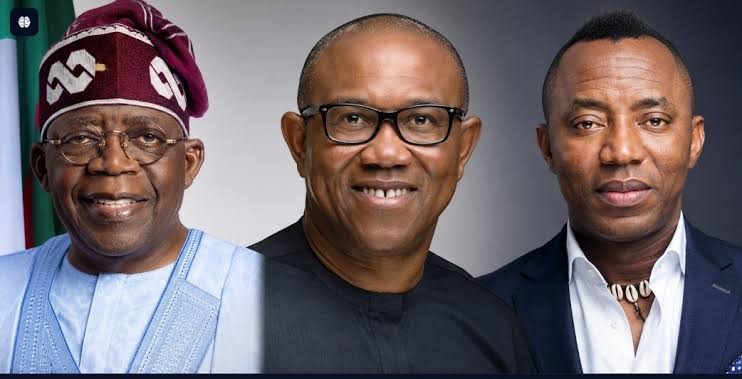



Nigerian political parties and presidential candidates sign a 2027 peace accord, while Peter Obi and Omoyele Sowore raise concerns over its effectiveness
2027 Elections: Tinubu, Obi, Sowore Sign Peace Accord
Presidential candidates and national chairmen of political parties contesting the 2027 general elections have signed a national peace accord in Abuja, committing themselves to peaceful and issue-based campaigns ahead of the commencement of electioneering.
The agreement was signed on Tuesday under the auspices of the National Peace Committee, chaired by former Head of State Abdulsalami Abubakar, in partnership with The Kukah Centre.
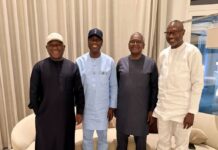
The ceremony at the International Conference Centre attracted representatives of several political parties and presidential candidates, including the Nigeria Democratic Congress candidate, Peter Obi; African Action Congress candidate, Omoyele Sowore; and Social Democratic Party candidate, Adewole Adebayo.
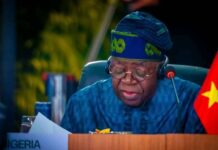
President Bola Tinubu, the presidential candidate of the All Progressives Congress, was absent and represented by the Secretary to the Government of the Federation, George Akume, while the APC National Chairman, Nentawe Yilwatda, signed the accord.
The ADC presidential candidate, Atiku Abubakar, was also absent from the event.
The signing came a day before the commencement of campaigns for the presidential and National Assembly elections, in line with the Independent National Electoral Commission timetable.
Representing Tinubu, Akume said the accord provided an opportunity for political parties and candidates to reaffirm their commitment to peaceful and transparent elections. He commended members of the National Peace Committee, particularly Abubakar, the Sultan of Sokoto and Bishop Matthew Kukah, for sustaining the initiative since 2014.
Akume also cited the use of technology, including Permanent Voter Cards and the Bimodal Voter Accreditation System, as measures that had improved Nigeria’s electoral process.
He urged parties to focus on policies rather than exploit ethnic and religious divisions, saying, “Let us campaign on superior ideas. Let us debate issues and promote the best policies to expand opportunities for our people.”
He added that the APC rejected violence, hate speech, misinformation, including misinformation generated or amplified through artificial intelligence, and incitement on social media.
“Win or lose, our country, Nigeria, must be the ultimate winner,” he said.
However, Sowore questioned whether the peace accord would make any meaningful difference, describing it as a “ritual” and pointing to previous agreements that failed to prevent electoral violence.
Speaking after the ceremony, the AAC candidate said he had little confidence in the agreement, particularly following violence and deaths recorded during the August 15 Osun governorship election.
“I don’t have faith in it. I’m bringing faith to the system. Those are two different things,” he said.
Sowore called for a “Justice Accord” that would impose sanctions on candidates and political parties that violate the peace agreement, arguing that commitments without consequences would have limited impact.
Obi also questioned the need for politicians to sign a peace agreement, arguing that candidates seeking public office should demonstrate responsible conduct without being compelled to do so.
Asked what punishment should apply to candidates or parties that breach the agreement, Obi said, “The punishment is that Nigerians should not vote for them.”
The former Anambra State governor added, “You can’t answer ‘His Excellency’ without being an excellent person.”
Obi also urged Nigerians to demand a credible 2027 election in which their votes would count.
“I don’t have any fear [going into next year’s election] except to say that, please, for the sake of the children of Nigeria, can we have an election where people’s votes will count?” he asked.
Reacting to the deaths recorded during the Osun governorship election, Obi said no political contest should cost lives.
“We should comfort their families, and we should remain prayerful and conduct ourselves in a way that in our democracy, nobody needs to die for an election,” he said.
INEC Chairman, Joash Amupitan, said the peace accord was coming at a critical point in the electoral timetable as parties prepared to begin nationwide campaigns.
He expressed concern over the increasing use of hate speech, misinformation, political polarisation and personal attacks, saying electoral discourse was increasingly shifting from policies and governance to character attacks, identity-based mobilisation and inflammatory rhetoric.
Amupitan urged candidates to focus on issues affecting Nigerians, including economic growth, insecurity, infrastructure, healthcare, education and social inclusion.
“Electoral contests in a constitutional democracy are not total wars; they are competitive job interviews before the electorate,” he said.
The accord is expected to guide political parties and candidates as campaigns intensify for the 2027 presidential, National Assembly, governorship and State House of Assembly elections.